Humanoid Robot with Living Nerve Cells: Part of Its Judgment Grows in a Swiss Laboratory Dish
The US start-up OpenMind has its humanoid robot Iris evaluate social signals through living human nerve cells that grow in Australia and Switzerland. The hit rate reaches up to 94 percent, but the cells age and change the robot over time.
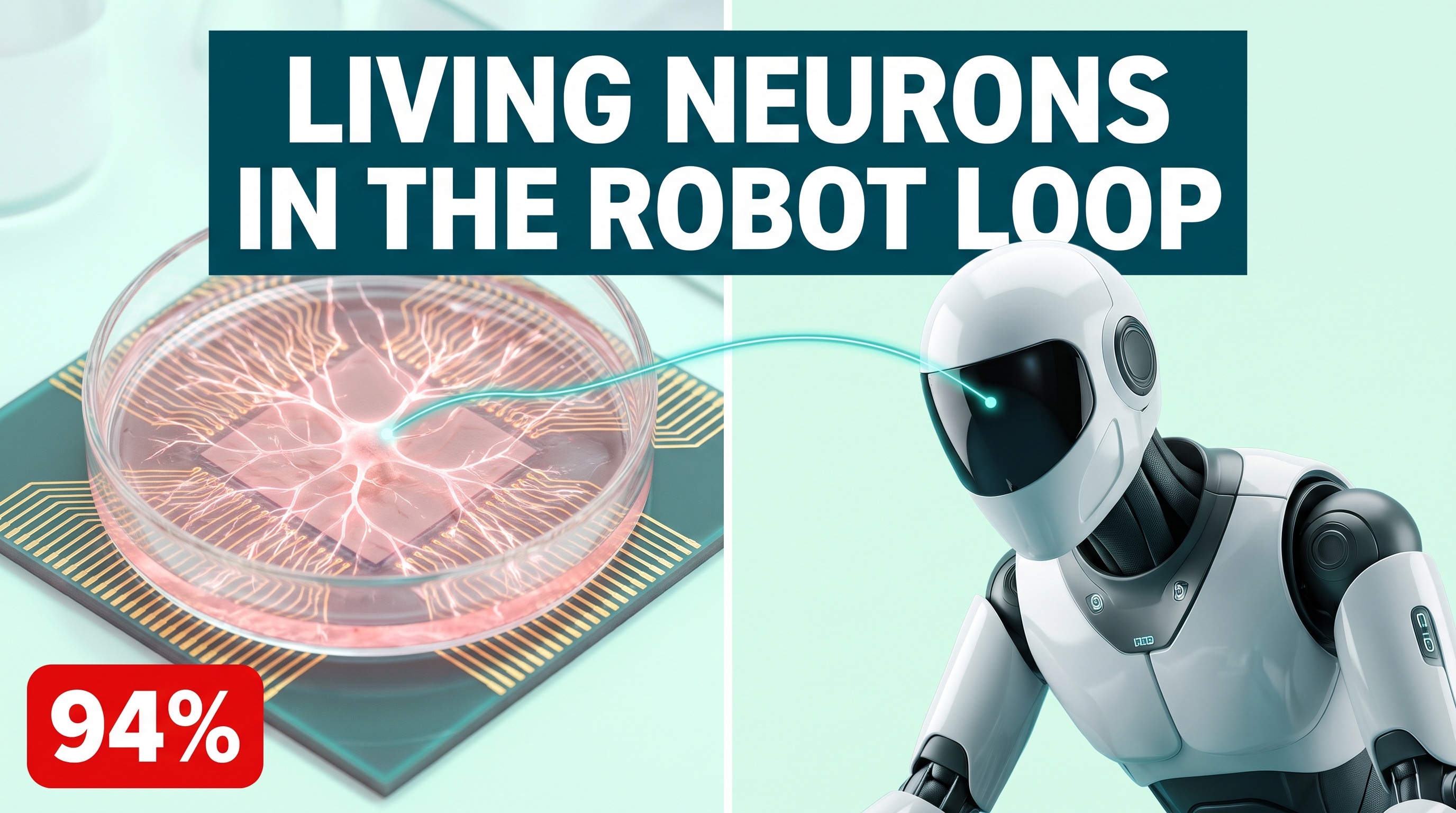 AI gen.
On November 13, the California start-up OpenMind demonstrated how its humanoid robot Iris evaluates social signals through living human nerve cells. Camera images are transmitted via an interface to cell cultures in Australia and Switzerland, and their response helps determine whether Iris turns toward a person. Fresh flat cultures achieved up to 94 percent of expected reactions across roughly 500 trials.
What makes this remarkable is that living tissue participates in the feedback loop of a humanoid, even though it delivers more of a reflex than actual brain function. The catch lies in the biology: the cells age, and as they do, the speed and temperament of the robot change, so the same Iris responds differently to the same environment after a few weeks.
The neurons don't travel with the robot. They grow in the laboratories of both providers on electrode arrays that work bidirectionally, sending electrical impulses into the cells and reading back their firing patterns. These patterns generate a signal that feeds back to the robot and influences its decisions alongside conventional perception, sensor fusion, and language models. Camera, body, and control remain ordinary electronics; founder Jan Liphardt's team has rented the biological component, much like a start-up purchases computing power in the cloud.
Both platforms use the same source material: nerve cells from the human cerebral cortex, cultivated from reprogrammed stem cells. The difference lies in their form, and that determines almost everything. The flat cultures from Australia responded within 150 to 240 milliseconds, which still counts as a natural reaction in conversation. The spherical cell clusters from Switzerland, known as spheroids, achieved up to 91 percent hit rate but sometimes took up to two seconds, and such a pause comes across as disinterest in an encounter.
Reports don't name who supplies the spheres in Switzerland. The description fits precisely with FinalSpark from Vevey, which since May 2024 has been selling research groups internet access to small brain organoids on electrodes. For the Australian side, Cortical Labs also seems like a likely candidate—their neurons already learned to play Pong in 2022. OpenMind has not confirmed either, but for Switzerland it's already noteworthy that an American robot draws part of its reactions from a Swiss laboratory.
With longevity, the picture reverses. The flat cultures lasted over one hundred days on their electrodes; the spheroids only a few days, despite coming closer to actual tissue. An electronic chip fails according to a calculable pattern, while a cell culture fades to biology's rhythm. A household robot that becomes slower and more temperamental over time is a service case for which no one knows the price today.
Liphardt, who besides his company works as a bioengineeer at Stanford University, sees this more as a characteristic than a flaw. He likes the idea that each robot develops its own personality, he said, and he emphasizes at the same time that he is not building a RoboCop. As for whether living neurons can serve any useful purpose for real robots, he answers with a yes—but only for a small part. He also cites security as an added benefit, because what is stored in living cells is hardly possible to read out or copy, which would indeed matter for a device in one's own home.
Lian Jye Su, robotics analyst at market researcher Omdia, is more skeptical. He calls the work a significant but narrowly limited proof of concept, because sensing, actuation, and interfaces remain entirely dependent on classical electronics. He sees no realistic path to a product at present; at best, a hybrid system would emerge. The advantages of biological networks—such as low energy consumption and learning from limited data—could probably also be replicated with technology that doesn't live, in his assessment.
OpenMind has so far attracted attention mainly with OM1, an open-source operating system for humanoids and quadrupeds, which also includes its own app store. Iris is a research project in this context, not a product that could be ordered. Ethically, Liphardt considers the situation manageable for now, since stem cell donors have consented and nothing suggests that such simple cell layers can feel anything. With significantly more complex structures or trials involving animals, he would draw the line differently.
As the next step, the team names neither a new model nor a financing round, but cell care, because every additional week in which the cultures remain stable is a week in which Iris still responds as it did on day one.
This article was created with the support of artificial intelligence and editorially reviewed. The article image is an AI-generated symbolic image, not a press photo.