ASUS Gallop: The PC maker's first humanoid robot has a benchmark, but no measured results
Asus has unveiled Gallop, its first humanoid robot, and is using it in its own facility to pack mainboard accessories. The goal is 99.5 percent error-free operations in a maximum of 20 seconds, but the manufacturer does not provide a result. The robot will not go on sale until the second half of 2028 at the earliest.
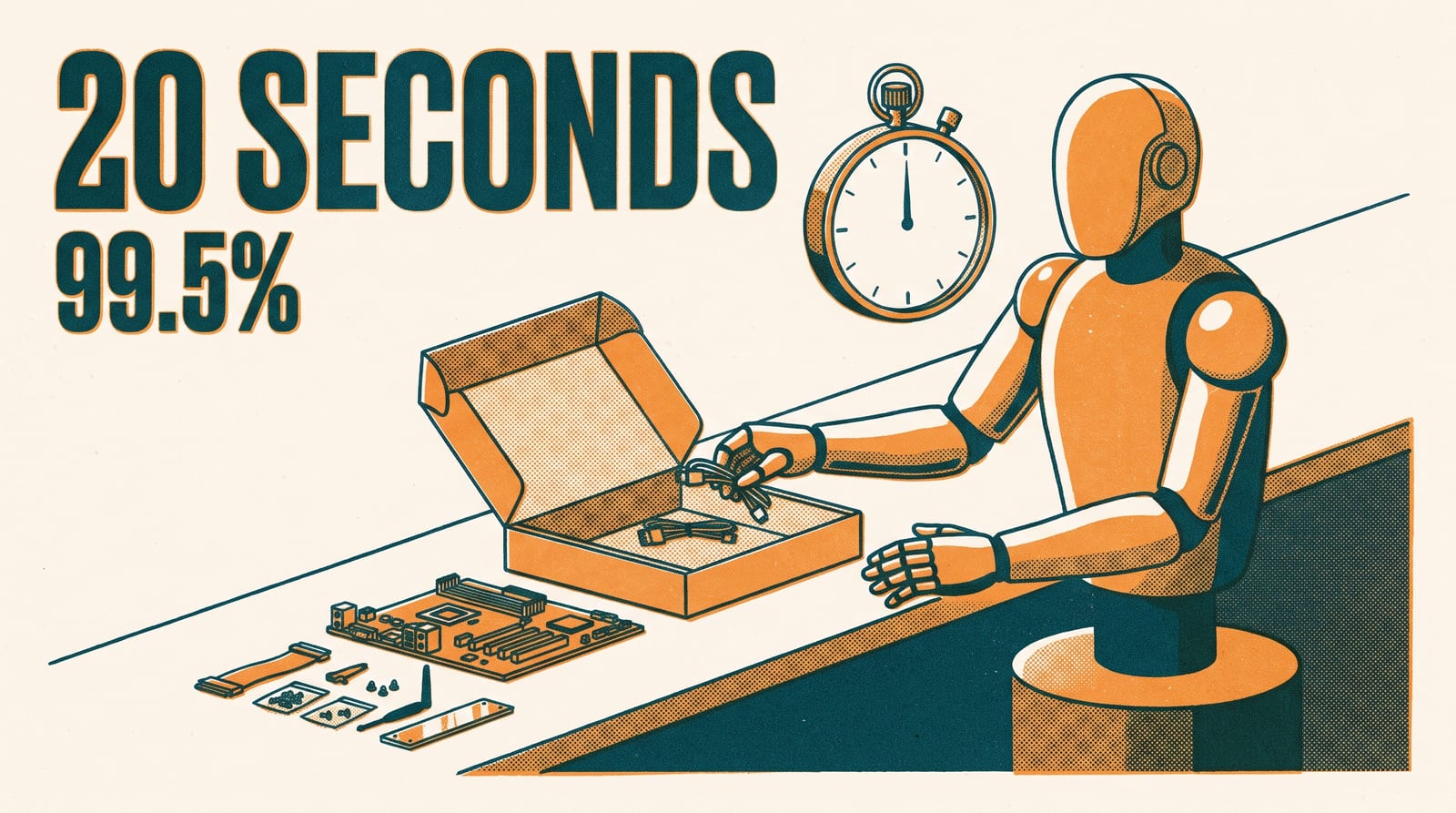 AI gen.
On November 13, Asus unveiled its first humanoid robot, and for now it performs a single task: In a facility of its own group, Gallop places the accessories that come with a mainboard into the box. The robot has a head and two arms, but stands on a fixed base instead of legs.
What is remarkable is the benchmark that the Taiwanese PC maker itself sets: Gallop is supposed to perform 99.5 percent of packing operations flawlessly and do so in a maximum of 20 seconds—the same time it takes a human today. This commits Asus to a figure that the trial can be measured against, but the company falls short of providing the measured value, as it does not say how close Gallop comes to the target. It will not go on sale until the second half of 2028 at the earliest.
The trial is running in a contract manufacturing facility of the group, and the task is trickier for a machine than it sounds. According to the manufacturer, a mainboard's accessories consist of 15 different small and thin parts that the robot must grasp and place individually. Trade publications such as Interesting Engineering and Humanoids Daily report consistently that Gallop is in practical trial there and is not merely being demonstrated, but the two target values are specifications and not measured results. Asus is not disclosing which facility in the group is hosting the trial.
Computation happens in the robot itself, on a single Jetson AGX Thor from Nvidia, while Asus develops the body and arms in-house according to its own statements and sources motors and other components from suppliers. A proprietary hand is also in development, but according to the company blog it has yet to be integrated into the robot, as will a chassis with wheels that will replace the base. Asus plans to show both to customers at Computex 2027.
Gallop is trained in three ways that have by now become standard in the industry: Experienced workers wear a small camera on their head and provide the template, while operators remotely control the robot with a VR headset and gloves. A simulation then augments the training material that is compiled in this way. Asus emphasizes that the robot is intended to take over monotonous and physically demanding tasks and not replace the workforce.
Co-CEO S.Y. Hsu unveiled it in a conversation with U.S. broadcaster CNBC, and there he also laid out the roadmap: Partners are to receive Gallop in the second half of 2027, with regular sales following a year later, first to electronics manufacturers. For a company that has so far built notebooks, mainboards and servers, this is a cautious timeline, especially since manufacturers such as Unitree or UBTech are already shipping their humanoids today.
What is missing is almost everything that makes up a datasheet, as Asus provides neither size nor weight, neither the number of degrees of freedom nor payload, runtime or price. For a profile in the robothub24.ch directory, the information is therefore not yet sufficient. Compared to the trials of recent weeks, what is striking nonetheless is that here a target in figures exists at all: Xiaomi reported an eight-hour shift without a success rate, E.ON and Neura Robotics sent the 4NE1 into the substation without a benchmark.
However, the 20 seconds also reveal how modest the target is set. If Gallop achieves it, it will pack the box as quickly as the human who stands at this station today, and not a moment faster.
This article was created with the support of artificial intelligence and editorially reviewed. The article image is an AI-generated symbolic image, not a press photo.