Humanoid robots: J.P. Morgan expects the U.S. to deliver less than half of Tesla's promises by 2030
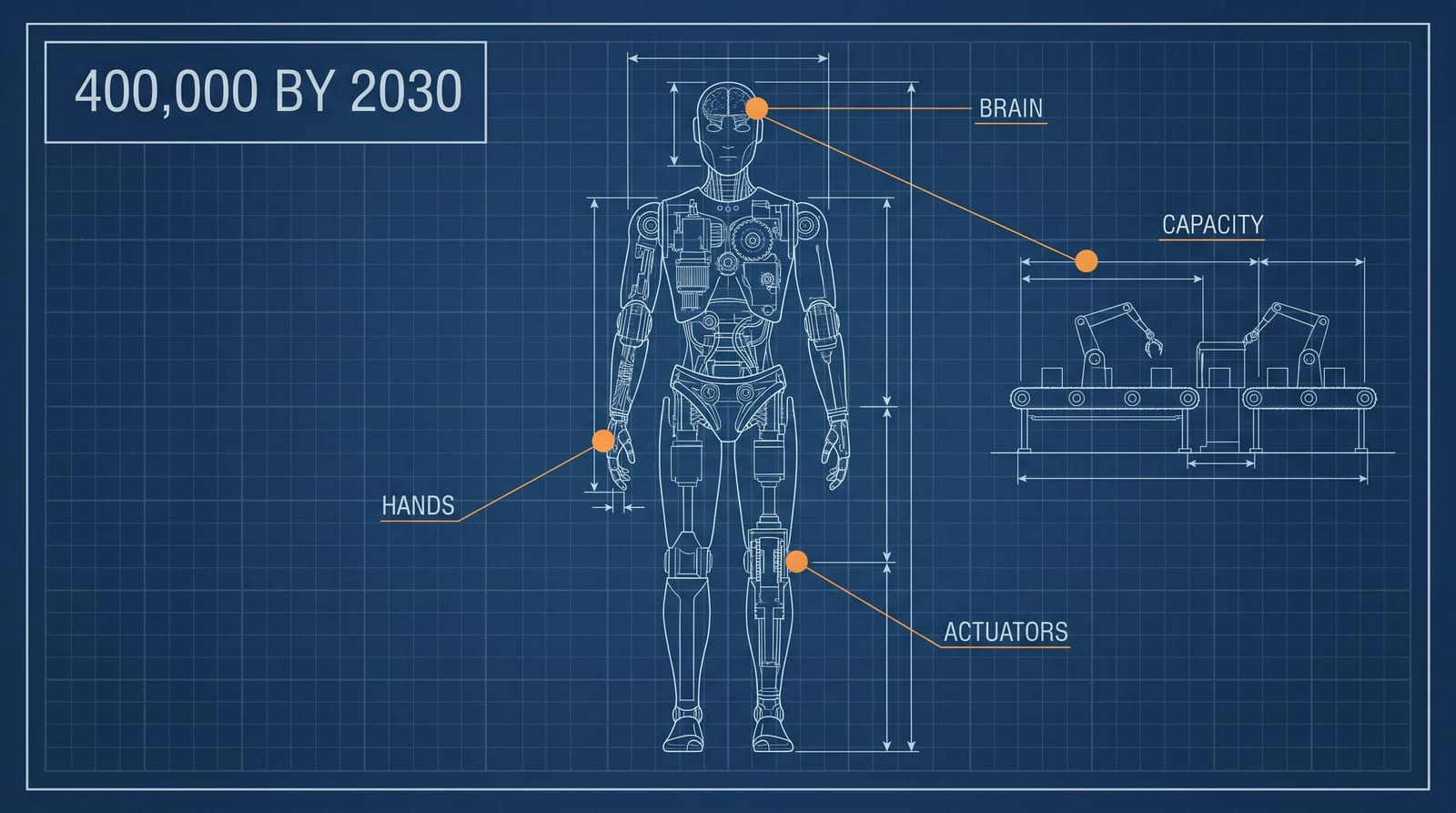
J.P. Morgan expects up to 400,000 humanoid robots from U.S. production by 2030. Tesla alone has announced more than double that. The bank identifies four bottlenecks: hands, actuators, the machines' brains, and manufacturing capacity.
 AI gen.
U.S. bank J.P. Morgan presented a study on humanoid robots on Thursday, first reported by news agency Reuters. According to the study, American production will rise to 300,000 to 400,000 units by 2030 and to around 1.5 million by 2035, driven by labor shortages and the shift from demonstrations to paid deployment in warehouses and factories.
The headlines read like a breakthrough, but measured against industry announcements, the figure is a disappointment. Tesla outlined a rate of 20,000 Optimus units per week in October, equivalent to roughly one million per year, and J.P. Morgan credits all U.S. manufacturers combined with less than half of that for 2030. The bank provides the reasons—there are four bottlenecks.
In the short term, progress remains limited by supply, the analysts write according to Reuters, and they list what's holding things back: hands, actuators, the machines' "brains," and manufacturing capacity. A second finding from the paper fits this picture, though it went unnoticed in most reports. Apart from Tesla, most American manufacturers are targeting 10,000 to 30,000 robots per year, meaning that even at the upper end of this range, more than a dozen companies would need to hit their targets to reach 400,000 without Tesla.
How far the bank diverges from Elon Musk is evident from his own words of October 21st. To reach a weekly rate of 20,000 would take at least a year, perhaps a bit longer, the Tesla CEO said then, and the Fremont plant is designed long-term for one million units per year. J.P. Morgan sets around 1.5 million for the entire country by 2035—only half more than Tesla promises for a single facility. This is remarkable also because the same bank upgraded Tesla's stock from "Underweight" to "Neutral" only in June, citing the prospects of robotics as justification.
Measured against the current state, the forecast remains bold nonetheless. Market researcher IDC counted nearly 25,000 humanoid robots delivered worldwide in the first half of 2026, of which 77.9 percent came from China, leaving roughly 5,500 machines for all other countries combined. Around 69 percent of these deliveries went to research, education, demonstrations, and data centers—not to the warehouses and factories on which J.P. Morgan bases its calculation.
The calculation works like this: a robot's costs are approaching labor costs, and whoever deploys the machines in multiple shifts saves about $100,000 per customer per year. For components such as actuators, motors, and image sensors, the bank expects a market of nearly $30 billion by 2035, and it sees suppliers gaining an advantage in the early phase before value gradually shifts to the robot manufacturers. It's precisely here that American production has a weak point, because according to an earlier Morgan Stanley estimate, the bill of materials for a second-generation Optimus would rise from around $46,000 to $131,000 without Chinese components.
Policy is more likely to sharpen than resolve this dependence. Reuters points to findings by the Trump administration that imported robotics and industrial machinery threaten national security, which could lead to tariffs or other measures favoring domestic manufacturing. However, tariffs on components first drive up exactly those actuators and hands that J.P. Morgan identifies as bottlenecks.
For Swiss companies, a forecast about American unit numbers says little about when such a robot becomes available to purchase here. Tesla plans to deliver outside its own group at the earliest toward the end of 2027, and the annual targets of other U.S. manufacturers are, by J.P. Morgan's count, so modest that little remains for export initially. Anyone looking around on a marketplace like robothub24.ch today encounters primarily models from China and Europe. In Tesla's latest quarterly report, the California facility carries the status "Early Ramp," and a unit number is still not listed there.
This article was created with the support of artificial intelligence and editorially reviewed. The article image is an AI-generated symbolic image, not a press photo.