Humanoid Robot as News Anchor: Zhang Yimou Gives It a Face, Xinhua Gives It No Voice of Its Own
Xinhua presented two life-sized robots with artificial skin in Beijing that are intended to present news. Developed with UBTech and designed by Zhang Yimou, they speak only from the agency's vetted text collection.
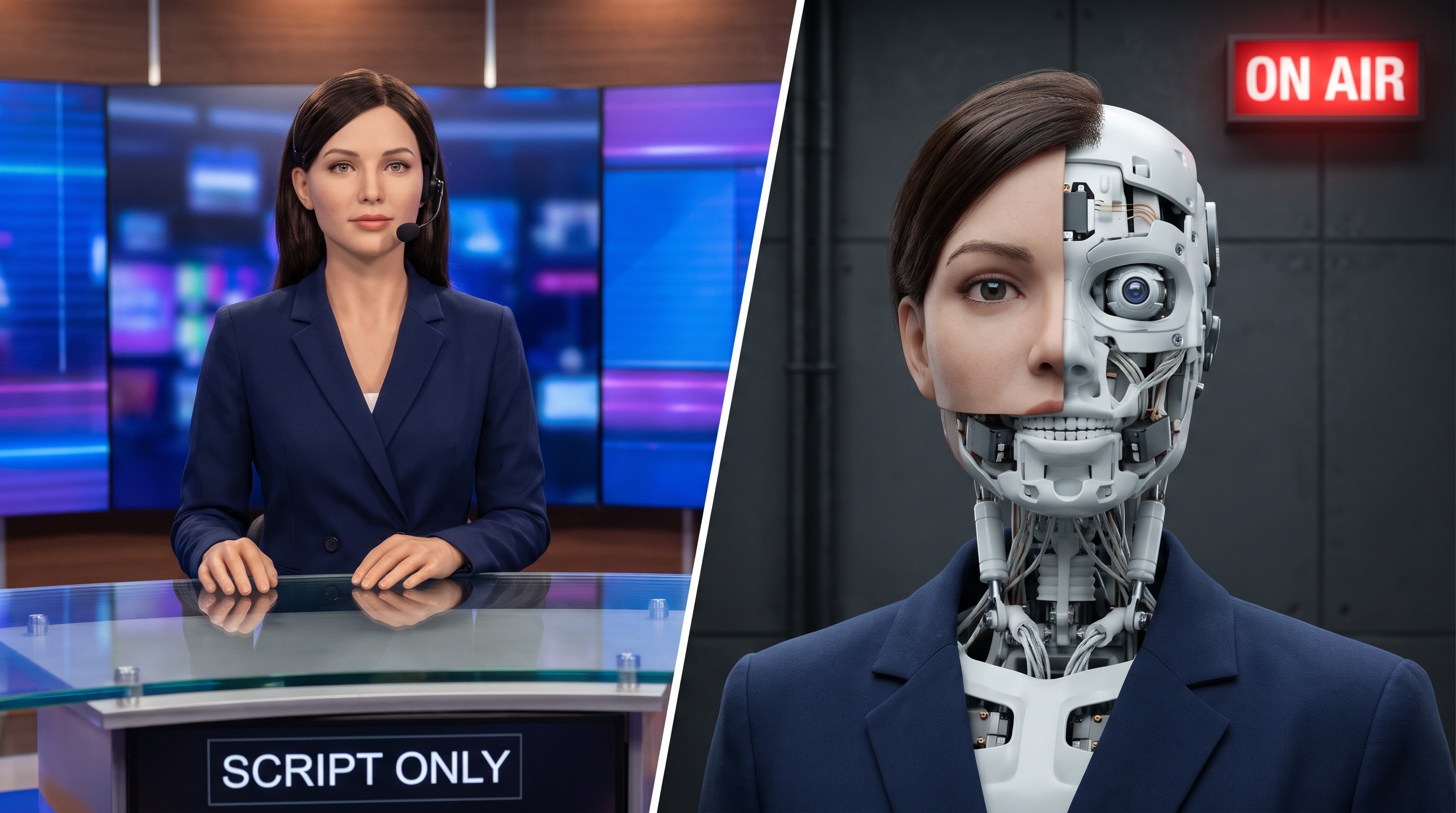 AI gen.
On November 5, Chinese news agency Xinhua presented two life-sized robots in Beijing that are to present news in the future. Xinyan and Xinyu have artificial skin and were developed jointly with UBTech, while their appearance comes from filmmaker Zhang Yimou, who directed the opening ceremony of the 2008 Beijing Olympic Games.
More remarkable than the face, however, is the leash it hangs from, because the two anchors draw only from the agency's vetted text collection and are explicitly not supposed to write their own pieces. With this, China is building the most human-like news robot to date while simultaneously taking away precisely what makes a moderator, namely having one's own voice.
The knowledge of the two comes from Xinhua Yudian, a language system that the agency launched in June 2026 for questions about current events. It is supplemented by an emotion-controlled speech model that selects appropriate facial expressions and tone of voice, with UBTech Chief Zhou Jian speaking of a continuous chain of brain, expression, and control. Xinhua justifies the restriction to its own sources by saying that the content remains traceable, safe, and controllable.
Much of what is usually mentioned first for a robot is missing from the documentation. Neither size nor weight, number of joints or price were published, and which languages the speakers—described as multilingual—actually speak remains unclear. It is also unclear whether they can move beyond a fixed location and whether a human intervenes in the background if an answer goes wrong.
Zhang Yimou said at the summit that they had refined facial expressions, eye movements, and lip shapes until composure, posture, and eye contact were right. A reporter for Australian agency AAP described the result more soberly: the heads tilted and turned at regular intervals, the eyes darted and blinked, and where a pupil should have been, you could see the camera.
Even the label of world premiere only holds up to closer scrutiny to a limited degree. Xinhua itself showed a synthetic speaker together with Sogou back in November 2018, though it only existed as a video, and in 2014 at the Tokyo Science Museum Miraikan, a remote-controlled android named Kodomoroid read news reports. So what is new above all is the combination of body, artificial skin, and speech model, not the idea itself.
Xinhua has not announced a broadcast date yet, but instead a long list of possible uses, ranging from educational centers and public spaces to cultural exchange abroad and reporting from space. Officially, the robots are to support journalists, and Zhang emphasized they would not replace anchors but rather enrich the audience with new experiences.
Media scholar Jock Cheetham from Charles Sturt University in Australia doubts that established broadcasters would take the risk of appearing wrong, cheap, or simply strange. Instead, he expects the opposite of what Beijing is demonstrating, because when machines get faces, real anchors become a quality mark.
This article was created with the support of artificial intelligence and editorially reviewed. The article image is an AI-generated symbolic image, not a press photo.