ABB Robotics and SoftBank: Beijing blocks only the Chinese division, and that's precisely the heaviest part
Beijing prohibits SoftBank from taking over ABB's robotics business in China, hitting the largest market in the sector. Neither ABB nor SoftBank are saying how the 5.4 billion dollar deal will proceed.
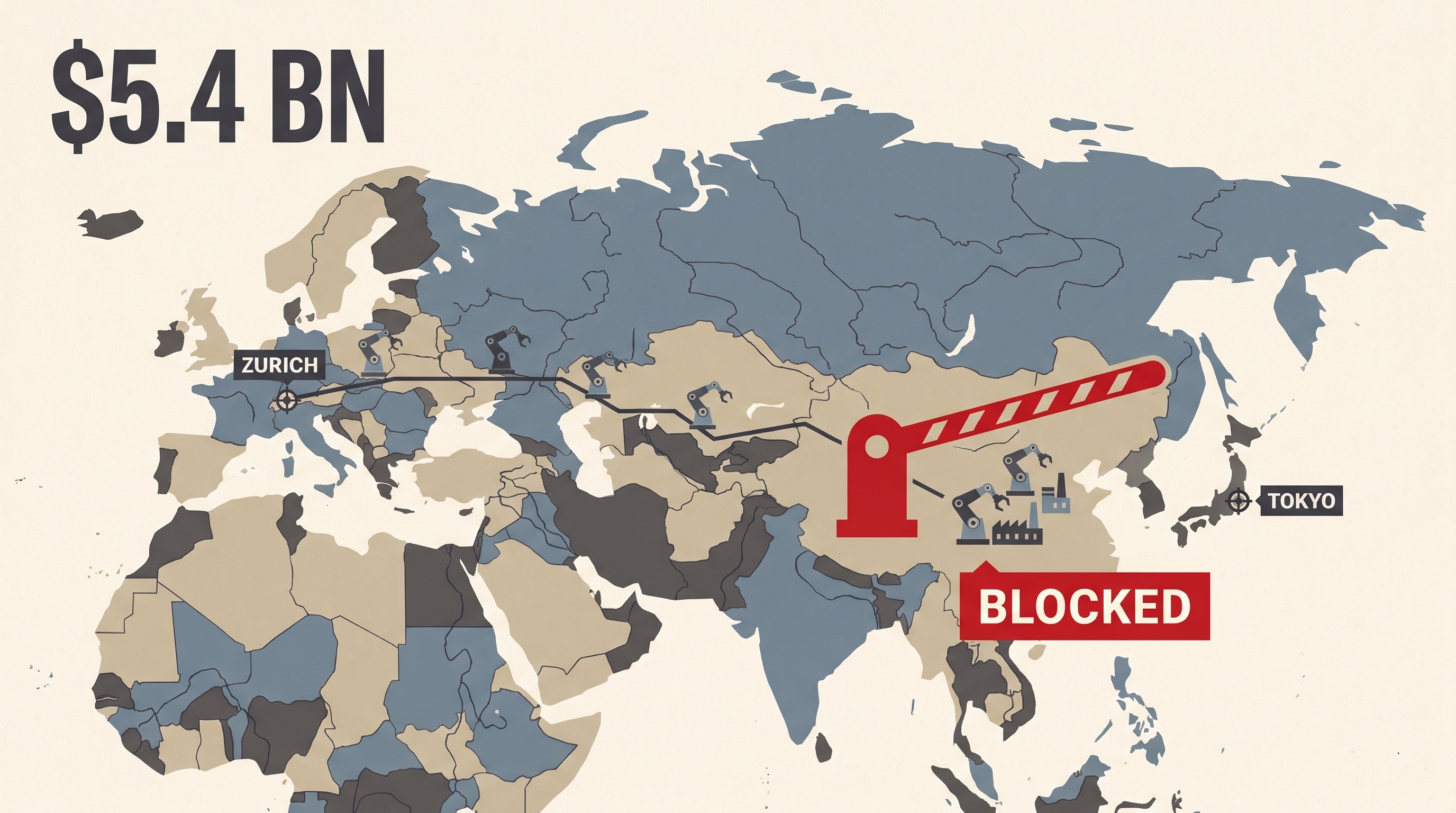 AI gen.
On November 5, ABB confirmed what the Financial Times had previously reported: China's foreign investment security review authority has prohibited SoftBank from acquiring ABB's robotics business in China. The Zurich-based group had sold the division to the Japanese company for 5.375 billion dollars in October 2025, with the transaction scheduled to close during the course of this year.
Formally, the ban affects only part of the business, but economically the most significant part, as China is the largest market in the sector and accounts for around 30 percent of it according to FT. This means that in the sale of a Swiss company to a Japanese buyer, Beijing suddenly has a say, and neither ABB nor SoftBank have indicated so far how they will proceed.
The authority, which is based at the state planning commission NDRC, has not published a justification. According to FT's account, Beijing fears that data from the robots could flow abroad and be used to train AI models there, including those from OpenAI, in which SoftBank is a major shareholder. The objection targets quite precisely the reason Masayoshi Son wanted the division in the first place, as he is marketing the acquisition as a building block for physical AI rather than as a bet on industrial robots with solid margins.
Clean separation of the Chinese business is barely possible because ABB doesn't just sell there, it also manufactures. According to the New York Times, around 90 percent of the machines for Chinese customers are also built in China, and the division employs thousands of people in the country. A deal without China would therefore be a different deal, with a different price, and according to FT, SoftBank is first examining what went wrong and whether a second application would be worthwhile.
For ABB, the situation is uncomfortable, but not new. Before SoftBank came knocking, the group wanted to spin off its robotics division and list it separately on the Swiss stock exchange, announced in April 2025. The division generated around 2.3 billion dollars in revenue in 2024 and employs approximately 7,000 employees, so it would also be capable of going public on its own. Whether this plan will be revisited remains open—ABB's statement from Thursday only mentions close and constructive dialogue with the buyer.
On the Tokyo stock exchange, SoftBank shares lost around five percent on Thursday, with a weak outlook from its holding Arm and the general selloff in technology stocks also playing a role. Remarkable is a single sentence in the brief statement from Zurich, which notes that the regulatory approval process is being led by SoftBank, meaning ABB is politely but unambiguously passing responsibility for the veto to Tokyo.
This article was created with the support of artificial intelligence and editorially reviewed. The article image is an AI-generated symbolic image, not a press photo.