Humanoid robot in the household: Already insured, but not delivered until 2027
British insurer Adrian Flux has been covering humanoid household robots in home contents insurance since 30 October, including emergency shutdown. Four days earlier, Tokio Marine & Nichido priced commercial robots in Japan with approximately twenty percent surcharge. The policies are in place before the robots are in the apartments, and cyber damages remain excluded.
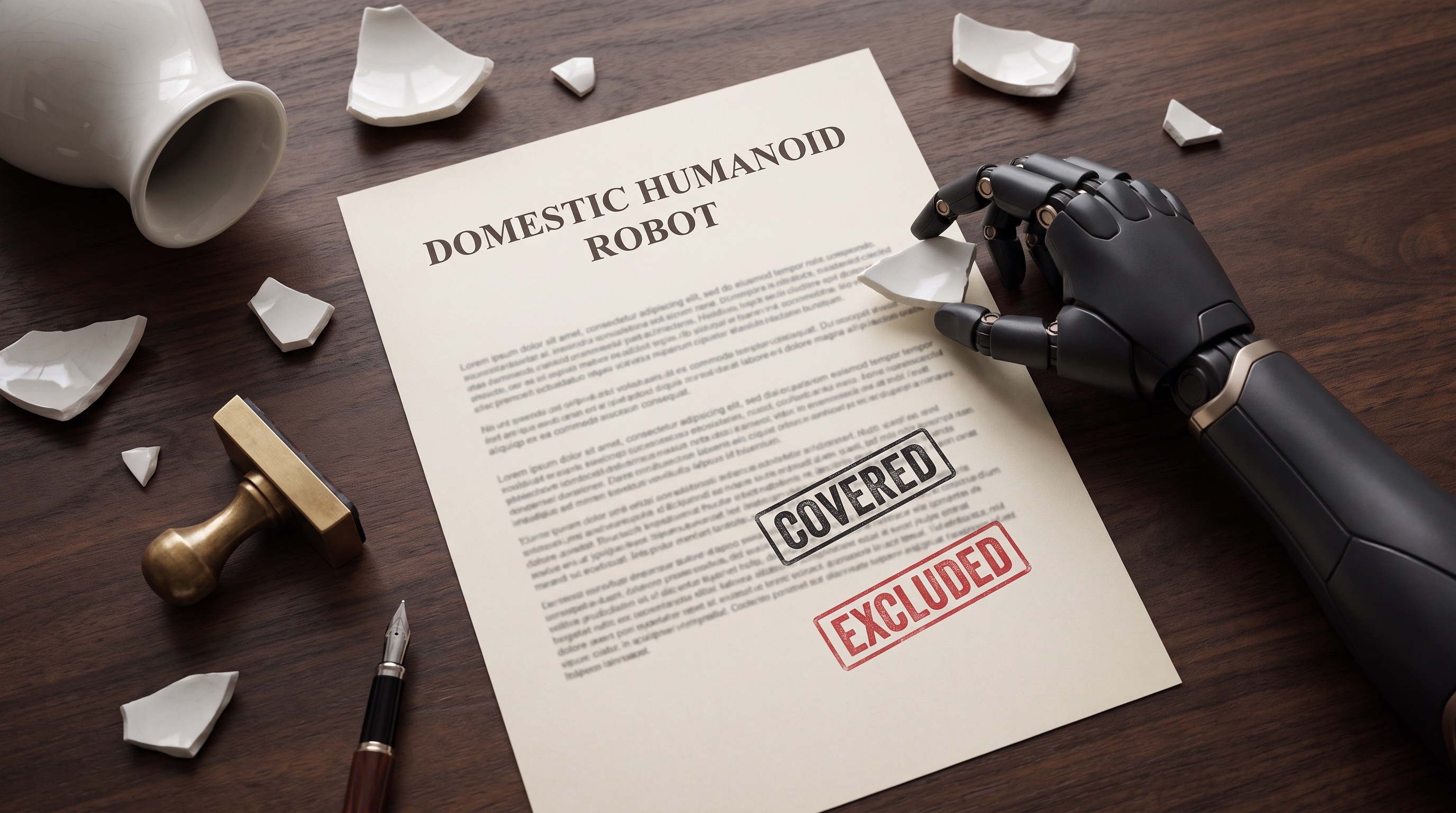 AI gen.
On 30 October, British specialty insurer Adrian Flux launched the first home contents insurance policy for humanoid household robots, underwritten by industrial insurer Tokio Marine HCC. Coverage includes theft and damage to the robot, damage to the apartment, liability for injuries, and emergency shutdown following a malfunction. Such machines are not expected in British households until 2027.
Four days earlier, Tokio Marine & Nichido announced a commercial robot insurance in Japan for November, and for the first time there is a price: approximately twenty percent above conventional industrial equipment. The risk of an autonomous robot thus has a figure before the market has a quantity. Cyber damages are excluded from the Japanese policy.
The most striking item in the British policy is emergency shutdown. The insurer pays if a humanoid must be recovered or safely shut down following a sudden malfunction, and that is unknown from home contents insurance because no dishwasher ever needed to be picked up. Gerry Bucke, General Manager at Adrian Flux, justifies the product with a question that remained unanswered until now: "When robots come into people's homes, we wanted to create clarity about who is responsible when something goes wrong." He cites as a model the policy for driverless cars that his company introduced in 2016, years before such cars drove on British streets.
None of the two partners have published what the coverage costs, what sums it covers, and which cases it excludes. Stuart Heath, responsible for distribution at Tokio Marine HCC International, provides the justification from the underwriter's perspective: "A robot that costs thousands of pounds is nothing you want to have standing outside its insurance policy." Insurers had traditionally reacted to new markets instead of enabling them. This refers to a device in the price category of the 1X Neo, which can be pre-ordered in the United States for 20,000 dollars or 499 dollars per month. For it, a human teleoperator takes over via camera as soon as the task goes beyond opening doors and turning off lights.
That is exactly where the liability question becomes uncomfortable, because if a paid operator somewhere in Europe guides the robot's arm and in doing so takes a vase off a shelf, the owner is not the actor, but he is the policyholder. The British statement says nothing about this, and as long as the conditions remain confidential, it is unclear whether the policy treats the remote-controlled action like its own.
The Japanese product reads considerably more concretely. As of November, Tokio Marine & Nichido insures robots on wheels, on four legs, and on two, deployed in security services, cleaning, logistics, construction, care, and customer contact. The policy is divided into three blocks: repair or replacement after collision and natural events, liability to third parties, and the costs for ongoing operations, such as wages for replacement personnel or rent for a replacement robot. The twenty percent surcharge comes from a report by Nikkei Asia; the insurer itself only states that each premium is individually determined based on the type of use and environment. Behind this lies a state target: From the global market for AI robots, which the Japanese government estimates at around 60 trillion yen by 2040, the country wants to hold more than thirty percent.
In China, this has long been mass business. China Pacific Insurance sells coverage for humanoids by day, week, or month, tailored to rental platforms like Sharebot from manufacturer AGIBOT, where a robot is available from 3,500 yuan per day. The People's Insurance Company of China has been covering such rental robots since December 2025 even without a fixed operating location and reached over one thousand machines with a coverage sum of more than 200 million yuan by the end of April.
For Switzerland, this is more than a footnote because the question here is older than the products. The Swiss Insurance Association described robotics in 2018 as an emerging risk and left open exactly the classification that Bucke now answers commercially. Does the holder bear liability by analogy to the animal keeper or to the motor vehicle owner, does the manufacturer who builds in the software bear liability, does the programmer bear liability, or does the machine ultimately need its own legal personality? The most obvious case in today's Swiss home contents insurance is the lawn mower robot, and that can be handled with theft and weather damage coverage because it does not leave the garden and does not fall down stairs. A comparable offering for humanoids is not yet known from Switzerland, although as of January 2027 the new EU machinery regulation will apply and manufacturers will be forced to provide safety documentation that an insurer could rely on.
The fact that two companies from the same group priced two robot risks within a week says more about the industry's expectations than any sales forecast from a manufacturer. Insurers profit from calculating risks that no one has yet counted, and they do not do this out of enthusiasm for the technology.
One gap at this point remains striking. The Japanese policy removes cyber damages, direct and indirect, and with it that case which robothub24 reported in October: A Unitree G1 could be hijacked via a Bluetooth vulnerability. A fallen robot is a claim, a hijacked one is not yet.
This article was created with the support of artificial intelligence and editorially reviewed. The article image is an AI-generated symbolic image, not a press photo.