Humanoid Robot Trained in 40 Minutes: Bleu Robotics Bets Against Billion-Dollar Models
Bleu Robotics from Paris has received five million euros in pre-seed funding and wants to train industrial humanoids in around forty minutes with about ten demonstrations. Two days earlier, Physical Intelligence announced it was seeking over one billion dollars for the opposite bet. The Parisian success rates so far come from simulation.
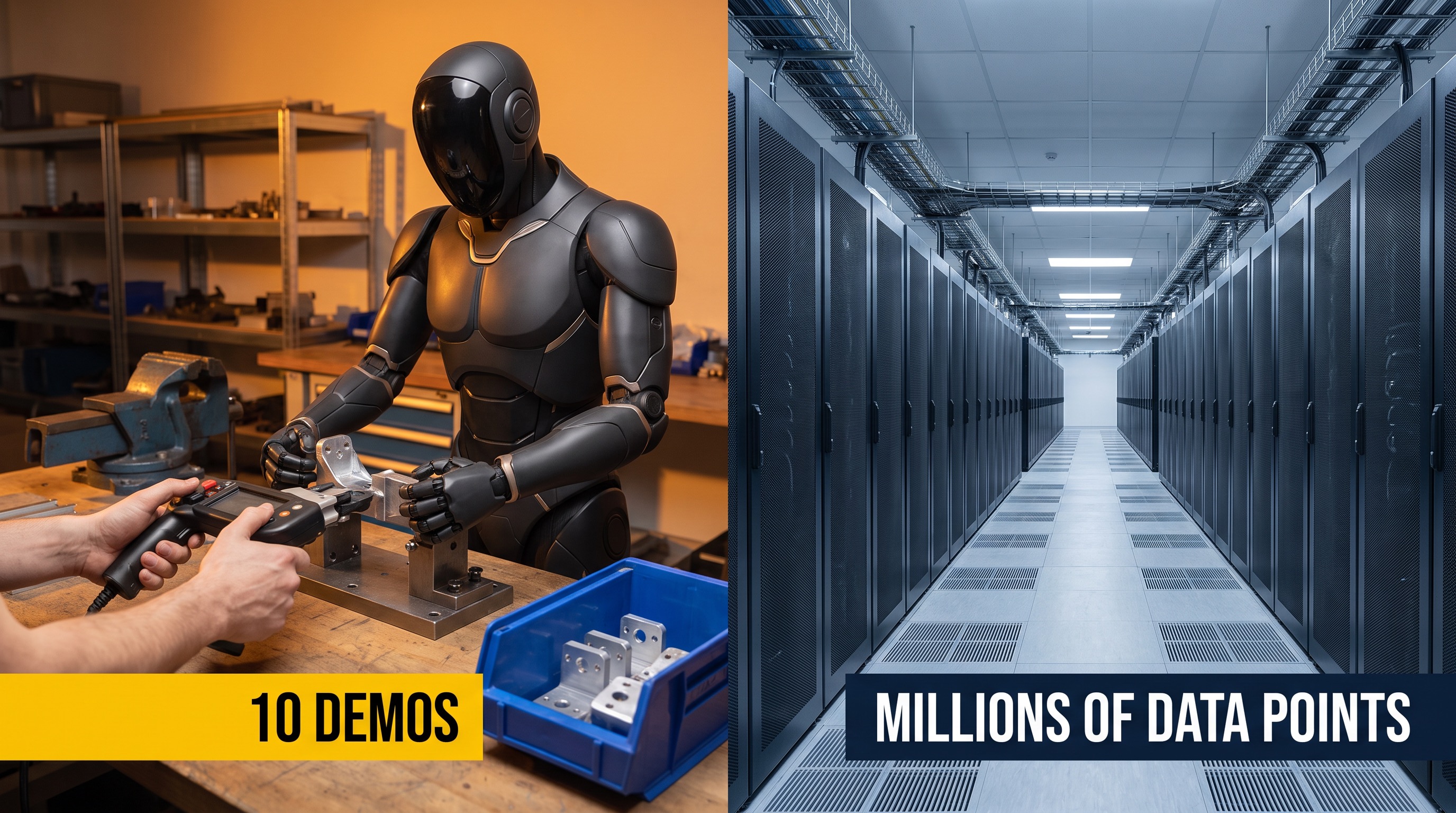 Symbolic image · AI-generated
On October 29, the Paris startup Bleu Robotics announced five million euros in pre-seed capital, and the math behind it sounds almost offensively simple: around forty minutes from the first demonstration to a working robot, and about ten shown runs are sufficient there where others calculate with millions of data points.
Two days earlier, it became known that Physical Intelligence in California wants to raise over one billion dollars, with no revenue and betting on the exact opposite. This puts two answers to the same question side by side: whether robots need to learn from huge amounts of data or from a few demonstrated hand movements. The Parisian figures so far come from simulation, not from a running factory.
Training takes place at the workplace itself, with a hand gripper that the employee takes in hand and uses to demonstrate the task once, without anyone writing a single line of code. The software then doesn't try to trace the movement, but instead infers the intention behind it—the goal and boundary conditions of the work step—and builds its own execution from that. Bleu calls this abductive learning and explicitly positions it against the widespread end-to-end models that derive movements directly from images. According to the company blog, calculations run on the robot itself and not in the cloud, and training a task should take less than two minutes on a laptop, whereas a diffusion policy needs one to three hours.
Behind the company are three people with unusually well-fitting biographies. Benoît Berkoukchi led large teams on assembly lines at Renault for years, and Jean-Baptiste Mouret and Serena Ivaldi are research directors at the French Inria institute and have worked on AI and robotics for around fifteen years, with publications in Nature. Bleu was only founded in December 2025, the round is led by Contrarian Ventures and OVNI Capital, with Kvanted, WEPA Ventures, Motier Ventures, and Charlie Songhurst, who sits on Meta's board, also involved.
Whoever does the math, however, finds a gap between the advertising and the evidence. The financing announcement speaks of up to a hundredfold better data efficiency compared to the state of the art, but the company's own measurements in the company blog don't support that. It states that in the ManiSkill3 simulation environment, a success rate of 98 percent is achieved with fewer than ten demonstrations, while a diffusion policy needs at least a hundred demonstrations for that. That's a factor of ten, not a hundredfold, and it's simulation. A second task in the lab, where a robot opens a door and presses a button, achieves 99 percent compared to zero for the comparison method, which is impressive, but wasn't measured in a workshop.
The company itself draws the boundaries, which is pleasantly unusual in this industry. In view are rigid parts, textiles are outside the scope, and independent switching between two workstations is still considered future work. Testing was conducted on, among others, a Unitree G1 and a Franka Research 3, the software should in principle run on any robot that speaks the ROS interface. According to the company, there are already two major industrial customers, but it doesn't name them, and the forty-minute figure comes from an interview with the founder and not from a published factory protocol.
Why this bet even finds funding is shown by a figure from Interact Analysis that circulates in the industry: of the more than 20,000 humanoids built last year, only around ten percent made it into real applications. The bottleneck, then, is not the robot, but the training, and that's exactly where several European projects are starting now. Since the announcement on October 21, Audi has been testing mobile humanoids from Agile Robots in the Production Lab in Ingolstadt for parts sequencing, together with a digital twin from Dassault Systèmes and libraries from Nvidia. It is explicitly a feasibility demonstration, without performance figures and without a timeline for rollout.
For Switzerland, this is the more interesting construction site. Whoever manufactures here does so in small series with many variants, and a robot that needs hundreds of hours of training data for each new variant is unusable in such an operation, no matter how cheap the hardware has become. The calculation decides on training time and not on the price tag, yet almost all providers so far only talk about the price tag. A workshop manager in Zurich or Biel doesn't need a humanoid for CHF 20,000 that takes three months to integrate, but one that the foreman switches to the new series on Friday afternoon.
Berkoukchi states the reason for the detour soberly. There isn't enough data about factory work, he says, and robots won't have data volumes on the scale of the internet for a long time, like the ones that made language models big. Whether this becomes a business is decided with the two unnamed industrial customers, namely whether the forty minutes also hold when the parts lie jammed in the container. There's a sentence in the company blog that reveals more about the state of the art than any success rate: if the robot doesn't recognize the situation, it stops and asks for help.
This article was created with the support of artificial intelligence and editorially reviewed. The article image is an AI-generated symbolic image, not a press photo.