LG's Humanoid Robot: Five Times More Training Data Than in August, Household Robot by 2030
LG has increased its target for robot training data to 500,000 hours by year-end, up from 100,000 in August—a fivefold increase. The household robot arrives around 2030. The company plans to showcase a bipedal humanoid developed with Nvidia in the first quarter of 2027, funded by its business cooling AI data centers.
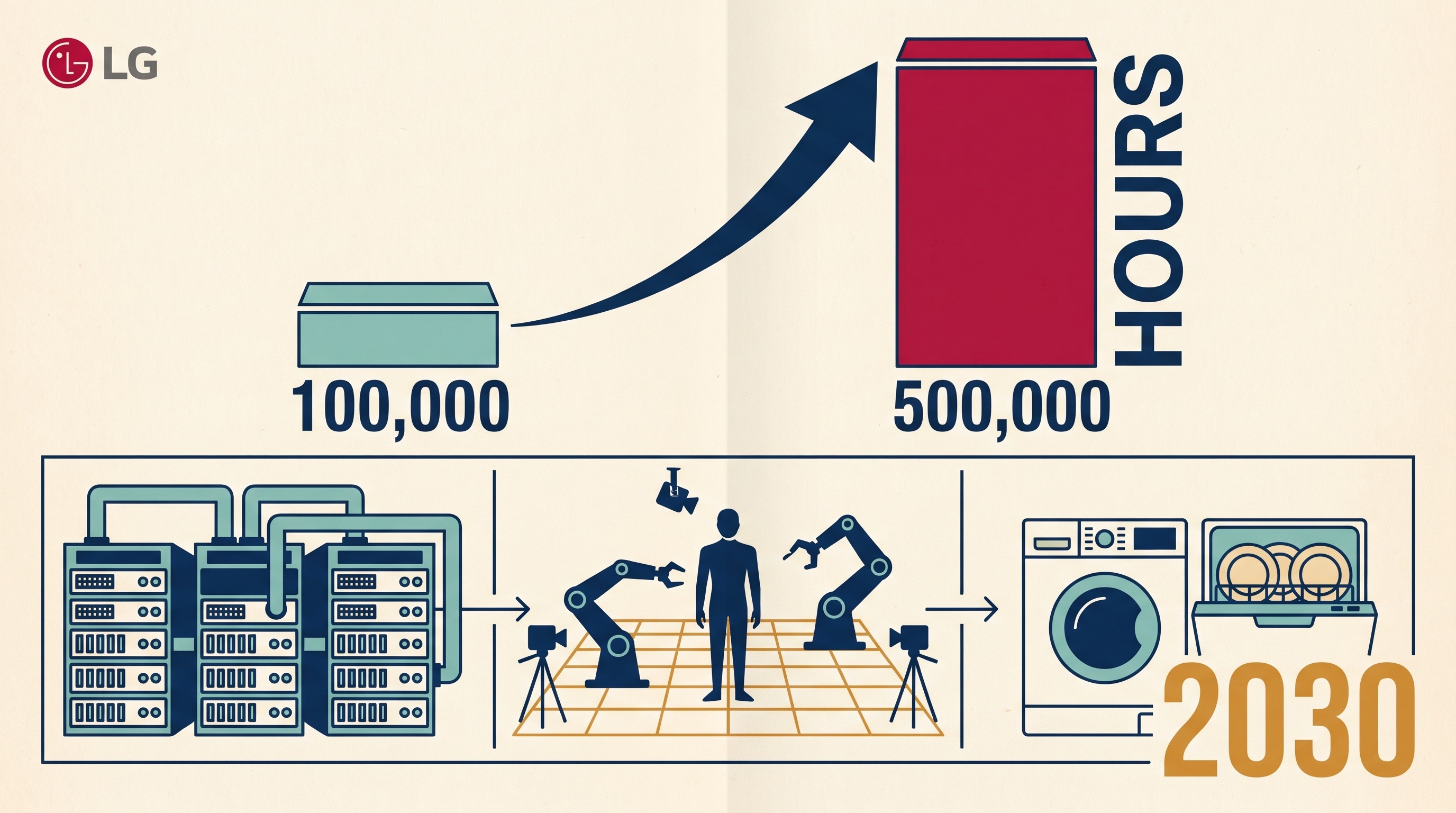 Symbolic image · AI-generated
LG Electronics revised its own data target for robots upward during the analyst call on third-quarter results on October 28. By year-end, 500,000 hours of training data should be collected, a mix of real and simulated footage. In August, the figure stood at 100,000 hours. A fivefold increase in just over two months, because the recordings came in faster than planned.
Data is being collected in a 10,000-square-meter Data Factory in Seoul that will run at full capacity starting in the fourth quarter. LG plans to showcase a bipedal humanoid developed with Nvidia in the first quarter of 2027, with the household robot following around 2030. Funding comes from another business: orders for AI data center cooling stand at over three trillion Won, while LG has not disclosed revenue figures for robotics.
The sentence that stays with you from this call is not a date. LG wants to build robots tailored to household appliances and household appliances tailored to robots. This sounds like engineering logic and is a business decision. Whoever buys a washing machine today may be buying an interface for a robot that doesn't yet exist. A humanoid that reliably loads its own dishwasher but not someone else's is not a household helper. It is an accessory.
The backstory goes back to August. On August 13, LG and Nvidia signed a memorandum of understanding on robotics, AI factories, and mobility at Nvidia's headquarters in Santa Clara, in the presence of LG Chairman Koo Kwang-mo and Jensen Huang. The individual components come from the group: actuators from LG Electronics, sensors from LG Innotek, batteries from LG Energy Solution, the data platform from LG CNS. The planned humanoid will be based on Isaac GR00T and Jetson Thor. A pilot line for actuators in Changwon started in the first half of the year, mass production is currently being prepared, and the wheeled CLOiD is currently training on a washing machine line at LG's plant in Tennessee. Additionally, roughly 220 billion Won, approximately 150 million dollars, is being invested in manufacturing capacity in Virginia, Pyeongtaek, and Changwon.
With these figures, precision matters. 500,000 hours is an ambition, not an existing dataset, and an unspecified portion of it is generated in simulation. Unit numbers are missing, a price is missing, a revenue target for robotics is missing. LG itself says what matters is a price that households are actually willing to pay, and precisely this figure remains unspecified. The first customers should be research, government, and manufacturing; households come last. The fact that the company is also exploring selling training data to third parties shows where it currently sees the viable part of the business.
The counterbalance appears in the same quarterly report. Group revenue was 23.8 trillion Won, 8.9 percent higher than the previous year, with operating profit at 781.9 billion Won, thus 13.5 percent higher. This surge is driven by data center cooling, whose order backlog jumped from 600 billion to over three trillion Won within half a year, equivalent to roughly two billion dollars. Behind this is, among other things, a long-term chiller agreement with North American provider Air Control Concepts for a project with five gigawatts of planned capacity. Robotics does not appear in any segment line. So LG profits from building the data centers in which models are trained and uses that to fund robots co-developed by the same partner.
What stands out is how uniform the year has become. Panasonic names 2029, Kawasaki 2030, LG now around 2030, and Samsung is also aligning its factories with this decade's end. When four major corporations cite the same horizon, it is less a forecast than an agreement with capital markets. What needs to be examined are not the announcements but the intermediate steps: will the Data Factory really run at full capacity in the fourth quarter, will a bipedal robot actually take the stage in the first quarter of 2027, and at what price.
For Switzerland, this is not an industrial question but a consumer question. No humanoid is being built here; one is being purchased here, and LG appliances sit in many Swiss kitchens and laundries. Anyone who wants a household robot in 2030 is factually already deciding on an ecosystem with their next appliance purchase, without any indication of this on the price tag. Add to this the regulatory timeline: the new EU Machinery Regulation takes effect in January 2027, roughly when LG wants to show its prototype, and for devices with learning components in the home environment, it will pose more interesting questions than any keynote. We will track on robothub24.ch which of these intermediate steps are met.
This article was created with the support of artificial intelligence and editorially reviewed. The article image is an AI-generated symbolic image, not a press photo.