Humanoid robot climbs the ladder: learned in 13 minutes, proven only in simulation
A humanoid robot from ETH Zurich climbs ladders and rights itself after falls, having learned this from just 13.2 minutes of human movement. However, the success rate of 92.5 percent comes from simulation, with sensor noise disabled. The paper provides no figures for deployment in a real hall.
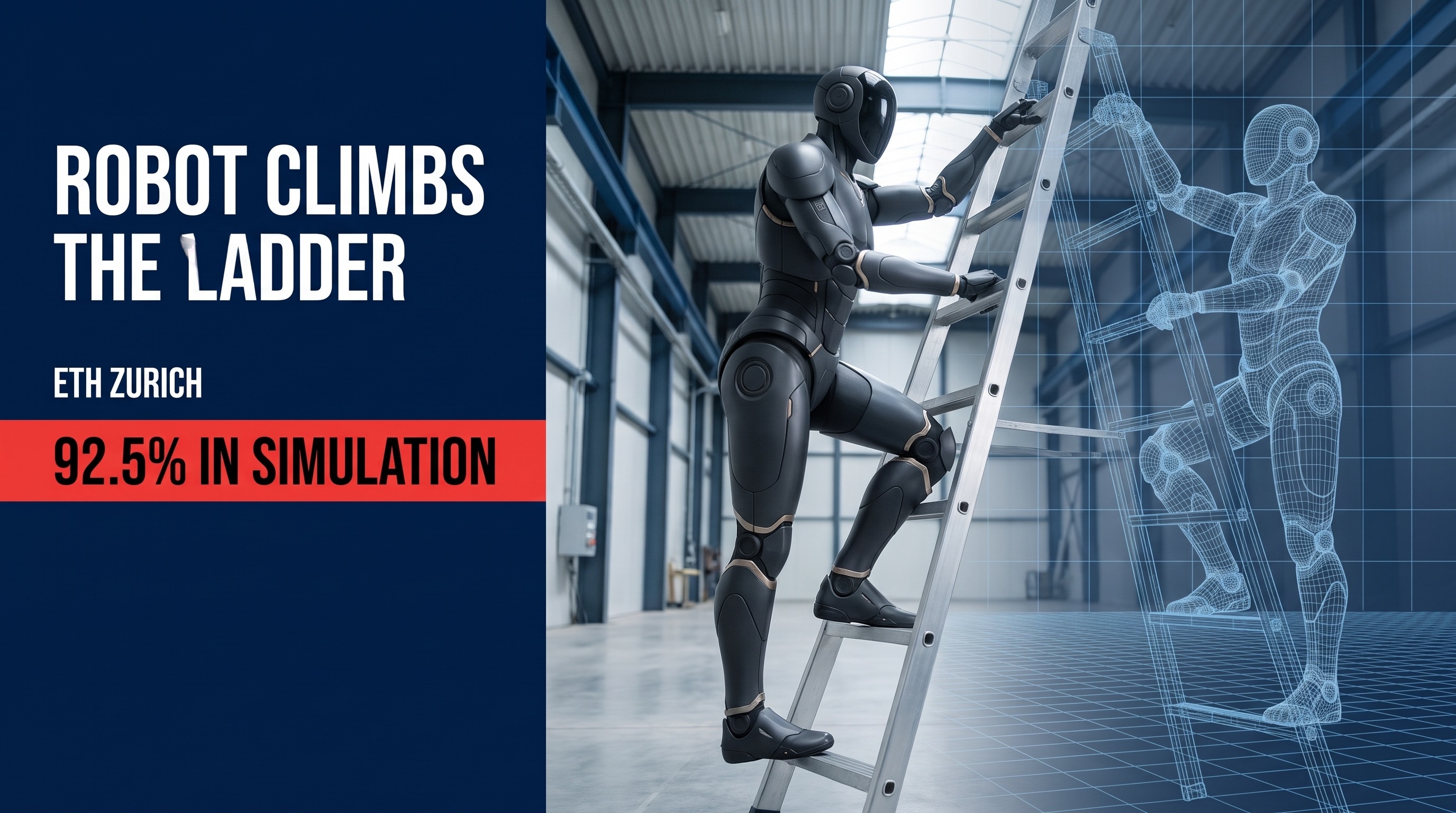 Symbolic image · AI-generated
A Unitree G1 climbs a ladder, jumps over a box and rights itself after a fall, having learned this from 13.2 minutes of human movement. The Robotic Systems Lab at ETH Zurich submitted the work on October 22, together with researchers from Apple and Nvidia.
What's new is the elimination of templates, because the robot no longer copies recorded movement, but instead plans ahead where it wants to support itself with hands, knees or elbows. The success rate of 92.5 percent sounds convincing, but it comes from simulation courses in which sensor noise and control delays were disabled. For the real robot in a real hall, the paper provides not a single success figure.
Two neural networks share the work, both running on board at fifty hertz. The first predicts where hands, elbows, knees, feet and pelvis should make contact with the environment over the next 1.5 seconds—nine contact points in total. The second translates this plan into commands for 23 joints, while the joint control below it operates four times faster. The environment is seen by a lidar at the head, whose point cloud becomes a height map with three-centimeter resolution in less than thirty milliseconds, and all calculations run on the main processor of a Jetson Orin NX.
Behind this lies a decision that robotics has been debating for years. If you train a controller without movement templates, you get a machine that handles unfamiliar terrain well, but looks clumsy and struggles to be coaxed into coordinated whole-body movements. If instead you have it imitate human recordings, you get fluid movements that immediately fail outside the recorded trajectories. The Zurich group uses the movement data only as prior knowledge in training and makes contact itself the interface between perception and control. At runtime, the machine thus gets by without any reference and knows only its own state, the height map and a goal.
The 13.2 minutes of movement material don't come from a single archive, but from multiple collections like Mixamo, LAFAN and Omniretarget, and were computationally augmented. The material itself isn't expensive; what's expensive is computing time, because training happened in three stages on RTX 4090 graphics cards, with up to twelve thousand parallel simulations per card. The final stage alone ran for nearly two days on four of these cards. This stage is the most valuable because it extends capabilities to terrain forms that never appeared in the human data, and increases the success rate on sparsely-spaced footholds by 54.8 percentage points.
The authors themselves spell out the limitations, and they are clearer than the videos suggest. The contact representation thinks in floors and steps—essentially two-and-a-half dimensions—so overhead grips or hanging from a bar are not provided for. Global navigation is also missing; the robot moves only locally toward a predetermined target. And movements without their own contact sequence cannot be distinguished with this approach, because a backflip and a vertical jump produce the same sequence of contacts.
The comparison value also deserves a second look. The 58.8 percent that the paper attributes to the previous MGMT method on the same eight courses were measured under exactly the same relaxed conditions as the 92.5 percent. The gap therefore shows mainly that the new contact planning plans better, not that it holds on concrete. What happens in the real hall is documented so far by recordings of individual runs, and the authors explicitly call them extensive tests without providing a success rate.
For Switzerland, there is something interesting in this that doesn't appear in the paper: the body comes from Hangzhou, the capability comes from Zurich. The equipment described corresponds to the research variant G1 EDU-U1 with 23 degrees of freedom and Jetson Orin NX, which is listed in the robothub24 directory at a guide price of CHF 31,879. Measured against the six-figure sums cited for the large American humanoids, that's the price of a delivery van.
That's exactly where the economic question hangs. If the capabilities of such a machine come later as software, its value shifts from metal to code, and an economy that has done well from metal so far must consider where it can earn its share. Since the US blocked imports of Chinese robots in July, this division of labor has become additionally politically charged, because European groups can research undisturbed on devices that an American lab can no longer procure anew.
How closely intertwined things have become is shown by the author list. Vladlen Koltun and Matthias Müller research for Apple, Clemens Schwarke sits at Nvidia as well, and overseeing it all is Marco Hutter, whose lab already brought the quadruped ANYmal to industry. The paper carries the notation under review, the code is not yet published, and the project page is still missing even the main video for the work.
This article was created with the support of artificial intelligence and editorially reviewed. The article image is an AI-generated symbolic image, not a press photo.