US robot ban: Intel gets exemption for vehicles that may not be robots
Intel is allowed to keep its autonomous transport vehicles running in its US chip factories for another year while making modifications. The FCC approved the request on October 22, six days after submission. The robot ban from July 28 thus affects not a Chinese manufacturer first, but the American chip giant itself.
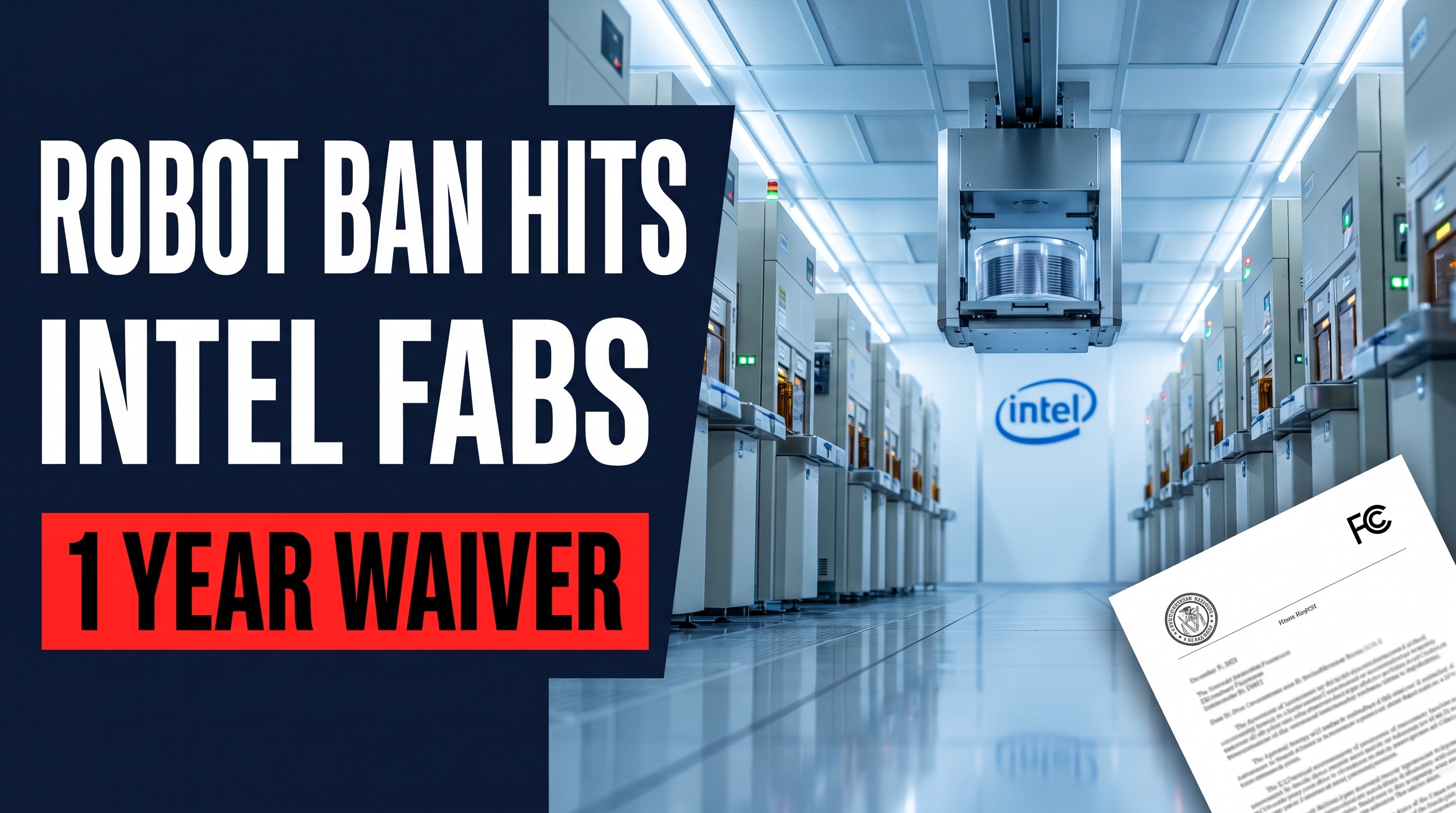 Symbolic image · AI-generated
On October 16, Intel submitted a request to the American telecommunications regulator FCC; on October 22 it was approved. The chip manufacturer is permitted to keep the driverless transport vehicles in its US semiconductor plants running for another year while making modifications. This became necessary because Washington placed foreign-made robots on its ban list on July 28, and Intel was uncertain whether its own wafer transporters fell under this category.
Thus the robot ban affects not a Chinese manufacturer first, but the American company whose factories it is meant to protect. According to Intel's account, replacing the entire fleet would take years, tested American replacement materials do not exist, and a halt would have an immediate negative impact on manufacturing.
A wafer is the round silicon disk from which chips are eventually cut, and it goes through several hundred process steps on different machines in the factory. Between these stations it must be moved dust-free and without vibration, which is why the disks are placed in sealed containers that travel along overhead rails or on the floor through the cleanroom. When these vehicles stop, manufacturing stops.
The definition on which everything hinges comes from a White House national security regulation and is drafted as broadly as possible. An advanced robotic device is any mobile machine that moves on the ground, operates at a distance from an operator, and together with its charging station weighs more than 4.4 pounds. It must also combine three components: a sensor for the environment, a network connection of at least 200 kilobits per second, and software for navigation, data collection, or remote control. Two kilograms and a WLAN module are therefore enough, which is why alongside humanoids, warehouse vehicles, cleaning robots, and lawn mowers fall into the category. But in July the intent was Chinese manufacturers.
Intel's vehicles move on rails or predetermined paths and often require human supervision, which is exactly the gray area the company found itself in. The company filed the request as a precaution, according to the filing, which Bloomberg first reported. It also contains the sentence that turns the logic of the ban against itself: The routine maintenance with which Intel wants to extend the service life of these work animals does not bring cybersecurity risks, and it is precisely such risks that are the main reason for the restrictions. Which models are meant is stated in a confidential appendix that no one outside the agency reads.
That an individual exemption was needed at all stems from a peculiarity of US device approval. Anyone who changes the hardware, firmware, or software of an approved product needs a new or modified approval for it, and devices on the ban list no longer receive one. For purely software updates to machines that were approved before July 28, the FCC had already issued a general exemption in the summer lasting until at least early 2029. Intel wanted more, namely also hardware modifications, and received them limited to one year. An agency employee clarified that it was about minor changes to existing models.
The origin question is piquant. The major suppliers of such factory vehicles are not located in China but in Japan, where Murata Machinery and Daifuku divide the wafer transport market between themselves. The ban names no country but ties to the place of production, thereby treating machines from allied states the same as Chinese ones. A calculation from procurement law is decisive: only those who manufacture in the US and maintain more than 65 percent of component costs in the country qualify as a domestic product; from 2029 the threshold rises to 75 percent. Bloomberg expects that TSMC, Micron, and Samsung will need to file similar requests.
For European manufacturers this is not a distant administrative matter but an export hurdle. The only permanent way around the ban list opens through conditional approval, which is not granted by the FCC but by the American Department of Defense. Those who want it must disclose owners, investors, and supply chain, and provide a scheduled plan for manufacturing in the US, with the deadline running until early 2028. Husqvarna was the first to succeed; the Swedish company received approval for four models of its lawn mowers, as did ANSCER Robotics from India for three warehouse vehicles.
A Swiss provider is thus formally on the same side of the line as a Chinese one. An inspection robot from Zurich that walks through a facility with cameras and lidar and sends its data to a cloud meets every element of the definition, and it is not built in Texas. Anyone who wants to supply to the US must therefore either meet the component calculation or submit to a procedure in Washington that demands insights that a mid-sized company rarely likes to grant.
The approval for Intel expires in late October 2027. What applies after that depends on whether American factory vehicles exist by then that hold up to comparison, and even the agency does not doubt this currently. Until then, a ban remains in effect whose reach is so unclear that the country's largest chip manufacturer had to ask for permission without knowing whether it needs it.
This article was created with the support of artificial intelligence and editorially reviewed. The article image is an AI-generated symbolic image, not a press photo.