Humanoid Robot as Nvidia Reference: The Second in Five Months, and It Comes from Munich
On October 21st, Nvidia presented its second reference humanoid at GTC in Berlin, and the body comes from Agile Robots in Munich. The machine is set to be available in early 2027, but neither company has announced a price. The chip and robot model are the same as the first reference device from June.
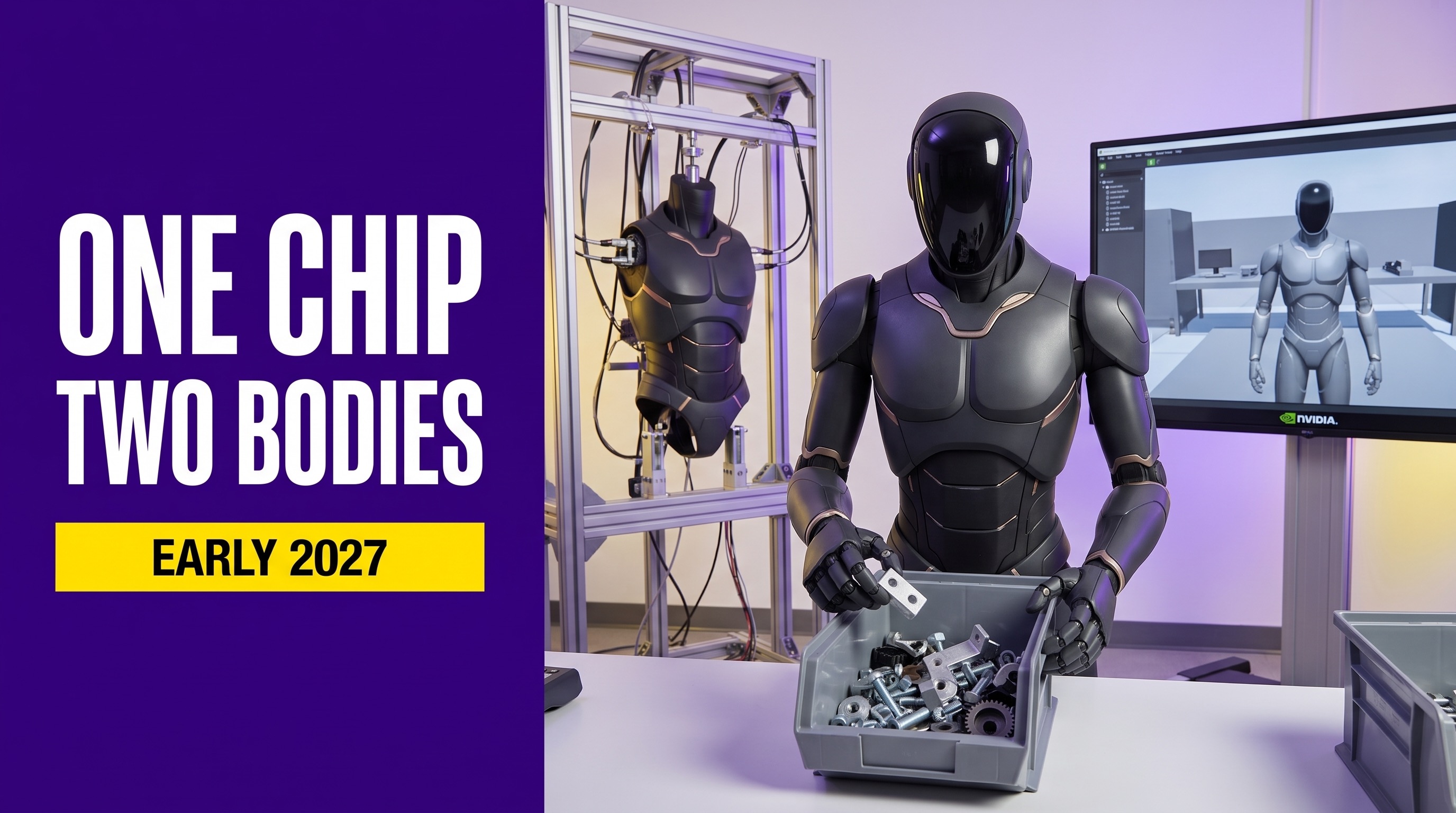 Symbolic image · AI-generated
On October 21st, Nvidia presented a reference humanoid at GTC in Berlin that Nvidia does not build. The body is called Agile ONE SN, comes from Agile Robots in Munich, stands 1.40 meters tall, and features 71 joints with two five-fingered hands. It runs on Nvidia's Jetson Thor, controlled via its robot model GR00T. Available from early 2027, no one is naming a price.
This is Nvidia's second reference humanoid within five months. In June, it still wore a chassis from Unitree in Hangzhou. The body changes continents, the chip and model stay the same, and whoever sets the reference doesn't determine the design, but rather what the next generation of robot research will compute on. At the same time, Europe's new machinery regulation takes effect.
The real argument is the hands. Two Wuji hands with twenty degrees of freedom each sit on the arms, controlling force at kilohertz rates and reporting touch back. With three kilograms of payload per arm and up to 140 newton-meters of joint torque, this feedback determines whether a grip holds or a component gets crushed. Add to this cameras on the head and at the wrists, a lidar and inertial measurement, and Agile Robots promises that a lab can be operational in days instead of weeks, because drivers, simulation models, and learning environments already fit together.
Nvidia makes its money from this fitting together. The robot runs GR00T 1.7, an open model that translates images and speech into movement. Nvidia provides the whole-body control and the files with which the same machine can be virtually reconstructed in Isaac Sim and Isaac Lab. Isaac Lab 3.0 has been generally available since the Berlin conference, as has a runtime system called Isaac OS and a library with more than two thousand simulation-ready factory components. However, not everything is open: the new Human 1M dataset, which shows human activities from three viewpoints with hand tracking, is available in full only to partners of the so-called Cosmos Coalition.
The comparison with June is instructive, because back then the reference robot was called H2 Plus, was significantly larger at 1.82 meters and around seventy kilograms, came from Hangzhou, and was supposed to be available by the end of 2026. A binding price was never mentioned there either; trade figures circulate between 95,000 and 150,000 dollars, none of them confirmed. Identical then and now is the processor: a Jetson AGX Thor with 2070 teraflops in low precision and 128 gigabytes of shared memory. Two chassis, two continents, one supplier for the brain.
On the subject of safety, the announcement is cautious. Nvidia mentions a planned connection to Halos, its own security system for robotics; Agile Robots phrases it even more carefully and says it is examining integration. At the same time, Nvidia lists the Munich company as a Halos partner, and Accenture, TÜV SÜD, and Reynolds & Moore are working on certification, but none of this is complete. For a research device with an emergency stop button, that may suffice, but the path into the factory floor runs through standards, and South Korea has already written its rules for operation without fencing, while Europe is still waiting.
Agile Robots is no longer a startup hiding behind a prototype. The company was founded in 2018 from the DLR, employs over 3,500 people according to its own statements, and has acquired a group including Franka Robotics, idealworks, BÄR Automation, and Krause Automation that counts more than 20,000 robot installations. At the same conference, it showed a trial with Audi and Dassault Systèmes at the Ingolstadt plant in which mobile humanoids pick parts from mixed containers and place them in assembly sequence. Audi explicitly calls this a proof of concept, not production use, and names neither quantities nor timeline.
Switzerland appears in both announcements, but in the role of user. Nvidia mentions ETH Zurich alongside Stanford as an interested institution, and Hexagon in Zurich supplies perception technology to the platform with its robot AEON. Anyone in Switzerland who wants to procure such a device will import it, pay in euros or dollars, and comply with European machinery law when putting it into operation. The prices of available models, as they also appear in the robothub24 directory, so far point rather upward than downward.
Marco Hutter from the Robotic Systems Lab at ETH said in June about the first reference design that it gives his teams a state-of-the-art platform to collect data, test algorithms, and verify behavior. The sentence fits now a second time, for a different body from a different country. Jensen Huang called the ChatGPT moment of robotics dawning in Berlin, but with a machine whose price no one names, it remains unclear for now who can afford this moment.
This article was created with the support of artificial intelligence and editorially reviewed. The article image is an AI-generated symbolic image, not a press photo.