Tesla Optimus enters production: The process is proven, not the robot
On October 21, Tesla confirmed the start of Optimus production in Fremont, but names no production volume, price, or customer. The company says the manufacturing process is proven, while design work continues. According to Elon Musk, reaching the target rate of 20,000 robots per week will take at least a year.
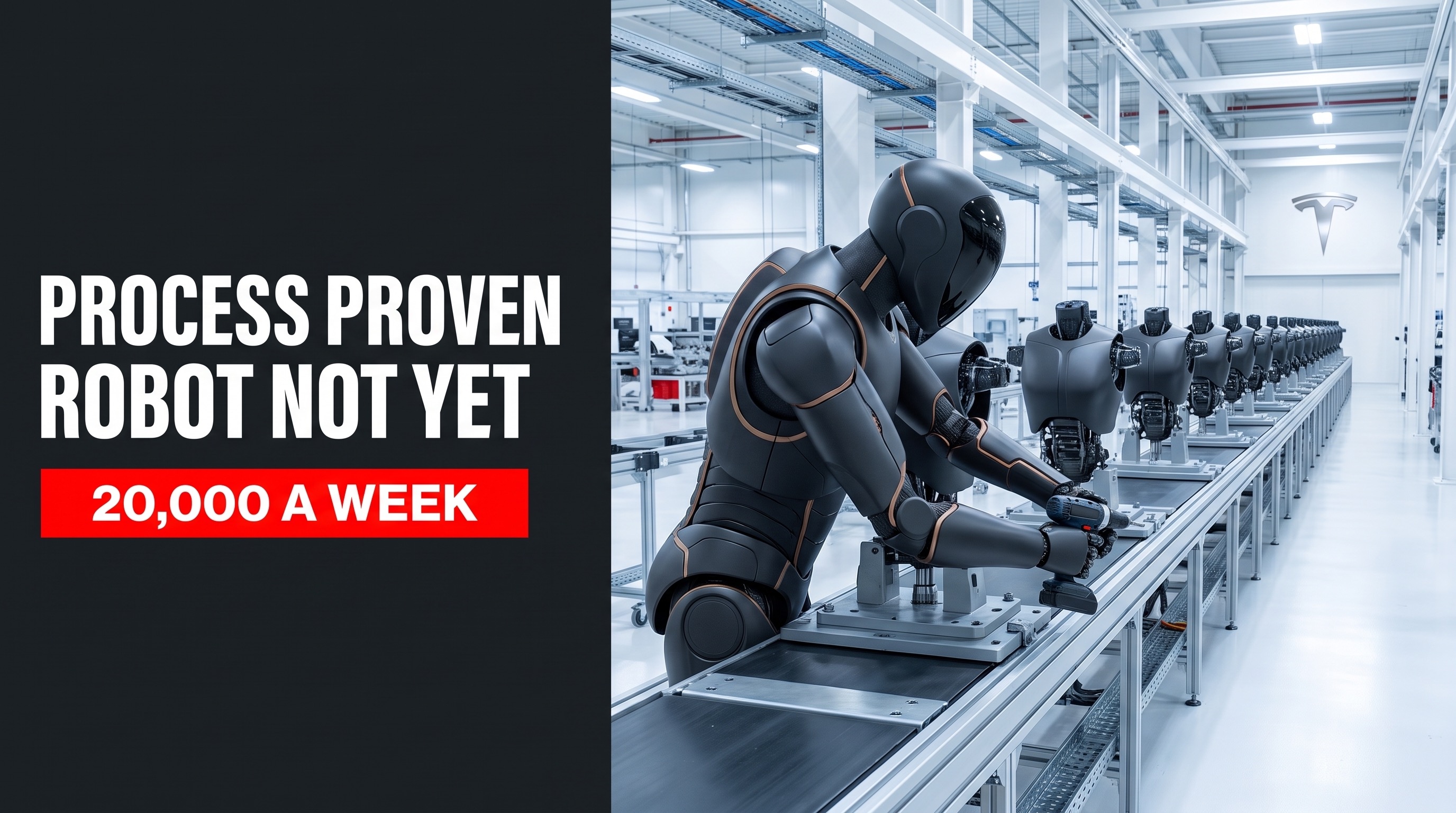 Symbolic image · AI-generated
Wednesday evening, Tesla delivered the sentence the industry has been waiting for two years to hear: Optimus production has begun in Fremont on high-volume lines, and the machines are the first in production quality. No production volume is mentioned anywhere, nor is a price or customer. Quarterly profits fell to 787 million dollars, 43 percent less than the previous year.
The wording is crucial. Tesla does not declare the robot finished, but rather the manufacturing process proven and suitable as a commercial product. In the same conference call, Musk acknowledged that design work must continue, because such a machine should not wear out after a month. The line is proven, not the device on it.
How gradual the ramp-up will be, the CEO has described himself. Reaching the targeted rate of 20,000 robots per week will take "at least a year, possibly somewhat longer," and growth follows an S-curve, whose first section has a very shallow slope. Outside of Tesla, a machine should arrive at the earliest toward the end of 2027, which Musk tied to a parenthetical remark that has given the industry much to discuss: He expects open issues to be resolved "around the end of next year."
These 20,000 per week are not a factory size, but a statement to the entire automation industry. Extrapolated, that would be just over one million robots per year, while globally in 2025, according to counts by the industry association IFR, just over 600,000 industrial robots were newly installed, across all manufacturers and all applications. Tesla would thus have to double an industry that has been refining its supply chains for sixty years, and with a product whose durability its own CEO openly questions.
The line itself is the result of a departure. Where Model S and Model X were assembled until early May, Optimus fixtures now stand, with the California hall long-term designed for one million units per year. In Texas, the second factory is growing, with groundbreaking at the end of March, and in September drone footage showed an nearly complete steel framework. In the quarterly report, California carries the status "Early Ramp," Texas the status "Construction," and no additional figures are provided for either.
What the first devices do, Tesla calls "Optimus Academy." The robots practice tasks and generate training data in the process, customer work is not planned, and Musk promised a video about it in one or two months. This is the same logic as in spring, when the first Optimus units remained internal, only with a name attached. On the software side, "quite a lot remains to be done" before the robot is truly useful for open-ended tasks, Musk said, and that is the real news of this quarter: The mechanics have become manageable, the intelligence has not.
Financially, the quarter shows what this transformation costs. Revenue remained at just over 28 billion dollars, practically at the previous year's level, gross margin recovered to 19.6 percent, but operating income plummeted 56 percent to 718 million dollars. Research spending climbed 69 percent to 2.76 billion, investments to 4.73 billion and thus more than double the previous year's value. Those wanting to know where the money goes will find the answer in these two lines and not in the profit statement.
For context, it's worth looking back at the promises. In January 2025, Musk announced around 10,000 Optimus units built in the same year, several thousand of which were to perform useful work; a year later he admitted that at Tesla, not a single robot was performing useful work. Against this track record, a sentence about a proven manufacturing process is indeed progress, just smaller than the headlines suggest.
Swiss companies considering deploying a humanoid should read a sequence above all else from this announcement. First, Tesla serves itself, then American companies, and only after that is export discussed. Those wanting something functional on the shop floor sooner end up with Chinese providers or European manufacturers with small production runs, such as Hexagon from Zurich, whose AEON is already in an order for over a thousand machines. Add to this a formal point that gets lost in the euphoria: A sentence in a shareholder report is not a declaration of conformity. Anyone operating a machine here needs documentation under machinery law, a risk assessment, and an operator to take responsibility for it.
Musk described the situation most accurately when he estimated the number of open construction sites. Around 10,000 things must run correctly for the robot to be mass-produced, he said, and things proceed at the speed of the slowest and most unfortunate of these 10,000.
This article was created with the support of artificial intelligence and editorially reviewed. The article image is an AI-generated symbolic image, not a press photo.