The Pentagon Pays $490,000 for the Robot Soldier, and the Winner Collapsed at the Finish Line
The US Army had nine humanoid robots compete, the winner collapsed while shoveling earth, the prize money was $490,000. Only the four-legged robot has been armed and deployed so far. No humanoid has ever fired a weapon in a war.
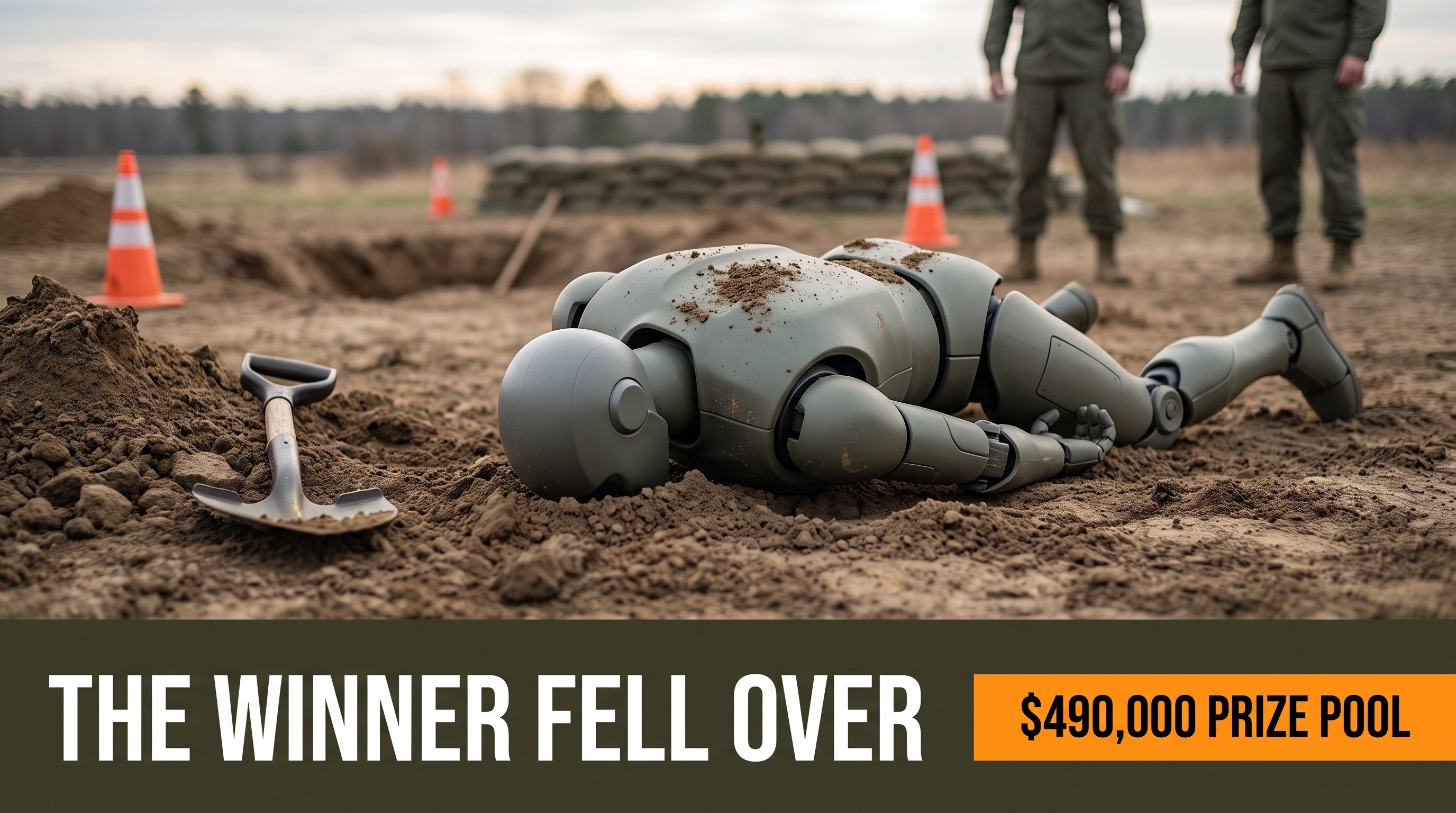 Symbolic image · AI-generated
On September 10, the US Army had nine humanoid robots compete against each other at Marine Corps Base Quantico, securing checkpoints, crossing trenches, extinguishing fires. Alex from the Institute for Human and Machine Cognition won, a humanoid with ballistic protection that collapsed while shoveling earth. The total prize money for the competition was $490,000.
The world's most powerful army has not disclosed more than that for the robot soldier so far. In the same year, Anduril received a contract vehicle worth twenty billion for drone defense software. And to this day, no humanoid robot has fired a weapon in a war, even though several companies now advertise exactly that.
Foundation Future Industries from San Francisco goes the furthest, now with 24 million dollars in research contracts from the Army, Navy and Air Force. Co-founder Mike LeBlanc, fourteen years with the Marine Corps, states the purpose without hesitation: there is a moral imperative to send these robots to war instead of soldiers. Chief Strategy Adviser is Eric Trump, which prompted Senator Elizabeth Warren to ask whether the Pentagon is a cash machine for the President's children.
Two Phantom MK-1 from this company went to Ukraine in February, the only front test of a humanoid to date. They carried material and did reconnaissance, but did not shoot. The Ukrainian assessment was sober: twenty kilos payload, not waterproof, battery too limited, and the machine frequently loses balance. The same Phantom nevertheless posed at a company demonstration with a revolver, shotgun and an M-16 replica.
Armed and deployed is something else entirely, namely the four-legged robot. The US Special Operations Command approved the CODiAQ from manufacturer Skyborne for testing in May, 6.5 million dollars for fourteen platforms and twenty-eight weapon modules, and this month operators are conducting live-fire exercises with it. Back in 2023, Marines fired an anti-tank missile from a robot dog, so the dog has long been capable of what the humanoid has only hinted at so far.
In China, Reuters reviewed over a hundred procurement solicitations, patents and studies in September. The agency found a solicitation for the purchase of a single humanoid, a feasibility study with six combat robots for urban warfare and a budget of around 300,000 dollars for labeling sensor data. It found no armed humanoid in an active military unit.
Russia barely figures in this calculation, because Yevgeny Dudorov, the central figure of Russian android development, said in July that combat androids would arrive with troops at the earliest in five years because they are simply too expensive for the military. The Ukrainian six-month deadline for the first soldier killed by a humanoid was a topic here; meanwhile it is established that every machine in the announcement video was an AI rendering and neither a company nor a budget stood behind it.
What is actually moving on this front are boxes on wheels and tracks. In April, the Ukrainian Defense Ministry counted 11,028 deployments of ground robots in a single month, and none of the models newly approved in the first half of the year were bipedal. Roughly ninety-eight percent of these deployments are supply and casualty evacuation.
The most honest statement about the situation comes from one of the Quantico winners themselves. Robert Griffin from the Institute for Human and Machine Cognition told Army Times on October 16 that no existing robot combines high speed, heavy loads and twenty-four-hour endurance. Robots should not decide matters of life and death anyway, because today's AI is too easily confused. A humanoid depends on around twenty motors, each of which must function.
None of this has been regulated so far. The United Nations expert group ended its three-year mandate on September 4 in Geneva without a treaty and without a negotiating mandate, and references to ethics, predictability and explainability disappeared from the final text at the instigation of the US and Russia. A decision will be made in November at the Review Conference, again in Geneva. Switzerland is among the 76 countries that want to negotiate, but is not calling for an outright ban.
For Swiss manufacturers, the crucial question does not depend on the customer, but on the construction. A robot dog is classified as war material under Article 5 of the War Material Act only if it has been specially built or modified for combat use, and a commercial ANYmal thus remains exempt from approval, even if an army buys it. Péter Fankhauser from ANYbotics nevertheless wants nothing to do with it: they are strictly opposed and do not conduct operations in armed conflicts.
Meanwhile, the Army itself is conducting research in Thun, where the Swiss Drone and Robotics Centre handed over a remote-controlled walking excavator and an underwater robot to the armed forces and hosted the European Land Robot Exercise ELROB with 21 teams in June. There is not a word about armament in these publications. How thin the line is, another Zurich startup shows: Auterion, created from ETH research in 2017, delivered 33,000 targeting kits for Ukrainian drones in July for 50 million dollars. Founder Lorenz Meier makes the statement on which the entire debate in Geneva hinges: the technology ensures that the decision to target remains with humans.
This article was created with the support of artificial intelligence and editorially reviewed. The article image is an AI-generated symbolic image, not a press photo.