Humanoid Robot from OpenAI: 17 Open Positions, Not a Single One for Intelligence
OpenAI's careers page lists 17 open robotics positions, and not one is seeking an AI researcher. They're hiring motor engineers, actuator technicians, and procurement specialists. Sam Altman says the brain matters more than the body, but hiring is happening in exactly the opposite direction.
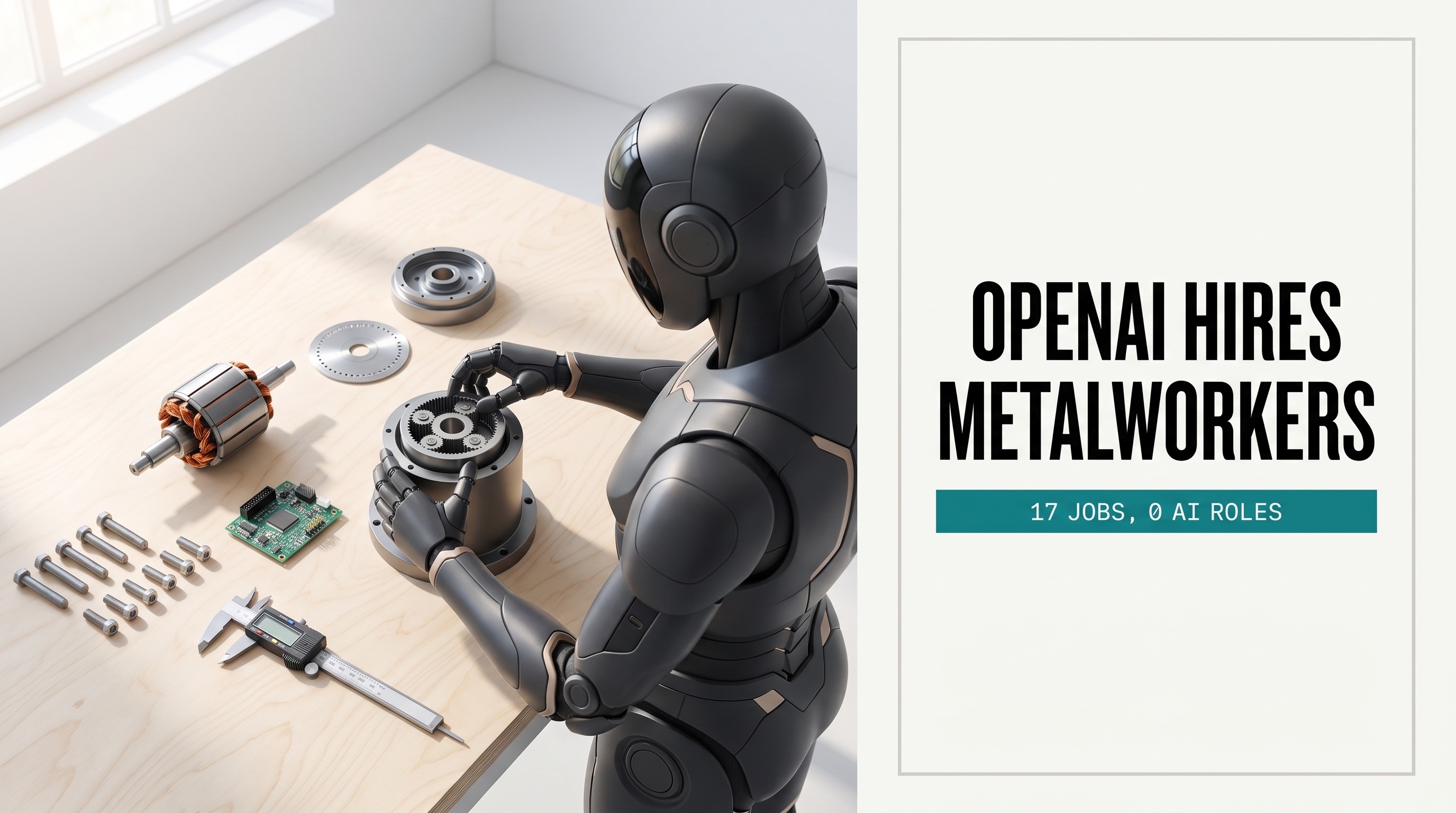 Symbolic image · AI-generated
17 open positions, not a single one for artificial intelligence. When you filter for robotics on OpenAI's careers page, as of October 20, you get exactly this list: motor design, circuit board layout, an actuator test stand, procurement, workplace safety. All 17 are based in San Francisco, all concern hardware.
This sits uncomfortably with what Sam Altman himself has said, because in the podcast Sources in early September, he confirmed that OpenAI will definitely build a humanoid, and the human form makes sense because the world is built for humans. He immediately added that getting the brain right—the one that makes the robot move—is less important than all of that. But right now, they're not hiring the brain; they're hiring the workshop for the body.
Whoever reads the job titles recognizes exactly this workshop. They're looking for a Mechanical Design Engineer for motor development and prototyping, a Manufacturing Engineer for motors and actuators, an actuator technician, a PCB layout specialist, and an engineer to build the test infrastructure including dynamometers. Then come a Technical Commodity Manager and a Procurement Coordinator—two people whose job is to buy components in bulk. They're also hiring a Senior Manager for Occupational Health and Safety, the kind a company needs when there are machines in its spaces, not just servers.
Engadget had discovered the collection on October 17 and counted 27 job postings at the time, some of which have apparently since been filled or withdrawn. In terms of content, the report describes the same picture: custom electromechanical actuators with motors, gearboxes, sensors and thermal management, plus manufacturing and a supply chain that should eventually produce hardware in series. There's nothing in all of this about a finished robot, a price, a subscription model, or a delivery date.
The backstory explains why this is surprising. OpenAI had stopped its robotics work around 2020 and later bought in from others—for example, in 2023 by leading a CHF 23.5 million financing round for Norwegian manufacturer 1X, whose home robot Neo is now on the market. There was a development partnership with Figure AI until Figure ended it in February 2025, because according to CEO Brett Adcock, language models were getting smarter but more interchangeable, which is why Figure built its own model called Helix, turning former partners into competitors.
Since May 2026, the robotics division has existed again, according to Tech Times emerging from an internal project called Worldsim and announced by Altman via text message. It's led by Aditya Ramesh, VP of Research, who previously invented DALL-E and led Sora. Hardware was the responsibility of Caitlin Kalinowski, whom OpenAI recruited from Meta in late 2024 and who left in March 2026 because she disagreed with how the technology was being used with the Pentagon.
For Switzerland, this is more than a personnel matter, because the component OpenAI now wants to develop itself is already being sold fully finished by an Obwalden company. maxon in Sachseln showed an integrated joint for humanoids at Automate 2026, in which a brushless DC motor, a reversible two-stage planetary gearbox, two encoders, and control electronics all sit in one housing—you only need to connect power and EtherCAT. There are two sizes: the larger one for knee, hip, and shoulder; the smaller for elbow, wrist, and ankle.
"The point of these robot actuators is to make it easy for roboticists to focus on the robot itself," said Biren Patel from maxon. Founded in 1961, the company employed around 3,200 people in 2021 and generated CHF 626.5 million in revenue, and its drives are used in surgical robots and in over a hundred units on Mars. At the 2024 SPS in Nuremberg, a two-meter-tall humanoid called Hope drove across the stand, with four maxon motors in each arm.
This is exactly where the personnel search becomes interesting, because actuators account for an estimated 40 to 60 percent of a humanoid's material costs, and whoever buys them gives away that margin. Tesla, Figure, and Chinese manufacturers build their own drives for this reason; Agility has bound itself exclusively to a single supplier for Digit 5's batteries. OpenAI seems to have done the same math, only in San Francisco and without any manufacturing experience.
Whether it works depends on something that can't be advertised. A motor program from zero to series production takes two to four years in industry, while Altman promises a demo for 2027 and at the same time admits that robots on the street won't exist for a few more years. A demo is not a delivery promise, however, and the company still hasn't named a manufacturing partner.
What remains visible from the hardware offensive is for now a gap. The woman responsible for building it has been gone for seven months, and OpenAI won't say who took over her role. Instead, the job list includes a technician for the prototype lab.
This article was created with the support of artificial intelligence and editorially reviewed. The article image is an AI-generated symbolic image, not a press photo.