Humanoid Robot 20 Hours a Day: Agility's Key Number Comes from a Battery Made in Cambridge
Agility sells the humanoid robot Digit 5 with 20 working hours per day, 90 minutes of operation and nine minutes of charging time. The number comes from Cambridge. The robot will be delivered with this battery not until 2027, and both companies remain silent on its capacity, weight and cycle count.
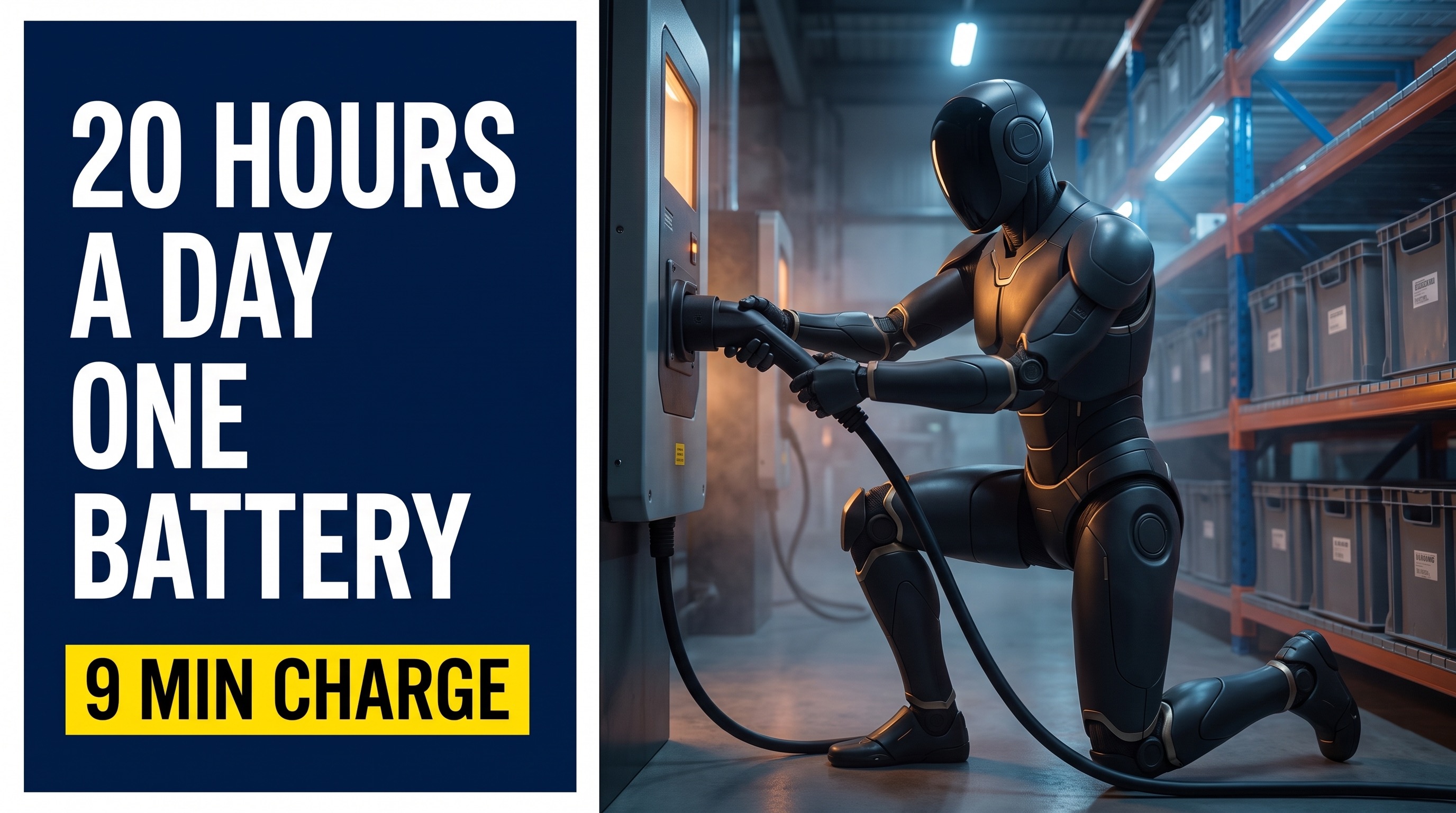 Symbolic image · AI-generated
On October 15, Agility Robotics announced who will supply the battery for the humanoid Digit 5, thereby delivering the figure with which this robot is marketed: 90 minutes of work, nine minutes of charging. From this, the Oregon-based manufacturer calculates more than 20 productive hours per day, more than two full shifts.
The decisive metric thus does not come from robotics, but from a battery startup in Cambridge to which Agility has bound itself exclusively. Neither company names capacity, weight, charging power or cycle count. The robot will not be delivered with this battery until the first half of 2027, and until then the figure works primarily on the stock market, as Agility is just going public on the Nasdaq via a special purpose acquisition company.
With the Digit 4, the ratio of work to charging time was two to one; with the Digit 5 it should be ten to one. The jump comes from Nyobolt, founded in Cambridge in 2019 and long no stranger to the robotics industry.
In May, the company raised 60 million dollars at a valuation of one billion, led by Symbotic, a warehouse automation company that can put the technology to good use itself. What makes the battery fast, Nyobolt describes as proprietary anode materials, a special cell design and integrated power electronics. Nothing more appears in the announcement, and that is remarkably little for a figure that carries a business model.
The Digit 5 was unveiled in September and is considerably more machine than its predecessor. It is 1.81 meters tall and weighs 129 kilograms, reaches up to a height of 2.2 meters and lifts loads of up to 22.7 kilograms, which is around 40 percent above the Digit 4. The legs work with a specially developed cycloidal gearbox, the grippers can be changed via ISO flanges, and an independent controller ensures safety by stopping the robot without waiting for the rest of the software.
Why Agility places so much emphasis on operating time is explained by its own calculation from investor day. The robot is expected to rent for around 8,500 dollars per month, and this rental only makes sense for the customer if the device runs as long as possible. "For our customers, Digit's availability is the business case," says Daniel Diez, who heads business at Agility, and this sentence alone explains why a battery announcement becomes the main news at a robot manufacturer.
Only the predecessor has been proven so far, with 65,000 operating hours at customers such as GXO, Schaeffler, Amazon and Toyota. In a GXO warehouse near Atlanta, a Digit 4 moved around 100,000 containers with a hit rate of about 98 percent. The much-cited order backlog for the Digit 5, however, according to the stock exchange documents, comes from a related customer and is released in tranches, depending on which tasks the robot can master.
Rapid charging has a downside that does not appear in any announcement. If you pump in in nine minutes what should last ninety minutes, you draw roughly ten times as much power during charging as the robot consumes in operation, and in a warehouse that is no longer a robot question but one of grid connection and peak loads. Then there is aging, because very fast charging stresses cells the most. Nyobolt explicitly cites high cycle durability as a strength, but gives no figures for it.
And twenty working hours assume that an operation actually has twenty hours of work available. That is not the case in most warehouses, which is why the gain in operating time primarily benefits places where three shifts are already being worked or where night work is particularly expensive for people.
This makes the number more interesting for Switzerland than for Ohio. Night work is subject to approval here, and anyone who orders it temporarily pays a wage surcharge of 25 percent; for permanent night work, a time surcharge of 10 percent applies instead. A machine knows neither, which means those same twenty hours are worth more in a high-wage country than in an American distribution center.
You still cannot buy the Digit here, however. The Digit 5 is supposed to be the first Agility model ever to leave North America, heading first to the EU and Great Britain, with a CE mark and early access in the first half of 2027. Switzerland is not on any of these lists, which formally changes little because Swiss machinery regulations refer to EU law and a CE-marked device may also be put on the market here. In practice, it means that in the model comparison on robothub24.ch, Digit will have neither a price nor a dealer before 2027.
That Schaeffler appears on the customer list is fitting, by the way, because the same corporation ordered a thousand inspection robots from Hexagon in Zurich in September. Industrial corporations no longer buy robotics from a single supplier, but from wherever a specific task is solved cleanly.
Most revealing is one line in the fine print of the stock exchange documents. There, the dependence on Nyobolt as the exclusive battery supplier is listed among the risks for investors. The same partnership that is supposed to sell the robot is a danger in its own prospectus.
This article was created with the support of artificial intelligence and editorially reviewed. The article image is an AI-generated symbolic image, not a press photo.