Humanoid robots without safety fencing: South Korea is creating the standard that Europe still lacks
South Korea is allowing 20 bipedal robots to work without safety fencing alongside humans in semiconductor plants, car factories, shipyards and cold storage facilities. Operating data from these deployments will form the basis for future safety standards. Europe and Switzerland lack an authority that can temporarily suspend safety rules for pilot projects.
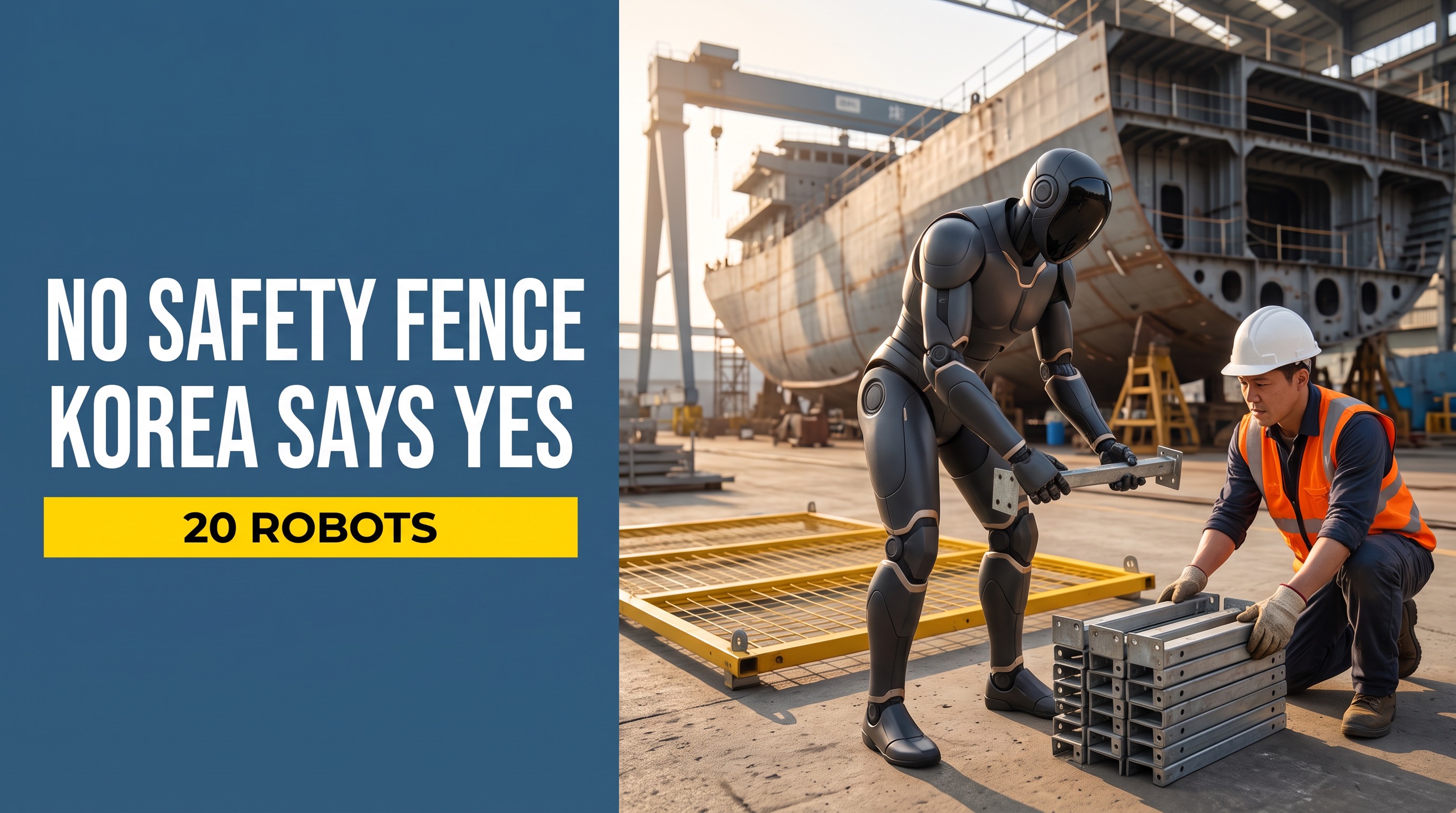 Symbolic image · AI-generated
On October 13, South Korea permitted twenty bipedal robots to work without safety fencing alongside humans. The Ministry of Industry granted an exemption to Seoul-based manufacturer Robros and approved the devices for use in four sectors: semiconductor manufacturing at Nepes, body assembly at Sungwoo Hitech, shipbuilding at HD Hyundai Samho, and cool chain logistics at Delivery Lab. Until now, such arrangements were only possible on a case-by-case basis per company.
Existing standards assume a fixed machine and require a fence to separate workers from the work area. Seoul is deliberately suspending this assumption for the pilot project, with a clear intention: future standards will be based on operational data. Whoever generates the data ultimately writes the rules that everyone else must follow.
Robros is not a major corporation but a company from Seoul's Seongdong district that started as a robot café business and develops both hardware and AI in-house. The company has sold 18 units of its Egris-C industrial model so far and aims to exceed fifty by year-end. CEO Noh Seung-joon says the humanoid revolution is beginning in manufacturing and logistics, and only when sufficient data and competitive pricing converge will deployment expand to services and households.
The four approved tasks sound deliberately unspectacular. In the semiconductor factory, the robot cleans round components from chip assembly; in the car plant, it positions body parts in their designated locations; on the shipyard, it stacks the clamps that secure work platforms to the ship's hull; and in the cold storage facility, it moves packaging units. None of these tasks require a humanoid—a fixed robotic arm or mobile platform could perform them just as well. What matters is that the machine operates in the same space as workers, because only this generates the data no one has yet collected.
The pilot is not running completely unrestricted, as approval depends on risk assessments and safety measures reviewed by the Ministry of Labor. On the same day, the same committee also approved for the first time patrols by quadruped robots on pedestrian paths: Maum AI is permitted to deploy its devices on waterfront paths and in parks in the city of Cheonan, where they assess conditions and provide alerts if danger is detected. Images are transmitted to a control center.
Skepticism is warranted, and in South Korea it has a specific historical precedent. The country has the world's highest robot density at 1,220 industrial robots per 10,000 employees—compared to a global average of 132—and has experience with what can go wrong. In November 2023, a gripper robot in a vegetable farm in Goseong crushed a technician who was inspecting the system and was standing in its work area with a crate. The fence was not the problem then; the question was who could be where and when. This question becomes harder, not easier, with moving machines.
For Europe, this development is uncomfortable because the opposite is happening here. As of January 20, 2027, the EU Machinery Regulation takes effect, governing the conditions under which equipment can be marketed, but not how it may be deployed alongside workers in operation. That is governed by national workplace safety law, and appropriate standards for moving machines are still lacking. ISO 25785-1, which is supposed to address legged mobile robots, is still in draft status in committee. Without operational data, it will not reach completion, and operational data only emerges where someone permits the trial.
In Switzerland, the situation is particularly quiet. With 294 robots per 10,000 employees, the country is in the European midfield. Anyone wanting to position a bipedal robot next to workers here must operate under existing workplace safety law, conduct their own risk assessment, and has Suva as the supervising authority. There is no authority with the power to temporarily suspend safety rules for a pilot project. Zurich canton does operate an innovation sandbox since 2022, but it is designed for AI applications, not for machine safety on the factory floor.
In practical terms, this means that a Swiss company interested in a humanoid today cannot get reliable failure rates from any manufacturer and cannot receive clear guidance from any standard on how far the machine must stay from workers. This is the recurring question in inquiries received by robothub24, and it can only be answered through an independent risk assessment. The answer from Korea will arrive in twelve to eighteen months, in Korean-language documents, prepared by a Korean manufacturer.
Trade Minister Kim Jung-kwan justified the decision by saying AI technology develops so rapidly that regulation can barely keep pace, and the state must remove institutional bottlenecks. This is industrial policy dressed in the language of workplace safety, and it is cheap to implement: South Korea installed 30,200 new industrial robots last year; China installed 354,200. Twenty mobile machines do not shift that ratio. But the papers they generate might.
This article was created with the support of artificial intelligence and editorially reviewed. The article image is an AI-generated symbolic image, not a press photo.