Humanoid robot seized in Cologne: A drone must be registered, he doesn't have to
A remote-controlled humanoid harassed a 16-year-old in Cologne, police confiscated the device and are investigating two young men. The case reveals the real loophole: A robot of this class costs around 5900 dollars, doesn't need to be registered anywhere, and can move through public spaces without approval.
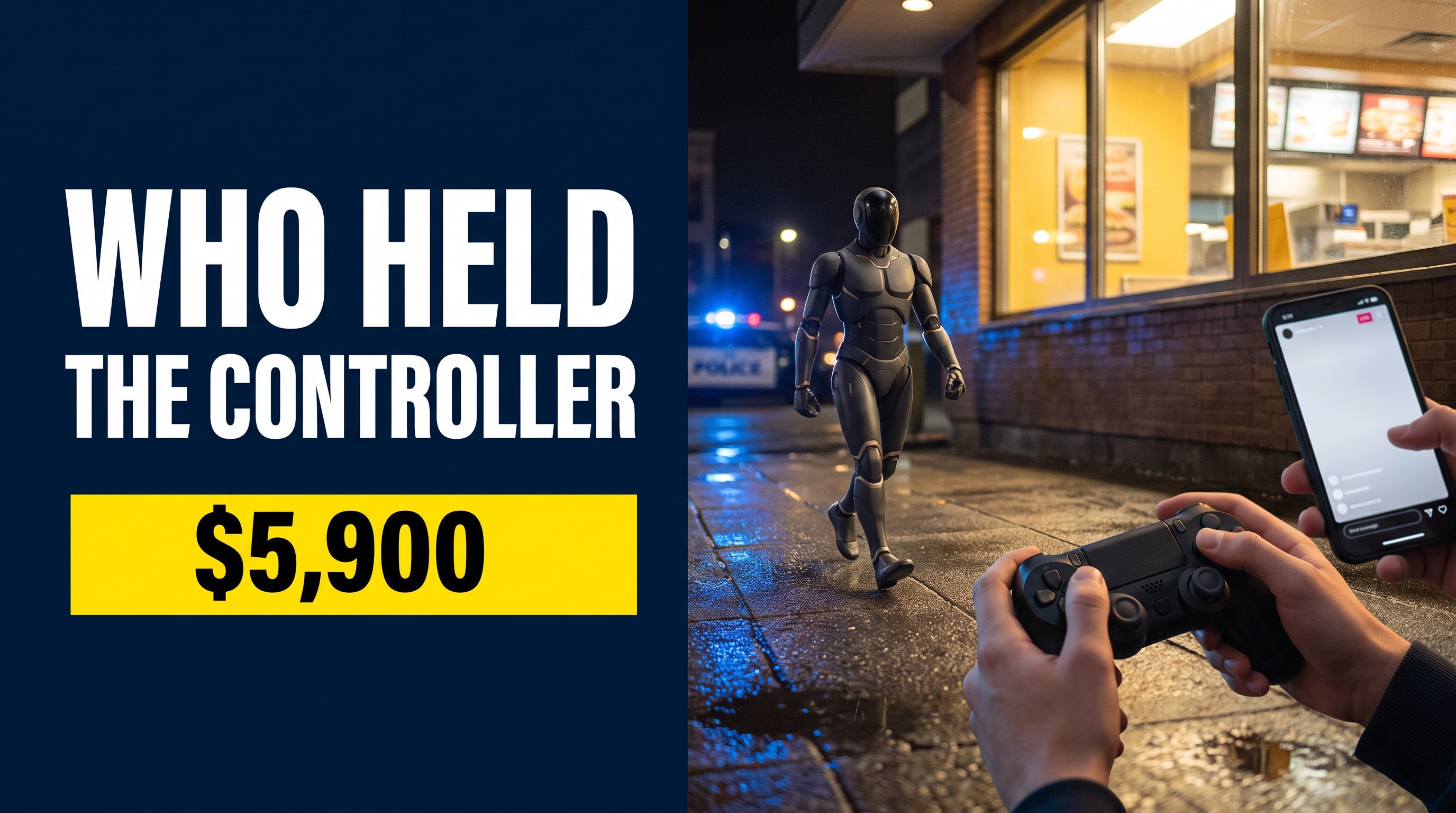 Symbolic image · AI-generated
In the night of October 11, a roughly 1.20 meter tall humanoid robot walked across the sidewalk in front of a fast-food restaurant in Cologne, grabbed a 16-year-old from behind, and then made unmistakable movements. Two young men livestreamed the scene on social media. Police confiscated the device along with two mobile phones and are investigating a 16-year-old and a 19-year-old.
What's new isn't the incident itself, but how easily it was possible. A humanoid of this size costs around 5900 dollars, follows an app or controller, and is freely sold in Europe. It doesn't need to be registered anywhere, there's no operating permit, and a minor is allowed to own it. For a drone over 250 grams, the opposite has long been true.
Legally, everything in Cologne hinges on one question, and the police asked it themselves: Did the robot move on its own, or did someone control it? For a device of this class, the technical answer is fairly straightforward, because such machines play back preprogrammed movements or follow a remote operator—they have no independent intent. This makes the robot legally a tool, like a stick or a vehicle, and the responsibility lies with whoever had their finger on the controller.
Specific robot law isn't needed for the act itself. In Germany, paragraph 184i of the Criminal Code provides up to two years imprisonment for sexual harassment; in Switzerland, it's a violation under Article 198 of the Criminal Code and is punished by fine on application. Because the two suspects are 16 and 19 years old, the proceedings also shift into juvenile criminal law, and the robot remains in evidence storage for now.
The model hasn't been officially confirmed. Observers believe the red and gold device is a Unitree R1, which at 1.21 meters tall and roughly 25 kilograms fits the picture and has been offered since summer 2025 for 5900 dollars. In Europe, it's available from electronics retailers and marketplaces sometimes for under 5000 euros, with home delivery and no checks on who's ordering. Unitree sells it as a development and entertainment platform, which means responsibility for operation lies entirely with the buyer.
Anyone familiar with Swiss practice will recognize a disparity here. In August 2025, Zurich startup Rivr together with Just Eat demonstrated a four-legged delivery robot in Oerlikon, weighing 60 kilograms and completely remote-controlled in the test phase. After a police tip-off, the Federal Roads Office classified the device as a vehicle and stopped the trial until an exemption permit was obtained. "Switzerland likes to present itself as one of the world's most innovative countries," said Rivr CEO Marko Bjelonic at the time, "but in reality, other countries in Europe and the USA are already years ahead."
The difference between the two cases lies neither in the technology nor in the risk, but in the design and purpose. A device that delivers something enters the realm of Swiss road traffic law and thus a procedure with deadlines, conditions, and permits. A humanoid strolling through a city center at night for fun falls through every regulatory crack because no one classifies it as a vehicle and the law doesn't know what to do with a metal pedestrian.
For retailers and operators, this isn't an academic question. Martin Ciupek, technology journalist at VDI-Nachrichten, called it cowardly to hide behind a seemingly autonomous machine on October 13, and warned that such incidents provide the template for strict regulations that ultimately affect harmless applications too. With drones, it went exactly this way—a handful of incidents led to registration requirements, competency certifications, and extended flight-restricted zones.
The effective lever probably doesn't lie in criminal law, but in sales. An age limit, documented instruction, and clear operator responsibility for public spaces would be implementable for specialist retailers without much effort, but barely for anonymous marketplaces—and that's where the cheap devices end up. Whoever rents or demonstrates humanoid robots in Switzerland should be prepared for the supervision question to be raised before the appointment, not after.
The WDR video ends with a scene that says more about the state of this debate than any statistic. The owner apologizes laughingly to a police officer and explains that the robot is simply badly behaved.
This article was created with the support of artificial intelligence and editorially reviewed. The article image is an AI-generated symbolic image, not a press photo.