Humanoid robot in the supermarket: Føtex stocks shelves at night, and a human controls every move
At a Føtex store near Copenhagen, a humanoid robot from Unitree stocks shelves at night, with every movement controlled by a human at a screen. Føtex says 40 to 50 percent of working time goes into stocking. The night shift is rented out at an hourly rate, remote operator included.
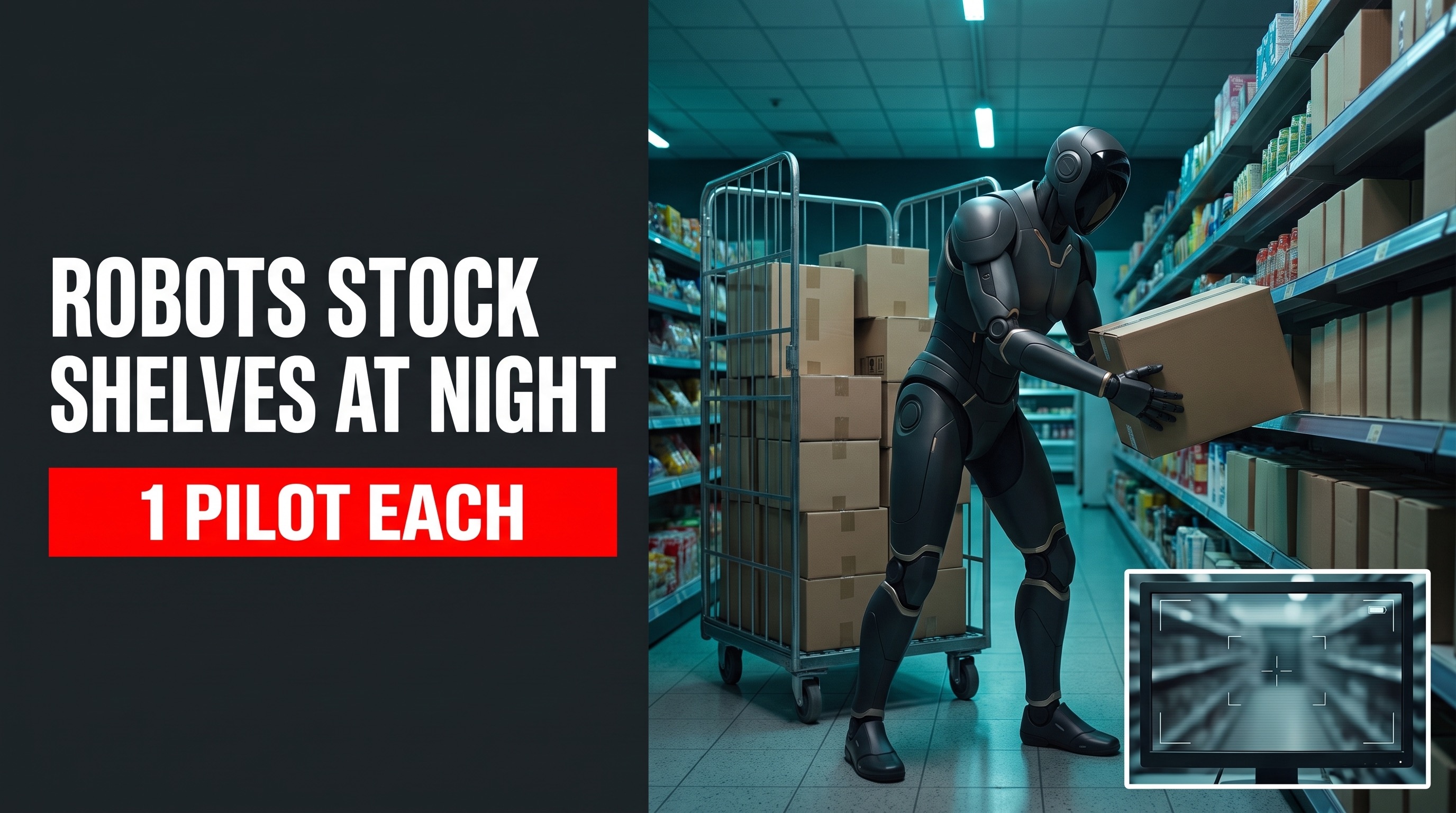 Symbolic image · AI-generated
At a Føtex store near Copenhagen, a humanoid robot works at night, and on October 11, the first images were circulated through European media. The device comes from Unitree in China, prepared by Danish startup HIVE Robots, and since June it has been filling shelves while the store is closed. Every movement is still controlled by a human at a screen.
The experiment is interesting because of the business model behind it. Føtex says its staff spend 40 to 50 percent of their working time stocking shelves, and the Salling Group operates over 2,000 stores across six countries. HIVE doesn't sell the robots but rents out night shifts at an hourly rate, remote operator included. The operator is the catch, because for now one attendant supervises one device.
Anyone who reads the program behind it notices how early the project is. HIVE is looking for one launch partner per country by 2027 and describes the process in four stages: one to two months of setup, then three months with one robot in a store, eight hours per night, seven nights a week. Only then do three robots come into the same store, and only in the fourth stage should the fleet grow to at least ten stores with three devices each, one new store per week. Two of the country slots were still available in mid-October, and Switzerland is one of the candidates that nobody has claimed yet.
Technically, the base platform was deliberately chosen to be inexpensive. The Unitree G1 costs around 16,000 dollars in the basic version and is thus the cheapest serious two-legged model on the market, 140 to 180 centimeters tall, which should be enough for the lowest and highest shelves. The real effort lies in the software and in the control center, which HIVE calls Heimdall, from which a trained pilot intervenes whenever the robot gets stuck. Whether it has to be a humanoid for this is by no means settled, because the Swedish chain ICA is having wheeled Cota robots stock shelves in parallel, and in German dm and Rewe stores, vehicles have been taking inventory at night for years without arms or legs.
Before customer contact comes the law in Denmark, because for a robot to work during the day among shopping carts and children, the legal situation would have to change, which is why the trial was moved to the hours after closing. Føtex emphasizes that it's not about layoffs but about freeing staff from dull hauling work. That sounds nice, but leaves unanswered what happens to the hours that become available.
In Switzerland, the night shift question would be even more complicated. Night work between 11 p.m. and 6 a.m. is basically prohibited under Articles 16 and 17 of the Labor Act and is only possible with permission; for permanent night work, the employer must prove its necessity. Anyone who regularly works nights is also entitled to a ten percent shift premium. A robot falls under none of these rules, but its remote operator does. If the control center is operated in Zurich, night work including the premium stays in the country; if the operator sits in a different time zone, it disappears from Swiss statistics without anyone working less somewhere else. This is not a technical detail but the actual labor market policy issue with this model.
As for autonomy, the current shift doesn't look like it, because a human performs every move and the pace is significantly slower than that of staff. The goal of working independently by early 2027 is the same promise that half the industry makes for the same year. For now, the realistic intermediate goal is two operators per three robots, which would for the first time create a ratio in which the math could actually work. Only then can it be said whether a robot rental hour is cheaper than a night shift with premium.
What makes the trial worth reading for Swiss conditions is not the robot but the transparency about the numbers. A retailer who publicly says that up to half of working time in its stores goes into shelf stocking provides a key metric against which any automation promise can be measured. In the data sheets we maintain on robothub24.ch for such devices, this value nowhere appears, and it matters more than lifting capacity.
HIVE will confirm its launch partners by late 2026. Whoever takes it will get a robot, an app, and a person who watches all night in 2027.
This article was created with the support of artificial intelligence and editorially reviewed. The article image is an AI-generated symbolic image, not a press photo.