Humanoid Robots from 2027 Onwards: It Can Be Cheaper to Build the Robot Less Intelligent
On January 20, 2027, the EU Machinery Regulation will replace the old Machinery Directive without a transition period. Humanoid robots fall under it; there is no separate law for them. If a safety function develops its behavior on its own, a notified body will review it going forward instead of the manufacturer.
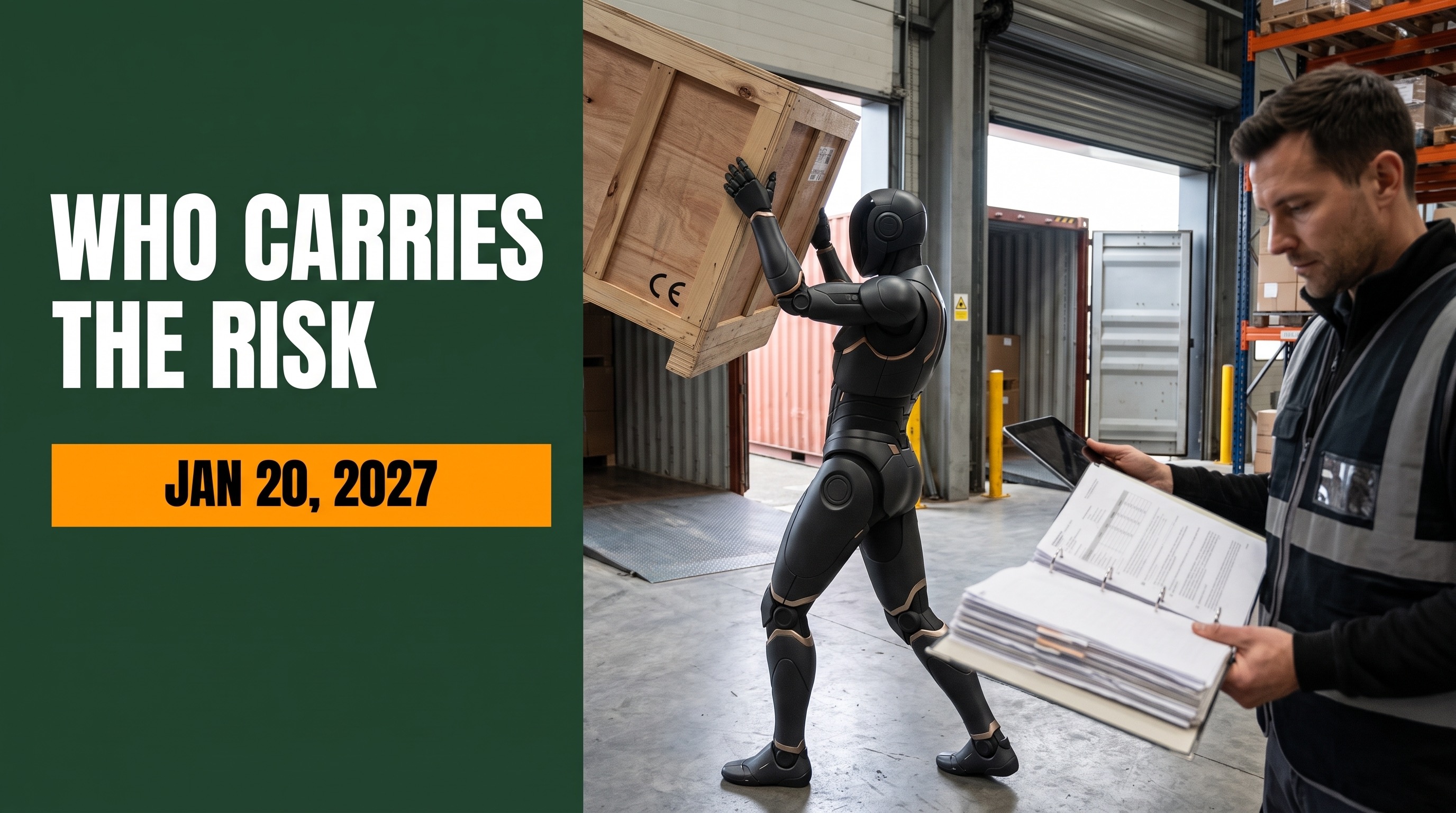 Symbolic image · AI-generated
On January 20, 2027, EU machinery law will change overnight. The Machinery Regulation (EU) 2023/1230 will replace the Machinery Directive 2006/42/EG without a transition period. It also applies to humanoid and four-legged robots, as there is no separate law for them. Anyone bringing products to market by January 19 will remain under the old law.
It will be expensive for a particular design approach. As soon as a safety function develops its behavior on its own, the manufacturer's self-assessment will no longer suffice; a notified body must review it, such as TÜV. Fixed programmed software, by contrast, remains excluded. This creates an incentive that runs counter to advertising: it can be cheaper to build the robot less intelligent precisely where it is marketed as particularly capable of learning.
This inspection obligation is the biggest change, and it has a loophole. Recital 55 excludes software that can neither learn nor further develop. A model that is trained at the factory and then frozen learns nothing more during operation; it only applies what was created in training. Under this interpretation, most of the humanoid robots currently offered do not fall under third-party inspection.
However, this interpretation is not entirely certain. The appendix only mentions approaches to machine learning and does not specify when learning occurs. This also makes the strict interpretation defensible, under which every ML-based safety component must be inspected. The industry association ZVEI has published guidance on this, and the Swiss standards commission NSBIV published an interpretation paper in October 2025. Harmonized standards on this question are lacking, as is case law.
The rest of the regulation is less contentious. It now requires protection against manipulation of control and safety logic. Software, digital components, and autonomous functions must be included in risk assessment, including after delivery whenever an update can change the device. Operating instructions can now be provided digitally, but on request must still be provided on paper.
Two additional deadlines apply to manufacturers and dealers. Starting December 9, 2026, the new Product Liability Directive (EU) 2024/2853 applies, under which software and updates are considered products. The EU AI Act, by contrast, has been defused for now because the Digital Omnibus Regulation (EU) 2026/1744 has postponed high-risk obligations for AI in regulated products to August 2, 2028.
For the buyer of a robot, the least changes. The regulation is directed at whoever brings a device to market, not at whoever uses it. What applies during operation remains governed by national occupational safety law. The changeover will be most noticeable in the documentation, in digital rather than printed instructions, and perhaps in the fact that an expected model appears later or not at all in the European catalog.
For the manufacturer, however, it is an architectural question and therefore strategic. If he keeps learning capabilities out of the safety circuit, he can stick with self-assessment and get to market faster. If he keeps them in, he needs a notified body, pays and waits, but can offer something the competition does not have. For models from Asia that previously came to Europe with self-certification, this is a bigger hurdle than any customs issue.
The risk lands in the middle. Whoever brings a device from China or Korea to Europe is usually the importer and thus bears the obligations of whoever makes the product available on the internal market. He must have the technical documentation, not just the brochure, and must be able to provide it throughout the device's lifetime.
The new product liability makes this situation even more stringent. In addition to the manufacturer, it also draws importers, authorized representatives, and under certain conditions dealers and platform operators into the liability chain. If a safety-relevant update is missing, this is no longer purely a manufacturer issue. Whoever sells without knowing how the device's safety functions are built and assessed is selling a risk along with it.
In Switzerland, distribution structure adds to this, because few humanoids are sold directly here. The official Ubtech distributor for Germany, Austria, and Switzerland has been with Terra Robotics in Löhne, Westphalia since late March, which also carries Unitree, Pudu, and Dobot. Whoever purchases there takes on the device's regulatory status.
The federal government has completely revised the Machinery Regulation (MaschV) and adopts EU rules by reference, including cybersecurity, machine learning, and notified body obligations for six machinery categories. The consultation period ended in December 2025. The agreement on mutual recognition remains open because the EU ties its update to ratification of the Switzerland-EU package. Until then, a Swiss provider for the EU market may need a notified body within the EU and an economic operator based there.
For practical purposes, two questions suffice for now. For every device with a delivery date after January 20, 2027, the Declaration of Conformity according to Regulation (EU) 2023/1230 belongs in the order documents before the machine arrives on site. And if a provider advertises learning capabilities, it is worth asking whether the safety functions are included and who has reviewed them. This classification does not replace legal advice, and anyone who wants to introduce or resell a specific model should consult a specialist.
This article was created with the support of artificial intelligence and editorially reviewed. The article image is an AI-generated symbolic image, not a press photo.