Humanoid robot for 8500 dollars per month: Agility shows the bill, and it has a catch
What a humanoid robot actually costs has been a well-kept industry secret until now, and Agility Robotics has revealed it: approximately 150,000 dollars in materials, 8,500 dollars rental per month. The catch lies in the order book, as the frequently cited 300 million dollars come from a single, affiliated customer.
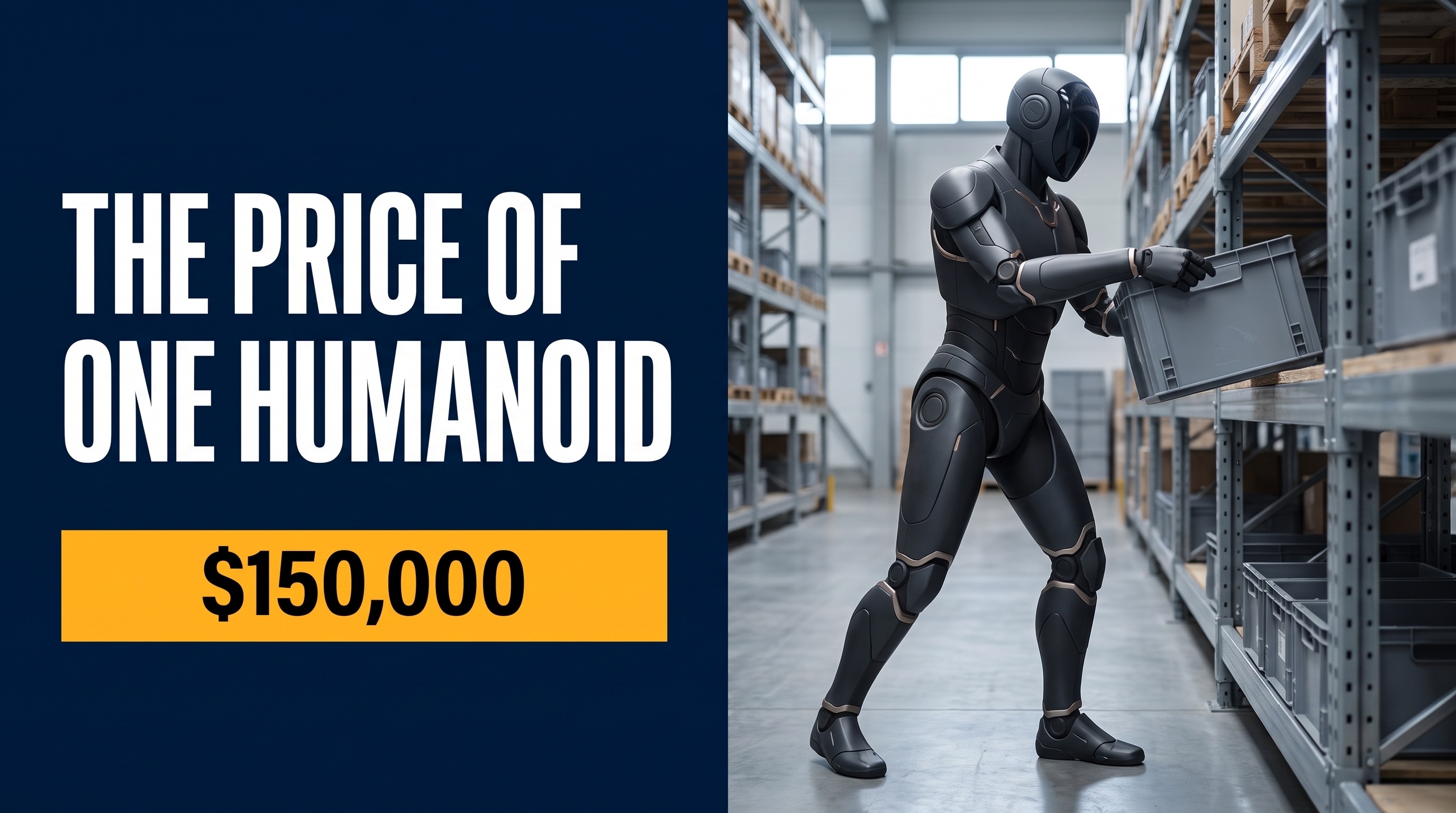 Symbolic image · AI-generated
What a humanoid robot actually costs has been a well-kept industry secret until now, and Agility Robotics revealed it on October 6 at its investor day. The materials in the Digit 5 amount to approximately 150,000 dollars, the machine is rented for about 8,500 dollars per month, and over five years it generates almost half a million.
No manufacturer has calculated this thoroughly before, but precisely because the numbers add up so cleanly, it's worth looking at the order book. The 300 million dollars for 1,000 robots come from a single customer, which the prospectus identifies as an affiliated party, and the order is released gradually, only when the robot masters another task.
The joints make up the largest line item on the bill of materials. Approximately a quarter of the material value goes to the cycloidal gearboxes that Agility developed itself, and that's exactly where the price should drop first, partly through a new in-house design, partly through cheaper standard parts from suppliers. Just under one-fifth of the planned reduction comes simply from volume discounts. At the end of this path stands 30,000 dollars in materials per robot, but only when 10,000 units are built annually.
Accordingly, the margin is closely tied to production volume. Chief Operating Officer Jen Hunter and Chief Financial Officer Michael Beer calculate approximately 50 percent product margin at launch and hardware that pays for itself in about eighteen months. With 1,000 units per year, 70 percent would already be possible, with 10,000 units even 75 percent, and amortization would then fall below six months.
This calculation assumes, however, that prices remain stable over the years, and it excludes the company behind the robot. For 2026, Agility plans 115 million dollars for research and another 60 million for administration, while 2025 saw revenues of only 1.78 million dollars and an operating loss of 140 million.
This gap is being closed through the stock market, as Agility is going public via a SPAC: Churchill Capital Corp XI, valued at 2.5 billion dollars, to be traded in the future under the ticker AGLT. Approximately 620 million dollars flow in, with a large portion from a private placement where Foxconn acts as anchor investor. The contract manufacturer has examined humanoid manufacturers according to three criteria, and only a few passed.
The company is now being considerably more cautious about timing than the prospectus suggested, which had stated a market launch at the end of 2026. The first devices are now to go to selected customers in the first half of 2027, and the Digit 5 should be generally available toward the end of 2027, with Sales Chief Daniel Diez already speaking of "end of 2027 and beginning of 2028."
Agility won't say who the major customer is, but Diez's description of "one of our most experienced Digit 4 users" significantly narrows the circle. In the Cheraw facility in South Carolina, a fourth-generation Digit has been pushing warehouse parts through the halls of Schaeffler for about 18 months, according to the supplier, well over a million pounds of material. The company has a dual interest in the development anyway, as it sells actuators worth about one billion euros annually and believes it can supply half of a humanoid's bill of materials. It has also ordered a thousand robots from Zurich-based provider Hexagon.
More revealing than the collaboration, however, is how cautiously Schaeffler is proceeding. The Digit still operates behind a safety barrier, and that should remain the case as long as the safety standard is not in place. While Agility lists ISO 25785-1 as approved in its own documentation, it has not been ratified, which means any operation that places such a device in its facility today must initially assume responsibility for the risk assessment itself.
For Swiss companies, the rental is ultimately the decisive factor. Just over 100,000 dollars annually is below what an industrial worker costs in two-shift operation here, making the comparison more favorable than in the USA, where observers calculate that the robot must replace about two and a half shifts daily to compete against conventional material handling technology. Assuming it runs, that is: based on 90 minutes of battery runtime and nine minutes of charging time, Agility promises more than 20 hours of availability per day. Over several months, no humanoid from any manufacturer has yet demonstrated this value.
How the company itself views the market was revealed in a casual remark by co-founder Jonathan Hurst, who when asked about competition named exactly one name: Boston Dynamics. Tesla didn't come up, nor did Figure, which suggests that Agility sorts the industry not by announcements but by operating hours, of which the Digit 4 has accumulated over 65,000 according to the company.
This article was created with the support of artificial intelligence and editorially reviewed. The article image is an AI-generated symbolic image, not a press photo.