Robot Training Data: Mecka Films People at Work and Earns More Than Robot Makers
Mecka AI raised 60 million dollars on October 7th, led by Sequoia, with Nvidia, Qualcomm and Samsung on board. The company doesn't build robots, but pays people to film themselves at work and sells the footage as training material. According to its own statements, it generates more revenue than the manufacturers it supplies.
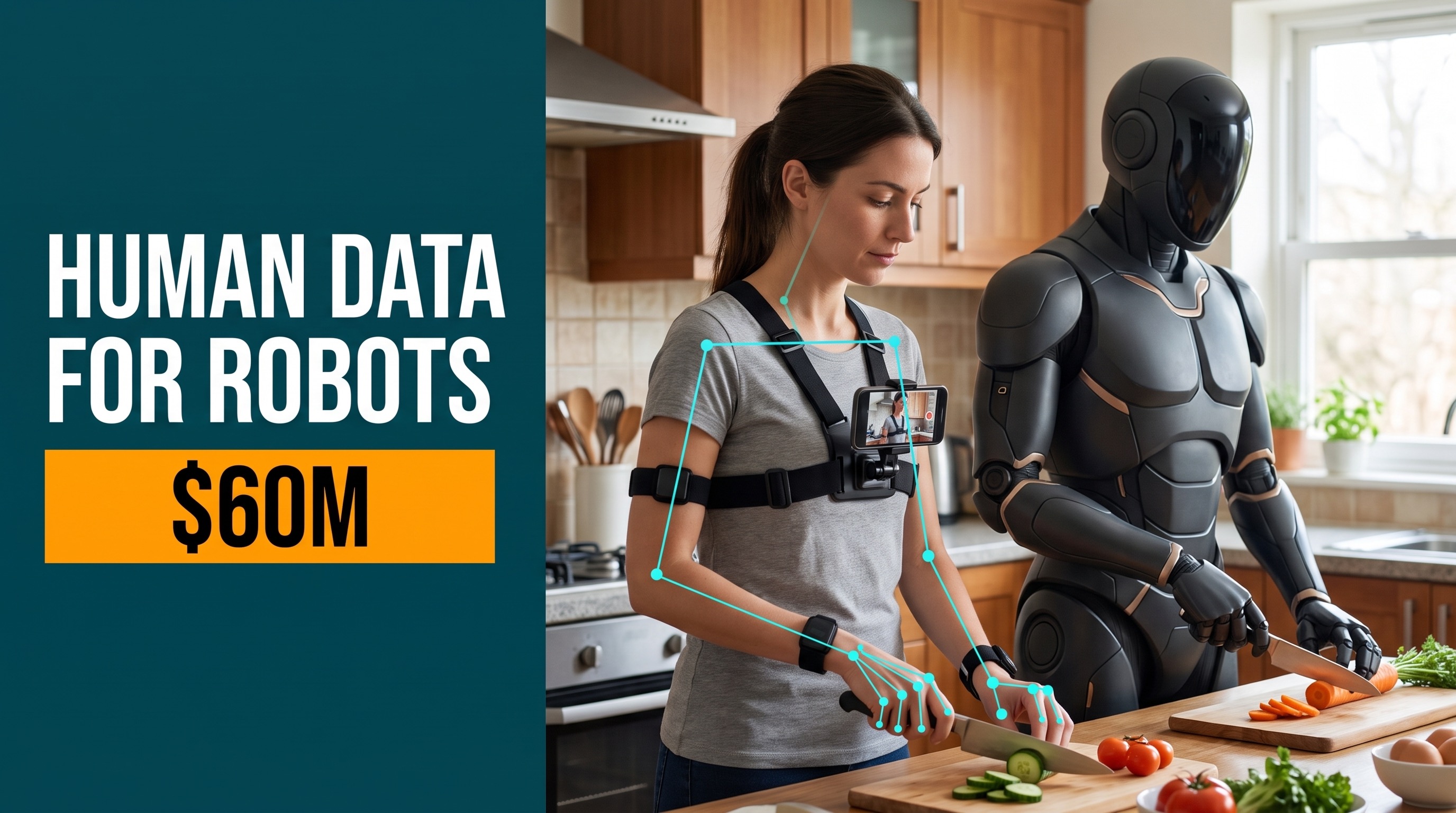 Symbolic image · AI-generated
Mecka AI raised 60 million dollars on October 7th, led by Sequoia, with Nvidia, Qualcomm, Samsung and Microsoft's M12 on board. The two-year-old company from Toronto and New York doesn't build robots. It pays people to film themselves at work and at home, and sells the footage as training material. According to its own statements, annualized revenue as of June exceeded 100 million dollars.
A data supplier thus generates more revenue than the robot makers it supplies: Agility Robotics, on its way to the Nasdaq, reported net revenue of 1.78 million dollars for 2025. What's striking is the raw material itself. Since Build AI posted around one million hours of egocentric videos openly online in April, mass-market material costs almost nothing.
What's being sold is the first-person perspective. Body sensors record hand movements, gait and posture, a smartphone films forward, recordings take place in apartments, restaurant kitchens, chemistry labs and metal workshops. An in-house lab then converts the flat video into three-dimensional spatial data. "Movement, contact, force and geometry aren't on the internet," the company writes. "You can't extract them, license them or buy them." That's exactly what the price is based on.
The dataset is called EgoVerse and has been available as an academic paper since April: 1,362 hours, 1,965 tasks, 2,087 people on camera, co-authored among others by researchers from ETH Zurich, Stanford and MIT. The same work provides the counterargument. The group measured the transition from human to machine in several labs and on different robot bodies. More human data helps, but only if it matches the robot's learning objective. A human hand has five fingers and tactile sensation, a robot gripper has two jaws.
That's the sore spot of the business. Build AI published 100,000 hours of recordings from 14,228 factory workers in December and another million hours in April, both for free. What remains expensive is teleoperation, where a human directly controls the target robot: 50 to 200 dollars per hour, because this data precisely matches the machine's body. Mecka sells the gap in between. How wide it remains is not decided by the company, but by model research.
For Switzerland, more is at stake than the distance might suggest. ETH Zurich is part of the dataset, and local robot makers need exactly this material: ANYbotics, Hexagon with the humanoid Aeon, Neura Robotics with its growing Zurich location. None of them operate their own recording fleet. Anyone wanting to build one would have to pay Swiss hourly rates and clarify what the revised data protection law permits when filming in private apartments and bystanders appear in the footage.
The logic behind it is uncomfortably simple. A humanoid is today hardware that can be ordered, available in China for a few tens of thousands of francs. What it can do depends on how many times someone has demonstrated something to it. That's why money flows to where this experience is created, not to whoever screws the joints together. Nvidia holds stakes at both ends, both in Figure and in Mecka.
This article was created with the support of artificial intelligence and editorially reviewed. The article image is an AI-generated symbolic image, not a press photo.