Galbot ET1 from 79,000 yuan: The humanoid robot gets cheap, the intelligence costs extra
Galbot is charging 79,000 yuan, around 9,800 francs, for its two-legged humanoid ET1. Learning by observation is only available in the mid-range version, for an additional 60,000 yuan. The motors come from Unitree, whose own robot is more expensive at nearly the same size.
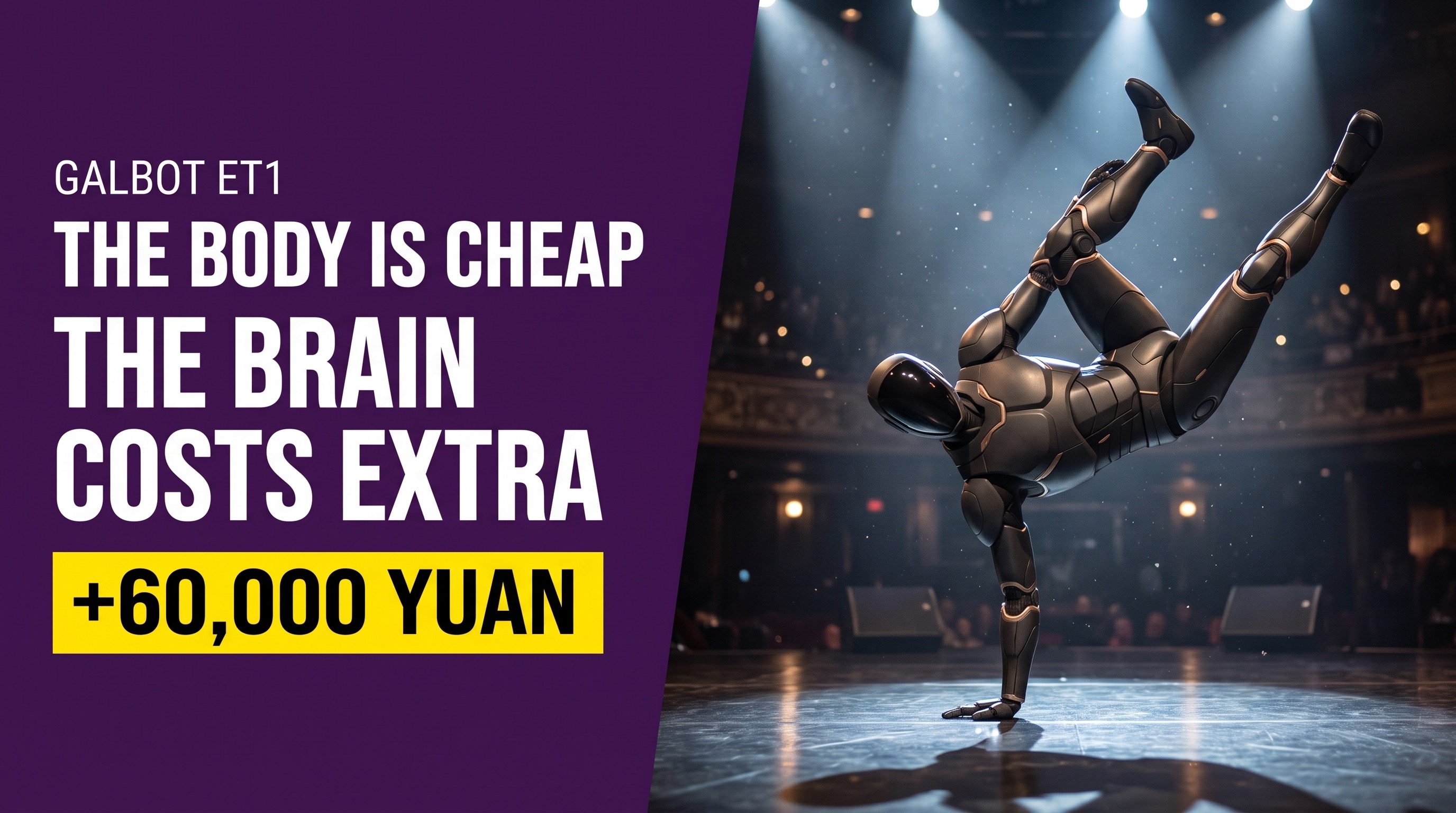 Symbolic image · AI-generated
Galbot announced the prices for its first two-legged humanoid on October 2. The ET1 costs 79,000 yuan, around 9,800 francs, in the standard version; the Pro and Flagship variants cost 17,200 and 22,200 francs respectively. The device is 1,250 millimeters tall, weighs 32 kilos with battery, and has 26 degrees of freedom. Every version can dance and speak. None can learn by observation.
This marks the first time a humanoid robot has openly separated intelligence on its price list. If you want the robot to watch a movement and immediately copy it, you pay an additional 60,000 yuan for a compute module. There's also a detail Galbot itself confirms: the motors come from Unitree, whose own G1 at nearly the same size starts at 13,500 dollars.
The standard version runs on a controller with RK3588 and RDK-X5 chips and sees via stereo cameras. Nothing more is needed for what it's supposed to do: play a choreographed routine and respond to voice commands. The Pro version gets an Orin Nano module with 40 TOPS, and only then does Galbot enable what impresses in the demo videos. The robot observes a dancer and adopts their movements in real-time operation, including figures where it balances on its hands. The Flagship version adds an NX module with 100 TOPS and opens the platform for custom development. Dexterous hands with twelve additional degrees of freedom are only available for Pro and Flagship anyway.
Behind this lies AstraBrain-WBC, a movement model with around a hundred million parameters. Galbot states it collected movement data totaling approximately one million hours for this, partly through high-precision recording in the lab, partly from internet videos converted to the robot's geometry. Classical motion capture is no longer needed during operation.
Galbot first showed the ET1 in August at the World Robot Conference in Beijing, where it performed alongside a human dancer. Pre-orders opened in early September; according to the manufacturer, over 200 reservations came in during the first 24 hours, more than a hundred of them via JD.com. The company was founded in May 2023 by Beijing-based academic researcher He Wang, has raised 980 million dollars to date, is valued at three billion, and is preparing for a Hong Kong IPO. Counterpoint Research ranks Galbot third worldwide for the first half of 2026, with just over 1,100 robots delivered and approximately five percent market share.
Anyone concluding from this that humanoid robots are now affordable hasn't read the product page to the end. Galbot explicitly does not sell the ET1 for household use or factory floors, but for theme parks, store entrances, stages, and comedy. A 32-kilo device with 26 joints and no hands included lifts nothing, carries nothing, and assembles nothing. What's become cheap is not the humanoid. What's become cheap is the demonstration robot. As recently as summer, estimated prices around 95,000 dollars for the ET1 circulated in databases because everyone suspected a work robot. The expectation missed by a factor of eight, and that says more about the expectation than the price.
QbitAI, which first reported the price list, places the base version between two camps. Companion robots for household use in China range from 20,000 to 30,000 yuan; professional humanoids from 120,000 to 200,000. Galbot targets exactly this gap, and until now nothing stood there.
For Swiss interested parties, the buy button on JD.com is currently worthless—it doesn't deliver here. What remains is the workaround through dealers and rental companies, and this market already exists: providers like Toneart carry Unitree G1 Event and H2 in their rental program; prices are available on request and depend on duration, transport, and operator accompaniment. If a comparable new device costs ten thousand francs, the rental suddenly makes completely different sense for a company attending a trade show twice a year. Add customs, VAT, and the question of compliance. A demo robot purchased in China comes without a European declaration of conformity, and whoever runs it at a booth with public traffic bears responsibility themselves. We've already calculated on robothub24 what a price tag on a Chinese product page can leave unsaid.
What becomes interesting is what Galbot does with the gap between Standard and Pro. Technically, the two versions are separated by a compute module that costs a fraction of 60,000 yuan to procure. What's being paid for, then, is not the board but access to a model. This is the point where robotics begins to calculate like the software industry, and Galbot is unlikely to be the last manufacturer to do the math this way.
This article was created with the support of artificial intelligence and editorially reviewed. The article image is an AI-generated symbolic image, not a press photo.