Physical AI 2026: Who builds robot intelligence, who discloses it, and what the numbers really say
Chinese manufacturers delivered nearly four-fifths of all humanoid robots in the first half of 2026 and publish the most open data in the industry. In the West, only those who don't sell robots disclose anything. An overview of pioneers, state of the art, and the question of which numbers to believe.
 Symbolic image · AI-generated
Chinese manufacturers delivered over 19,000 humanoid robots in the first half of 2026, 77.9 percent of global volume and a 432 percent increase, according to market researcher IDC on September 29. These same companies also release the industry's most open training data: AgiBot from Shanghai has released over a million recorded robot movements.
In the West, it's the opposite. Openness is essentially limited to those who don't sell robots at all. Hardware makers, from Tesla to Figure, remain silent on unit numbers, models, and failure rates. The pattern is familiar from language AI: whoever is ahead closes up, whoever is catching up opens up. But the most generous disclosure is of little use if its license prohibits any commercial use.
Physical AI, in other words embodied artificial intelligence, is an umbrella term for systems that don't produce text but act in the physical world. The term comes from Nvidia's marketing but describes an old problem. Honda showed with the P2 in 1996 the first biped robot that could walk independently without cables, and in 2000 its successor Asimo. Both moved impressively and could do almost nothing. Their movements were pre-programmed, and any unexpected situation threw them off balance. Honda discontinued the program in 2018.
The public low point came in June 2015 at the Robotics Challenge of the American research agency DARPA. Twenty-five teams had robots open doors, turn valves, and clear rubble, and the compilations of the stumbling machines went around the world. The Korean team KAIST won with eight points in 44 minutes. What mattered less was the falling than the reason: the robots failed not in mechanics but because they didn't understand their environment once it deviated from the script. And on the second day, none could get up on their own.
Why this took so long has a technical foundation. Walking works well with classical control engineering because the robot knows itself exactly and the world touches it only through a few brief foot contacts. Grasping breaks the model. Contact with an object is erratic, friction hard to predict, and the crucial physics belongs not to the known robot but to the unknown object. A shirt, a cable, or a half-full cup cannot be captured in a few state variables. This is exactly where the industry switched from programmed control to learning starting in 2022.
The chain of work that made this possible can be dated well. In December 2022, Google showed RT-1, a model that learned from 130,000 recorded episodes and achieved 97 percent on known tasks, 76 percent on unknown ones. In October 2023 came Open X-Embodiment, a shared dataset from 21 institutions across 34 labs with over a million movement sequences from 22 different robot types. That was the moment when robotics data was treated like internet data for the first time. Today's VLA models build on this, short for Vision-Language-Action, models that translate a camera image and a sentence into a movement. California startup Physical Intelligence led with pi0 in October 2024, Nvidia with GR00T N1 in March 2025.
A Swiss contribution stands squarely in this line. Nikita Rudin and colleagues at ETH Zurich showed in 2021 that thousands of simulated robots can be trained simultaneously on a single graphics card. Result: a usable walking motion in under four minutes, for rough terrain in twenty. The accompanying code named legged_gym became the foundation of Isaac Lab, the framework in which a large part of all robot learning procedures are trained today and which Nvidia developed jointly with ETH. Whoever does robotics in Zurich has been working in the toolkit of the American market leader for years.
The latest stage is called world models. This means software that calculates an environment including its physics such that a robot can practice in it before touching anything. Nvidia presented Cosmos in January 2025, Google presented Genie 3 in August 2025, and Fei-Fei Li, the Stanford researcher behind the ImageNet image dataset, brought the product Marble to market in November 2025 with her company World Labs. At the end of September 2026, AMD bought that company for 8.2 billion dollars. The practical benefit is threefold: the robot can safely play through failed attempts, training data can be obtained from internet videos, and new control can be tested without risking real hardware.
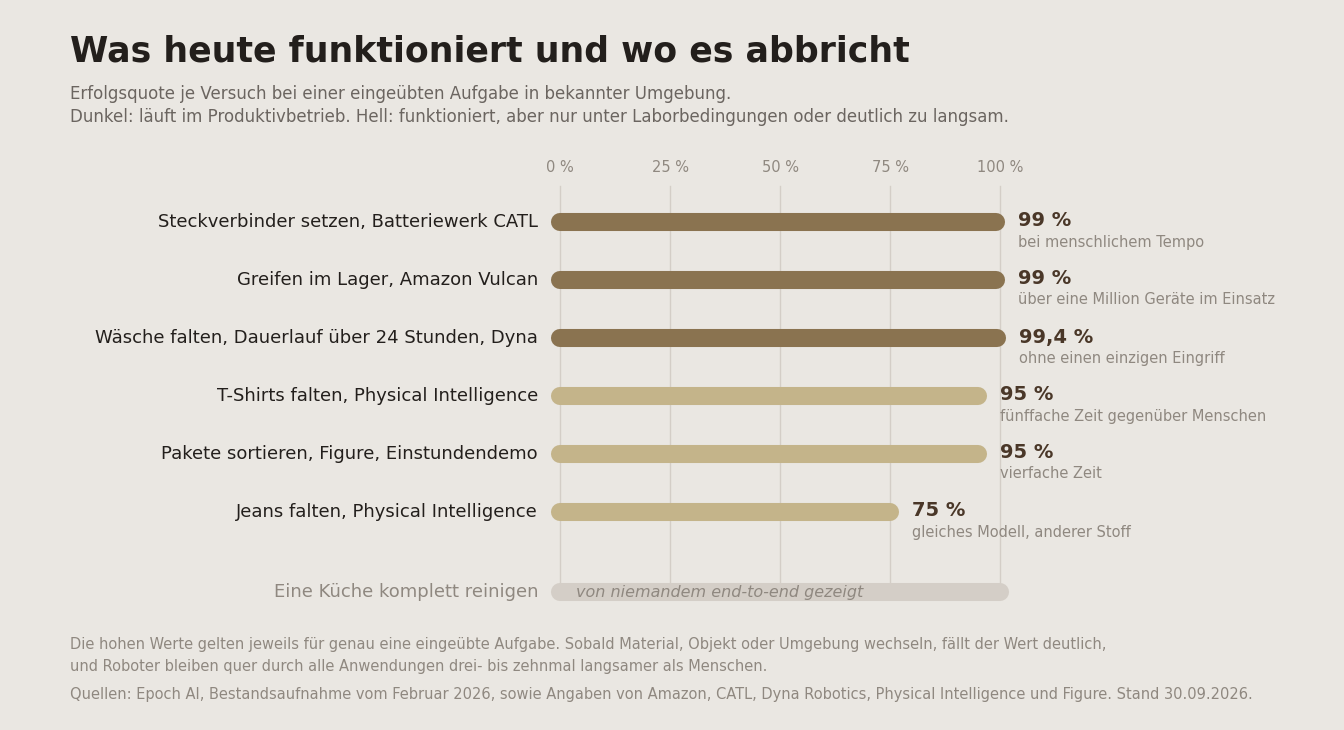
That leaves the question of what actually works today. The US research institute Epoch AI provided the best available inventory in February 2026, and it comes out divided. In narrow, repetitive tasks, the matter is decided: Amazon's grasping system Vulcan exceeds 99 percent reliability, battery maker CATL installs connectors at 99 percent at human pace, and a robot from company Dyna folded laundry over 24 hours with 99.4 percent success and without a single human intervention. As soon as the task varies, it breaks down. The same folding model achieves 95 percent with T-shirts and 75 percent with jeans. A shirt turned inside out takes twenty times longer than with a human. Cleaning an entire kitchen from start to finish is something no robot has yet demonstrated.
The reason for this gap is surprisingly simple and has nothing to do with computing power. Ken Goldberg, robotics professor at Berkeley, quantified the magnitude in August 2025 in Science Robotics: language models were trained on the equivalent of roughly 100,000 years of human reading time, the largest published robotics dataset corresponds to about one year. At current recording rates, it would take 100,000 years to assemble a robotics dataset the size of ChatGPT training. Epoch AI calculated that the largest grasping models are trained with roughly one percent of the computing power of top AI models. It's not chips that are lacking, it's experience. And in robotics, experience only emerges when someone moves a real machine.
This brings us to the power question. Data today comes essentially from three sources: teleoperation, meaning a person remotely controls the robot with a glove or data glasses, thereby recording every movement, simulation, and world models. Whoever has a large fleet in the field automatically collects more than whoever builds beautiful models. That explains why the industry map looks the way it does today.
China produces the volume. The Berlin China think tank MERICS counts around 12,800 built humanoids for 2025, roughly ninety percent of global production, and calculates that China controls 63 percent of global robotics component suppliers. This is driven by state money: a national lead fund of one trillion yuan, roughly 138 billion dollars, has been running since March 2025 for twenty years. In June 2026, the Ministry of Industry and Information Technology jointly with state-owned enterprise oversight instructed the deployment of over 10,000 humanoids into commercial operation by end of 2026, with implementation plans from provinces and progress reports in November.
The companies behind this vary greatly in size and honesty. Unitree, founded by Wang Xingxing, went public on the Shanghai exchange on August 19, 2026, closing the first trading day 460 percent above the IPO price. Revenue rose to 1.7 billion yuan in 2025. AgiBot, called Zhiyuan in China, built the 15,000th unit in June 2026 and is preparing a Hong Kong listing. UBTech from Shenzhen, already listed in Hong Kong, sold 921 full-size humanoids in the first half of 2026 and reports 590 million yuan in revenue, with a loss exceeding 300 million. XPeng, the automaker, raised over 900 million dollars for its robotics division in August 2026 and wants to be able to build over a thousand units per month by year end.
The US has the money and the most closed books. Figure was valued at 39 billion dollars in September 2025, Apptronik at roughly five in February 2026, Physical Intelligence at eleven over the course of 2026. Tesla has not disclosed a single production number for Optimus; early 2026 reports put it at several hundred units for learning purposes and not a single one working productively in a Tesla factory. Figure manufactured the one-thousandth robot in July 2026, the hardest number any American humanoid maker has voluntarily released. The only exception is Agility Robotics, and involuntarily: because the company is going to Nasdaq through a shell, numbers had to be included in the documents. There it states that the widely cited order backlog of over 300 million dollars comes from a single customer and is booked as a transaction with a related party.
Asia is meanwhile organizing itself by state. South Korea announced on August 27, 2026, that it will invest roughly 1.66 billion dollars by 2030 in a complete domestic value chain, including purchase commitments for 1,080 domestic humanoids. Japan finances its own base model for robots through the Ministry of Economy through 2030. Europe has money but not volume: Neura Robotics from Metzingen has relocated development of its humanoid to Zurich, Hexagon controls the AEON fleet for Schaeffler from Zurich, ANYbotics has delivered over two hundred of its four-legged inspection robots. These are respectable companies, but not factory-scale numbers.
And now the point that this is really about. Openness distributes itself in this industry in exactly the opposite way from what one would expect.
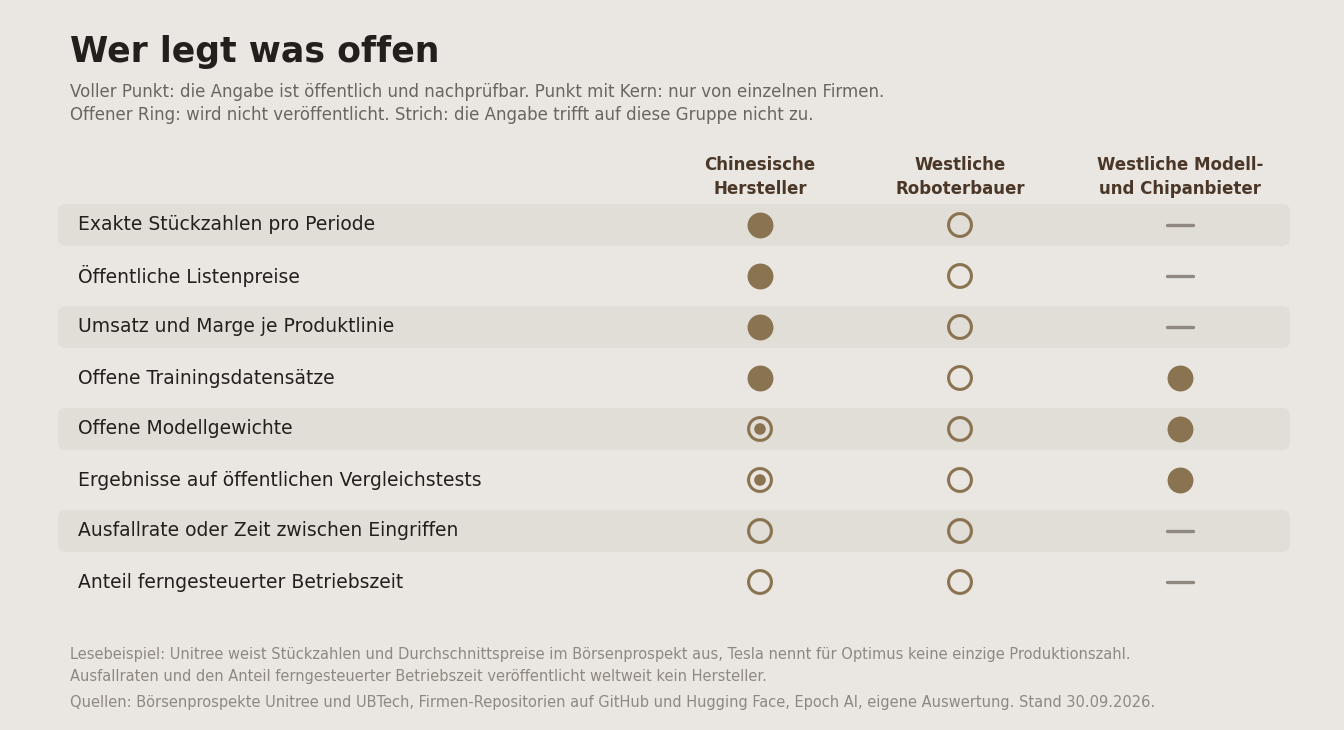
On the Chinese side, surprisingly much is open. AgiBot released over a million recorded movement sequences totaling roughly 44 terabytes through AgiBot World and published its model GO-1. The Beijing innovation center X-Humanoid released the RoboMIND dataset, 107,000 movements across four different robot types, containing 5,000 documented failed attempts with annotated causes. This is a transparency performance that no Western manufacturer delivers. Unitree makes its complete developer tools available on GitHub and released its own world model in September 2026. The Beijing academy BAAI publishes its RoboBrain model series even under the Apache license, which permits commercial use.
But right here lies the catch, and it's the single most practically important sentence for Swiss companies in this article. AgiBot's large dataset and model GO-1 are under a license called CC BY-NC-SA. The NC stands for non-commercial. Whoever builds a product with it that they want to sell violates the license. Nvidia's GR00T and the released models from Physical Intelligence, by contrast, are under Apache 2.0 and are commercially usable. The industry's most generous release is thus worthless for a company, the smaller one usable. Whoever reads a press release about open source and not the license file missed the crucial part.
In the West, openness sits almost entirely with those who don't sell robots. Nvidia releases models and simulation data because it sells chips and every open training layer increases demand for computing power. Hugging Face, the platform where AI models are shared, maintains LeRobot as an open library. Physical Intelligence released pi0 in February 2025, and pi0.5 in September thereafter. Then it stopped: the follow-up model from November 2025 was no longer published, nor was the one from April 2026, instead it's marketed as a cloud service. The same curve as OpenAI, just ten years later and faster.
Everyone else stays silent, and one even explains why. Elon Musk explained in April 2026 that the new Optimus would be shown only shortly before production launch because competitors take apart every publication frame by frame and copy it. Figure CEO Brett Adcock declined a live demonstration at an event in June 2025, saying it was a waste of time, and shows cut videos instead. The difference from the Chinese side is not a character difference but a regulatory one. Unitree publishes its numbers not from openness but because a Chinese stock prospectus demands this granularity.
What emerges is the most honest number this industry has ever produced, and it sits in Unitree's own prospectus: 73.6 percent of humanoid revenue for the first nine months of 2025 comes from research and education, and of the remainder booked as industry, 50 to 70 percent comes from facility tours. The global market leader thus sells its robots predominantly to universities and to companies that show them to visitors. American security researcher Samm Sacks put it perfectly in June 2026: Chinese humanoids have so far been more demonstrative than functional. The prospectus proves it with numbers.
The parallel to the language AI market is thus nearly complete. It tipped in January 2025 when the Chinese lab DeepSeek published its R1 model under a free license. Today, according to Hugging Face, 41 percent of all downloads on the platform come from China, and Alibaba's Qwen model series has over 151,000 derived versions, nearly five times Meta's Llama. With open models, Chinese labs lead, with closed top models the West leads. Research institute Epoch AI has quantified the gap since January 2026 at an average of four months. Mark Zuckerberg wrote the logic himself in 2024: selling model access is not Meta's business model, so releasing it costs nothing and creates an ecosystem. AgiBot argues in exactly the same words, just with different trenches: not the data is the advantage, but the manufacturing.
But the parallel breaks at four points, and that's the part most analyses leave out. First, model weights without matching hardware are of little use. Google's Gemini Robotics 2 achieved between 32 and 92 percent success in July 2026 on the same robot body, depending on which hand was installed. Not the model is the bottleneck, but the hand. Second, the real divide is the supply chain, and there China holds 63 percent of suppliers according to Morgan Stanley's assessment and roughly 90 percent of rare earth processing. This cannot be shifted by opening or closing software. Third, a robot has unit costs, a language model does not; a copied file is free, a robot hand is not. And fourth, there's a machinery directive. The safety standard ISO 25785-1, which for the first time is to capture actively balancing machines like humanoids, has to this day not been adopted.
That leaves the one metric both sides keep secret, and it's precisely what a buyer would need. Throughout the research for this article, not a single MTBF value published by any humanoid manufacturer could be found globally—that's mean time between failures—nor an MTBI value, mean time between human interventions. No manufacturer discloses what fraction of shown operating time was remotely controlled. Agility publishes over 65,000 cumulative operating hours but no error rate. Figure's much-cited run in May 2026 is cited with 50, 81, or 100,000 packages depending on source and was a self-organized livestream without independent oversight. At Tesla, Musk himself acknowledged that the well-known shirt-folding video was not autonomous at all, and at the We, Robot event in October 2024, robots were remotely controlled without Tesla making this clear. At 1X in Norway, the Wall Street Journal found in October 2025 that most shown tasks were controlled by a human with data glasses.
For Swiss companies, this yields five useful test questions. First: read the license file, not the press release, because NC means the software cannot be used for a product. Second, demand results on a public benchmark; such measurement series exist under names like LIBERO, RoboArena, or RoboChallenge, and the fact that not a single large humanoid manufacturer submits results there is itself a statement. Third, accept operating hours only together with error statistics; otherwise the number is marketing. Fourth, insist on a demonstration with your own objects in your own spaces rather than a video. And fifth, check the legal situation: the American regulatory authority FCC prohibited the import of new foreign humanoids and quadrupeds on July 29, 2026, in part because a backdoor was found in Unitree robots through which data went to Chinese servers. This ban does not apply in Switzerland, so you can buy here what an American company can no longer sell. Article 7 of the Chinese intelligence law, which requires every Chinese company to cooperate, still applies, and a machine with cameras and microphones in your own factory floor is not a minor matter.
Where it goes depends on a single open question. If world models remain open, the training layer becomes public good and competition shifts entirely to mechanics, hands, and supply chain. If they close, the same dependency emerges as with language models, only with machines in the hall instead of a programming interface. AMD now has the means with its purchase of World Labs and has not yet decided. For everyone else, a simple standard applies in the meantime: whoever names a number you can verify deserves attention. Whoever shows a video deserves a question.
This article was created with the support of artificial intelligence and editorially reviewed. The article image is an AI-generated symbolic image, not a press photo.