Humanoid robots on the front line: Ukraine sets a six-month deadline
Humanoid robots are to fight on the front line within six months: Former Defence Minister Fedorow announced this deadline on September 26 in Lviv. However, the launch video of the «Army of Robots» does not show a single real machine; all devices are AI renderings. Three weeks earlier, UN talks on autonomous weapons systems in Geneva ended without a binding agreement.
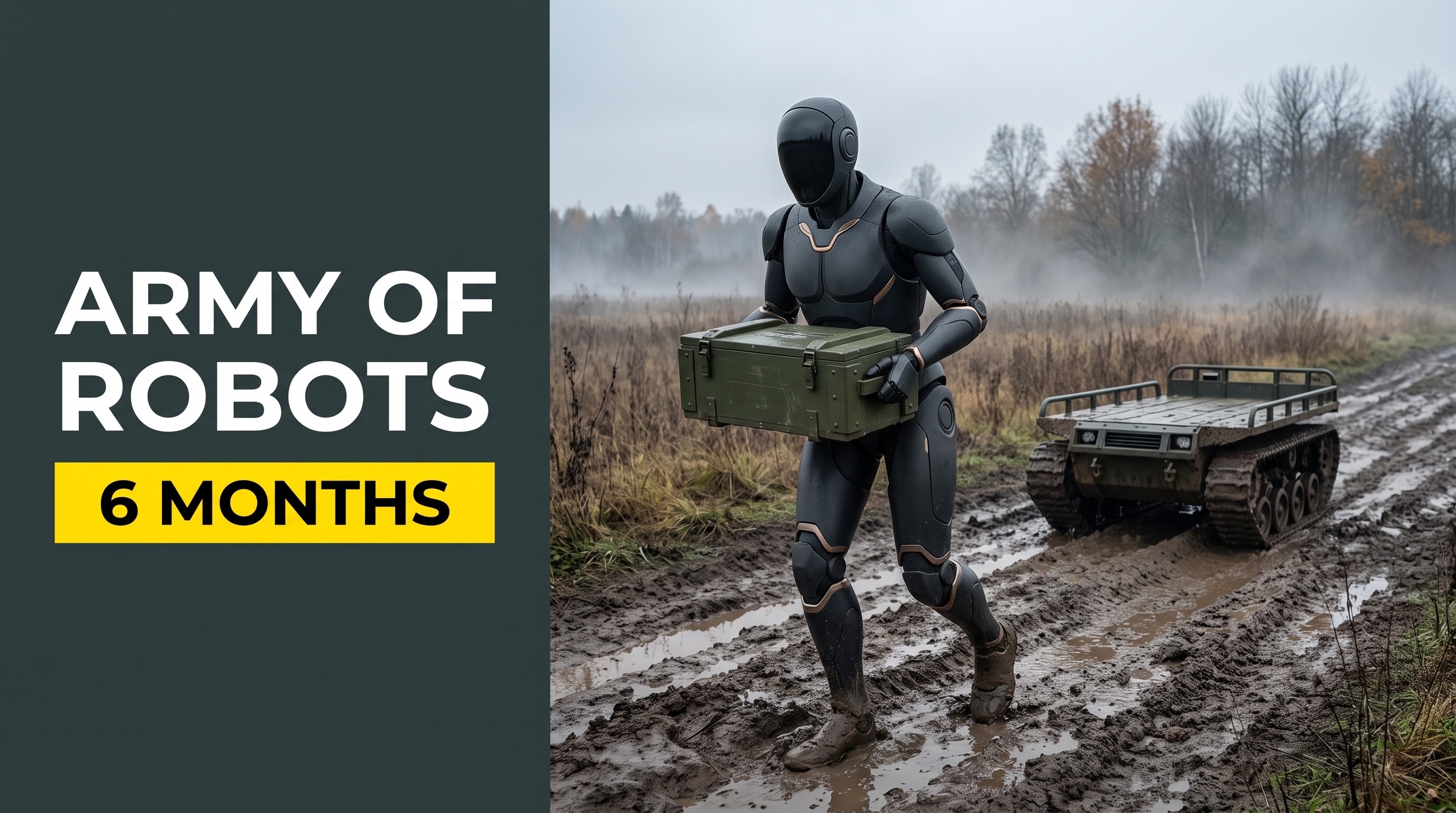 Symbolic image · AI-generated
On September 26 at the IT Arena in Lviv, Mychajlo Fedorow proclaimed the «Army of Robots» and immediately set a deadline: within six months, a humanoid robot should kill the first Russian soldier; within twelve months, a position should be taken without a single infantryman. However, the launch video does not show a single real machine. The humanoid with number 0427, the four-legged robots, the tracked vehicle: all AI renderings.
Fedorow was Defence Minister until July and launched the «Army of Drones» in 2022, from which over 700 manufacturers emerged. For this reason, the industry takes his deadlines seriously. Three weeks earlier, UN talks on autonomous weapons systems ended in Geneva without a binding agreement.
The actual track record of Ukrainian ground robots reads more soberly, yet it is still remarkable. From January to early September, unmanned ground vehicles completed around 112,000 operations, recorded via the DELTA situation system and published by the Defence Ministry on September 7. In January it was 7,511, in August 25,143—more than three times as many. The lion's share is logistics and casualty evacuation: ammunition forward, injured back, on routes where a vehicle with personnel on board is detected by a drone within minutes. Armed variants are in use, such as the Droid TW-12.7 with heavy machine gun. What never appears in this statistic is a walking humanoid.
That legs are precisely what is missing has little to do with software. Anyone wanting to move twenty kilograms of ammunition across waterlogged fields, through shell craters and over mined dirt roads opts for tracks or wheels, because they simply work and because an overturned device stays on the ground. There is also the radio link. Everything is jammed on this front, and a biped that maintains its balance over a data connection falls at the first signal loss. These are precisely the reasons why civilian manufacturers like Hexagon or Wandercraft also put their humanoids on wheels. In Ukraine, there is the additional factor that ground robots are calculated as consumables. A device for 3,000 dollars that can manage three missions is superior to one for 80,000 that would need to complete thirty to break even.
The «Army of Robots» is therefore not a device, but a structure. Fedorow describes an ecosystem: stakes in defence-tech firms, in-house development, testing with units at the front, rapid procurement of what proves effective. The search is on for engineers, companies, co-investors and a technical director. The money comes from a fund he announced in the USA in August; in early September, Palantir CEO Alex Karp was named as the first lead investor of his own defence-tech company. This includes TrophyLab, since June a kind of workshop where captured Russian technology is disassembled and reverse-engineered. The «Army of Drones» also began in 2022 as a slogan with a donation account. Today, according to Ukrainian figures, over 95 percent of hits are attributable to drones.
The deadline Fedorow has set falls into a regulatory gap, and this gap was cemented in Geneva this month. On September 4, expert talks within the framework of the UN weapons convention concluded with a final report that at least defines autonomous weapons systems and states that human control must remain. None of it is binding. In the final round, the USA and Russia deleted references to the development and design of such systems and narrowed the text to international humanitarian law. The deadline set by UN Secretary-General Guterres to have a treaty by 2026 has thus expired. 76 countries want to force formal negotiations at the review conference in November.
For Switzerland, this is more than hosting diplomacy. Geneva is where talks about these weapons have been taking place for over a decade, and Switzerland, which sees itself as a guardian of international humanitarian law, has consistently rejected an outright ban and instead relied on rules. You can consider that realistic or convenient. What is certain is that the era in which a ban could come before the technology is now ending.
And then there is the supply chain, which hardly anyone likes to look at. Swiss companies are not permitted to sell war material to a country involved in an armed conflict; a local supplier wanting to serve the Ukrainian robotics scene would not get past this licensing hurdle. Yet ground robots consist largely of components that no one classifies as war material: small motors, low-backlash gearboxes, encoders, camera modules, power electronics. In May, Vladyslav Vlasiuk, advisor to the Ukrainian president, accused Switzerland of nine out of ten Russian drones containing components of Swiss origin, and named five companies through which around 30,000 deliveries of war-critical goods reached Russia. Seco responded that these were often industrial products for civilian use. That is even true. It is the same parts list that allows a humanoid to lift a crate.
Whether a two-legged robot actually stands on the front line in six months will largely depend on how generously one interprets the term. A remotely controlled torso on a tracked chassis with two arms already half fulfils the announcement, and the pictures write themselves. What is remarkable, however, is less the deadline than the signal to an industry that has thus far sold its machines in warehouses and auto plants: there is now a second market, one that pays faster, demands fewer certifications and does not wait five years for a standard.
This article was created with the support of artificial intelligence and editorially reviewed. The article image is an AI-generated symbolic image, not a press photo.