Humanoid Robots in Europe and Switzerland: 7,000 Units Sold and Considerable Restraint
Globally, around 7,000 humanoid robots were sold in 2025, compared to 542,000 industrial robots. Europe does not appear in the statistics as a separate category. Anyone buying in Switzerland today prefers to lease, and forecasts for 2035 differ by a factor of fourteen.
 Symbolic image · AI-generated
The International Federation of Robotics presented its annual survey this week, and it contains a figure that puts the entire hype into perspective: globally, around 7,000 humanoid robots were sold in 2025 for industrial and professional applications. In the same period, approximately 542,000 classic industrial robots and 199,000 professional service robots were sold. A factor of 77.
Europe does not appear in this statistic as a separate category because the volumes are too small. Neither does Switzerland. What exists here are individual, well-documented decisions: four transport robots for Zurich's City Hospital starting in 2027, a delivery robot in a field test with Post and Migros, a care robot in a Thurgau rehabilitation clinic. Not a single one of them is a humanoid.
Anyone building humanoids in Europe today can be counted on two hands, and the money is flowing nonetheless. Neura Robotics from Metzingen raised up to 1.4 billion dollars in June at a valuation of around seven billion and relocated the entire development of the Model 4NE1 to Zurich's Seefeld in December. Around 1,400 people work for the company, with manufacturing remaining in Germany. British Humanoid raised 152 million dollars in July at a 1.35 billion valuation. French Wandercraft, previously known for exoskeletons, has a contract with Renault for 350 units of its headless Calvin-40 by 2027 and counts twelve signed customers. And Hexagon, headquartered in Zurich, agreed with Schaeffler in April to deploy at least 1,000 AEON humanoids in its factories by 2032. The first productive application, automated parts inspection, is scheduled to launch at the end of this year. The fact that Calvin-40 has no head and AEON operates on wheels doesn't change the classification: the IFR counts as humanoid anything built in a human-like manner and works autonomously in an environment designed for humans. Legs are not required.
These are the big names. Behind them comes a second tier: Agile Robots from Munich with around 3,200 employees, Oversonic and Generative Bionics from Italy, PAL Robotics from Barcelona, which has been selling research platforms for over twenty years, Norwegian 1X, which offers its household robot Neo for 20,000 dollars or 499 dollars per month and has largely shifted production to the USA. According to Dealroom data, 8.7 billion dollars flowed into humanoid startups globally in 2026 so far—double the entire previous year. Of total robotics venture capital, around 14 percent lands in Europe, 52 percent in the USA, 28 percent in China according to industry surveys.
The Swiss side looks different than one might expect. No humanoids are built here, but specialists are. ANYbotics in Zurich has delivered over 200 of its four-legged inspection robots and raised more than 127 million euros, but its customer list reads like a directory of foreign energy companies: bp, Equinor, Eni, Petrobras, Siemens Energy. Mimic Robotics, an ETH spinoff with 25 people, builds robot hands and the corresponding models and closed a seed round of 16 million dollars in November. RIVR, formerly Swiss-Mile, was acquired by Amazon in March. The pattern is clear: Switzerland produces technology and sells it abroad, or sells the entire company.
Anyone buying here buys small and calculates carefully. After a pilot trial, Zurich City Hospital decided in June to permanently introduce four autonomous transport robots, operational from 2027, for CHF 303,000 per year. The contract structure is telling: leased, not purchased, explicitly to remain technologically flexible. Post and Migros Online ran a RIVR robot delivering groceries in Regensdorf until September 2025, up to 60 kilos, stair-climbing; no decision on rollout has been made to date. Zihlschlacht rehabilitation clinic has been using care robots Lio and Lia from F&P Robotics for years, starter kit CHF 140,000. And in dairy farming, where the calculation has worked for decades, around 3,000 milking robots are now in operation.
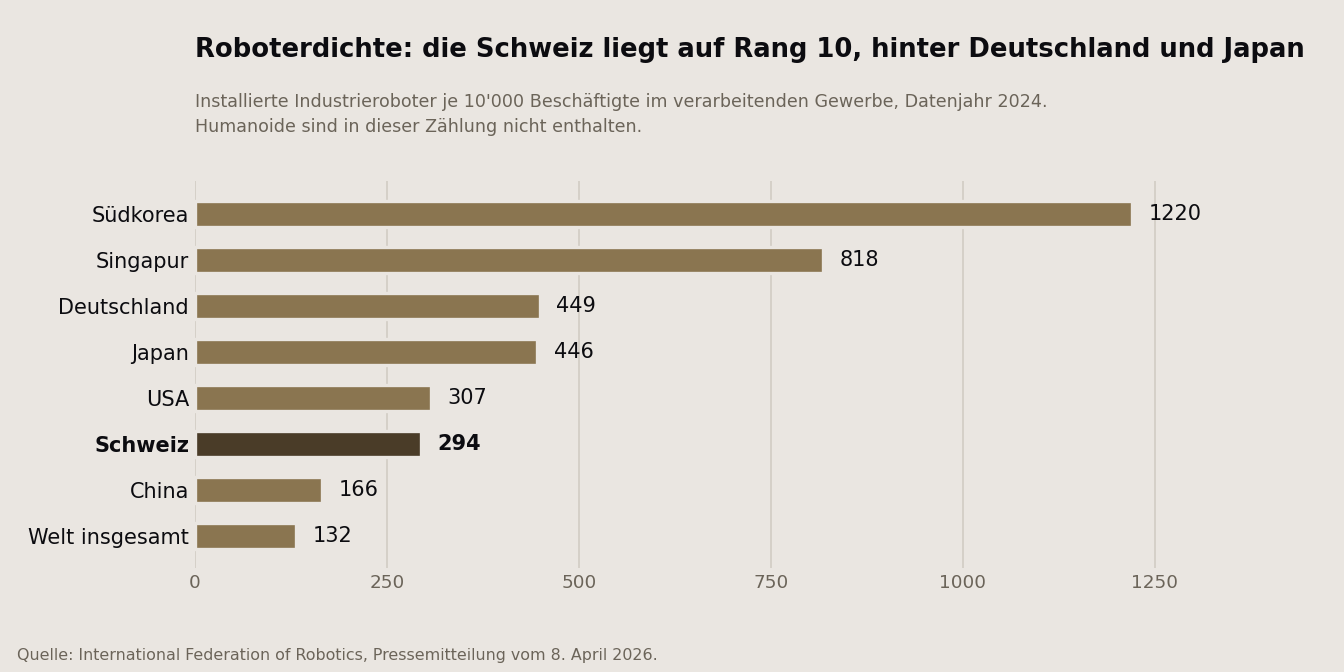
The restraint has concrete reasons, and the first is legal. The EU Machinery Regulation becomes binding from January 20, 2027, and for the first time it covers safety-relevant software as its own subject of examination. Yet there is still no applicable safety standard for a moving robot. The revised ISO 10218 from 2025 explicitly presumes a machine that cannot tip over. The standard that should regulate exactly that, ISO 25785-1, is a Committee Draft; the comment period ended in July, with publication expected no earlier than 2027. The high-risk obligations of the AI Act for machine-integrated AI were postponed from May to August 2028. A Swiss or German buyer placing an order in 2027 is thus procuring into a regulatory framework that won't be complete until after that. The fact that RIVR had to stop its test robots in 2025 in Zurich because authorities classified them as road vehicles is the Swiss variant of the same problem.
The second reason is that operating data are missing. The world's best-documented pilot project, Figure at BMW in Spartanburg, reached around 1,250 operating hours in eleven months. That's less than six hours per working day. Agility reaches over 65,000 operating hours across nine locations at GXO and reports 98 percent accuracy, which is respectable, but also means that on every fiftieth grasp someone has to check. No manufacturer publishes an MTBF value, the standard metric for failure intervals. Anyone who has to justify an investment over five years simply won't get the numbers for it. This fits with a look at the books: Agility Robotics posted revenue of 1.8 million dollars for 2025 with 140 million in operating loss, and the much-cited order backlog of 300 million comes from a single customer.
That leaves the question of when things will tip. The honest answer is that no one knows, and the forecasts tell you more about their authors than about the market.
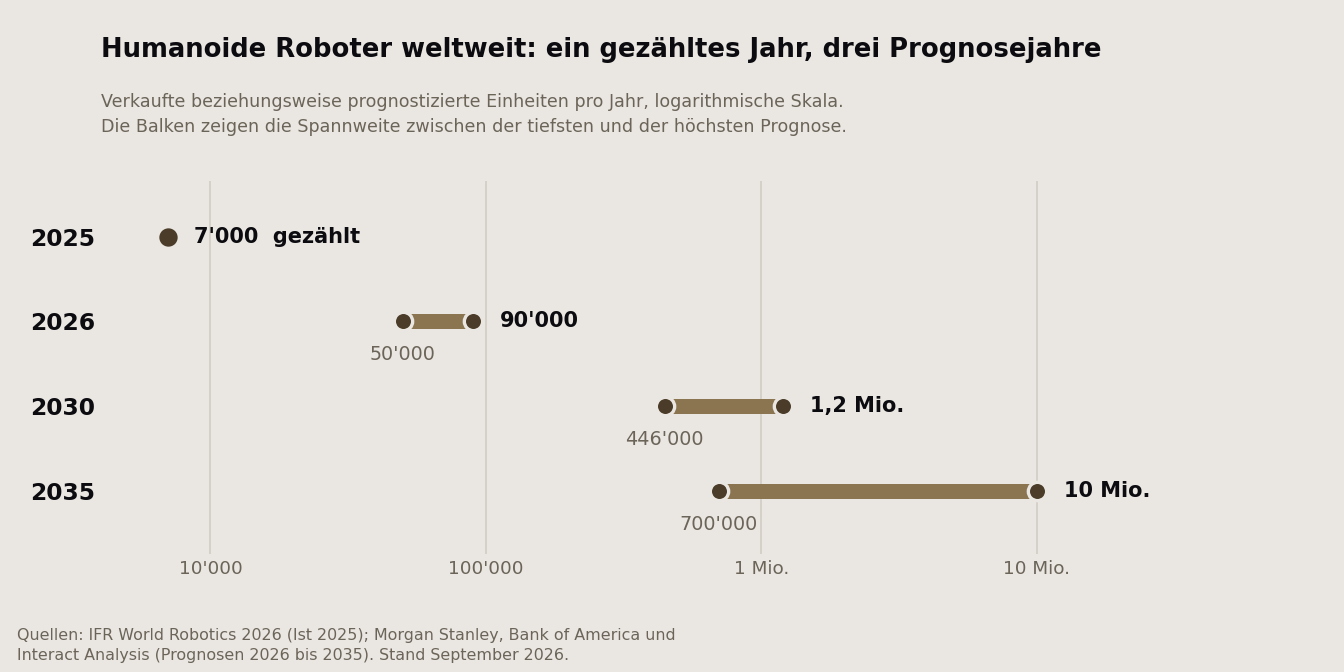
Bank of America dates the beginning of mass adoption to 2028 and bases this on demographics: you don't need a perfect robot, but one that shows up, doesn't quit, and costs less. Interact Analysis names 2032 and ties it to four conditions, including explicitly clearer regulation and useful efficiency levels. Morgan Stanley expects slow adoption until the mid-2030s and acceleration only after that. Between these three houses lie four to twelve years. The price trajectory is somewhat more concrete: IDTechEx expects the average price to decline from around 114,700 dollars in 2024 to about 37,000 by 2030 and calculates that an acquisition can pay for itself in six months with high utilization, with medium utilization in fifteen months. The decisive variable is not the purchase price but the utilization rate, and precisely that a company cannot credibly estimate beforehand.
For Swiss companies, this leads to something uncomfortable. In all major forecasts, Europe does not appear as an independent demand market; Interact Analysis sees over 65 percent of actually deployed units in China for 2035, the USA clearly behind. Anyone who waits until the standard is there and operating data are public will eventually buy mature equipment but will have neither experience nor negotiating power. Anyone who buys now pays tuition for a technology whose approval framework is not yet in place. The middle option, which several companies in Zurich are currently running, is by far the most sensible: lease a device, measure for a year, generate your own data that no one else will disclose.
This article was created with the support of artificial intelligence and editorially reviewed. The article image is an AI-generated symbolic image, not a press photo.