22 Joints, $6,500: Unitree Makes the Robot Hand Mainstream
Since September 22, Unitree has been selling a robot hand with 22 powered joints starting at $6,500; a pair costs around $13,000. The hand is considered the bottleneck of humanoids, and corresponding research models have so far only been available on request. However, important specifications are missing, and there is a company based in Zurich that is doing exactly the opposite.
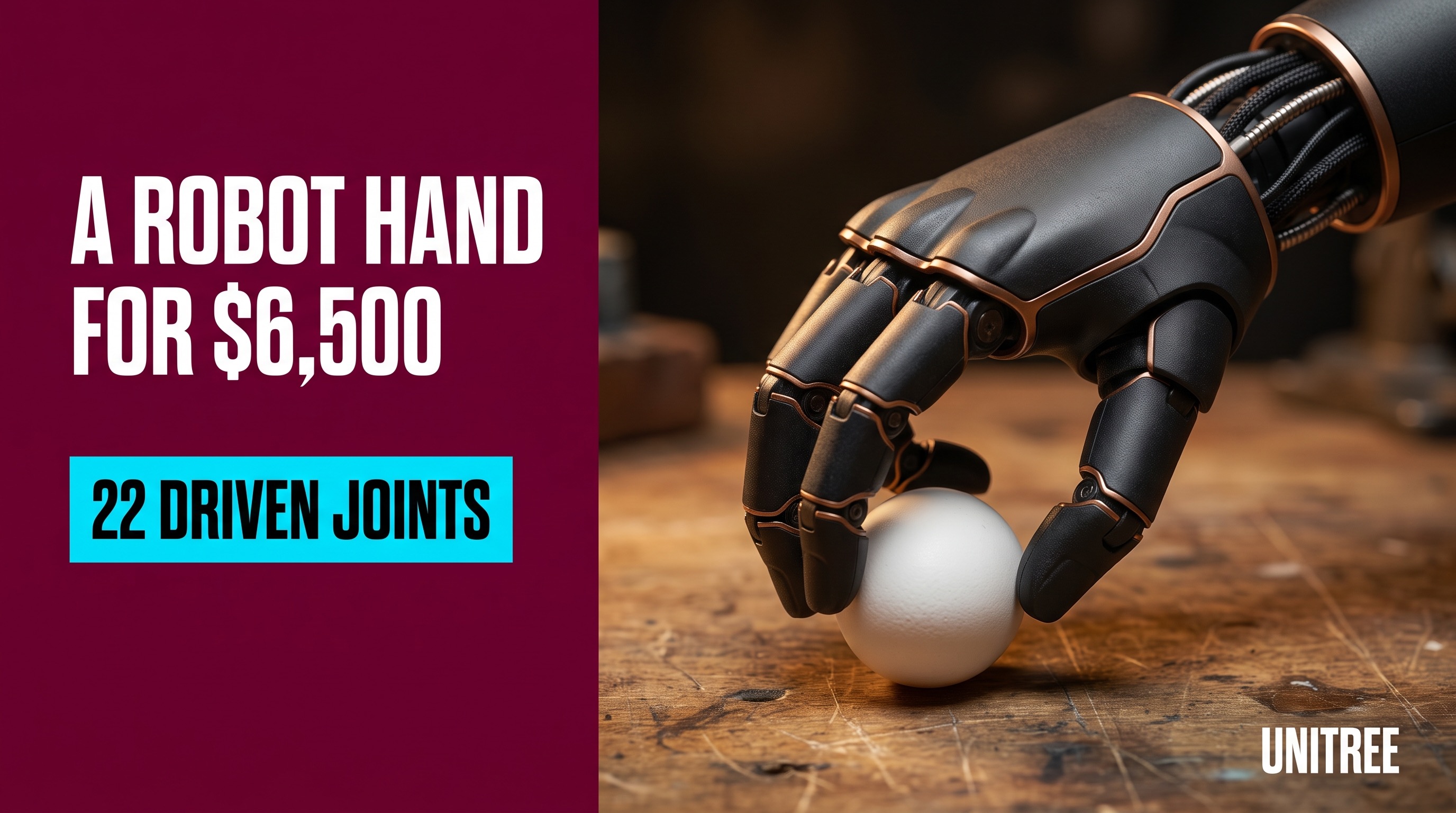 Symbolic image · AI-generated
On September 22, Unitree presented a hand with 22 joints, the size of a human hand, priced from $6,500. In the Dex5-S, all 22 joints are powered; each can be moved from the outside, and each has its own stop against torque spikes when colliding. A pair costs around $13,000, not including taxes and shipping.
The hand is the bottleneck of humanoids. They can walk now, but barely grasp. Research hands with similar mobility have existed for years, but only on request and at prices no startup pays twice. What makes this controversial is therefore less the technology than the message behind it: Unitree is setting the price before this market has even really emerged.
The leap over its predecessor is smaller than the number suggests, and that's precisely what's interesting. The Dex5-1 had twenty degrees of freedom, sixteen of them powered and four passive, weighed about one kilogram, achieved around one millimeter repeatability at the fingertip and up to ten Newtons of grip force, and the fingers could be deflected sideways by about twenty degrees. Those who wanted it could order up to 94 tactile points across the fingers and palm. The S now powers all 22 joints. Back-drivable means that a person can simply push the fingers without breaking anything, and the motor feels how much force is being applied. Without this property, neither clean grasping nor learning from demonstrated movements is possible, and both are why such hands are in demand right now.
What Unitree doesn't say is equally revealing. Whether the S uses the tactile sensing of its predecessor is not stated anywhere. Force and speed values are missing, as is a delivery date. The $6,500 is an entry price for the hand alone, not for a functioning system of hand, control, sensors, and the software that makes it capable. Anyone who has run a robot hand continuously knows the real equation: fingers constantly collide, gearboxes and tendons wear out, and a replacement finger after three months ends up mattering more than the catalog price.
Still, the number shifts something. The most well-known research hand comes from Shadow Robotics in London and has always been sold only on request, which in this industry is rarely a good sign for the price. California-based startup SharpaWave keeps pace technically with 22 individually powered joints. But Unitree is now in a class where a university orders two hands from the department budget instead of writing a proposal. That has a say in what hardware the next generation of grasping software is developed on, and thus in the long term also in whose hand it supports.
There is a company in Zurich that should be watching this development closely. Mimic Robotics, founded as an ETH spinoff in 2024 and now around 25 people strong, builds its own robot hands and the models that control them. Training happens with recordings of real hand movements, taken from experienced workers in running factories. In November, the company raised $16 million led by Elaia, with pilot projects running at major manufacturers. In pure hardware price, no one in Zurich wins against Hangzhou, and they know that there. The bet is that dexterity can sell as a skill, even if the hand underneath becomes cheap. Whether this calculation works, the electronics industry has answered several times before, and not always in Europe's favor.
For Swiss labs and development departments, this is good news in the short term. A hand for $6,500 makes experiments possible that previously failed at procurement. Just two weeks ago, a Zurich lab made a commercial Chinese robot hand run on its own fingers without touching the hardware. The mechanics came from China, the capability from Zurich. This division of labor works as long as someone consciously chooses it. It only becomes uncomfortable when it eventually becomes the only option.
This article was created with the support of artificial intelligence and editorially reviewed. The article image is an AI-generated symbolic image, not a press photo.