21 of 25 Falls Self-Rescued: At ETH, a Robot Hand Learns to Walk on Its Fingers
The Soft Robotics Lab at ETH Zurich is teaching a commercially available robot hand to walk on its fingers, right itself after falls, and press buttons. The hand from Chinese manufacturer Wuji remains unchanged; the new capability lies entirely in the software.
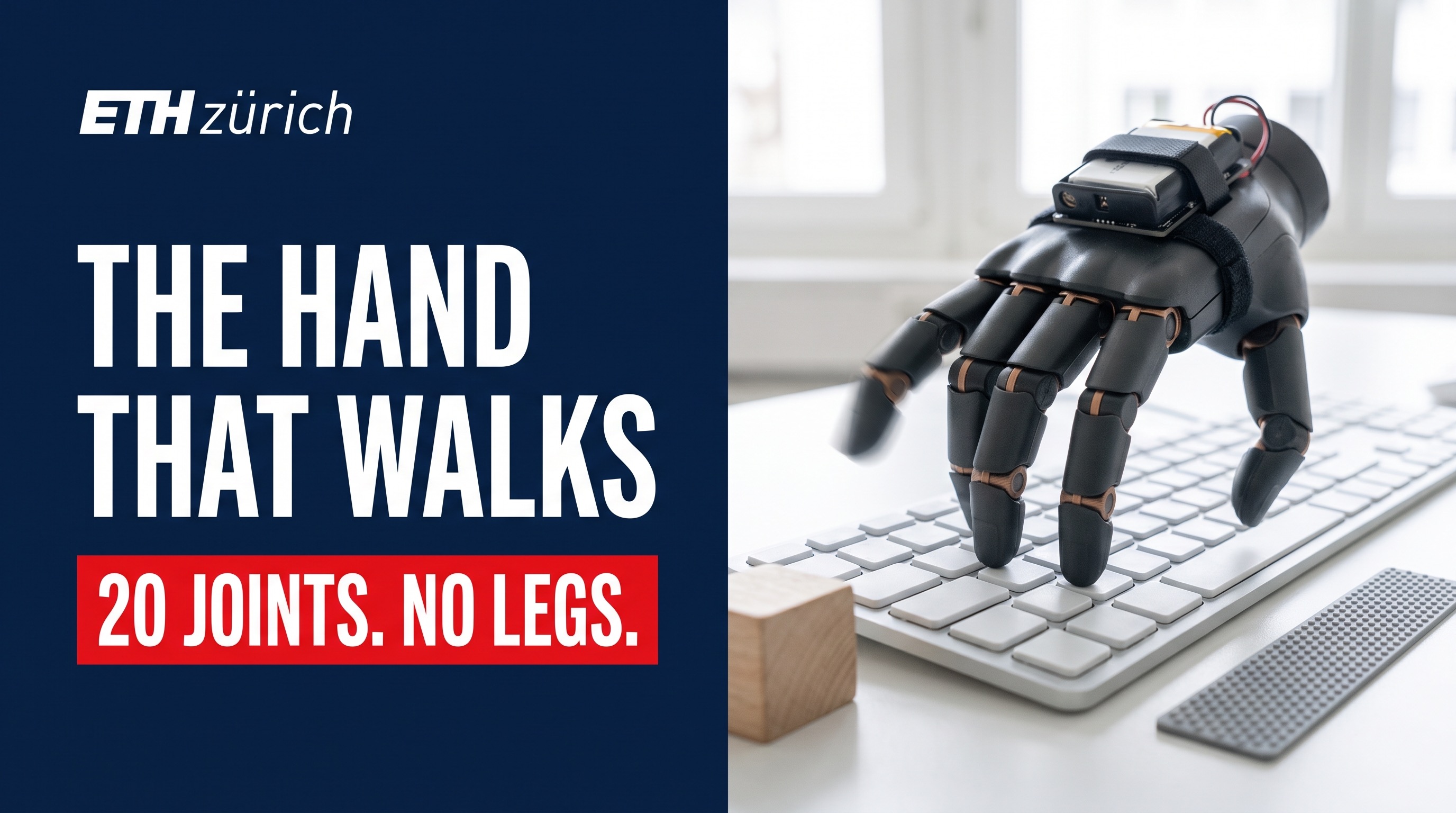 Symbolic image · AI-generated
It crawls away on its own fingers. On September 15, the Soft Robotics Lab at ETH Zurich published a study in which a commercially available robot hand without cables crawls across 14 different surfaces, rights itself after 21 of 25 falls, and presses buttons. 818 grams, twenty joints, no wheels. It learned to walk in a simulator.
What is remarkable is what the researchers did not change. The hand is a series product from Chinese manufacturer Wuji, with fingers of unequal length and the standard controller. The new capability lies entirely in the software. And this transforms a gripper into its own small robot that continues where the arm can no longer reach.
The study comes from Amirhossein Kazemipour, Hehui Zheng, and Robert Katzschmann. Training was conducted using reinforcement learning in Nvidia's Isaac Lab simulation environment, with 4,096 parallel runs. To ensure the learned behavior works in the real world, the three first measured the hand: friction of the fingertips, stiffness of the joints, approximately 19 milliseconds of delay between command and movement. These values were fed back into the simulator.
The real challenge was the anatomy. A quadruped has four identical legs; a hand has a short, laterally offset thumb and a pinky finger that bears little load. Reward functions developed for walking quadrupeds don't fit well here. The team therefore wrote their own specifications, assigning each finger its stance position and penalizing backward swings. In the simulator, the hand thus walks faster than with the adapted quadruped rules, which is ironic because ETH is precisely one of the places where these rules were once refined, through ANYmal and the spin-off ANYbotics.
On real hardware, the numbers are solid but not spectacular. After a fall, the hand usually gets back on its fingers in less than 20 seconds. On a keyboard, it executed 29 of 32 commands correctly, with a quarter-second delay, and solved a Sokoban puzzle in twelve key presses without a camera. With the help of a top-down camera, it pushed a cube to the target with an average precision of 17 millimeters. The computer and power supply sit on the back of the hand: a Raspberry Pi Zero 2 W, an attitude sensor, and a battery, totaling 80 grams.
The researchers do not hide the limitations. The hand drifts to the right while walking straight and must constantly correct; it turns differently to the left than to the right, and for the keyboard it had to be manually aligned because it doesn't know where it is. Motor current was limited to one ampere during the experiments. And the speed is in the range of centimeters per second, not meters.
Anyone thinking of the iron hand from The Addams Family when watching the video is not wrong, and this is precisely where some of the comments latch on. The serious thought behind it is different: a large robot sets down its hand in front of a tight opening, a cable shaft, a machine housing, a hollow space behind a panel, and the hand crawls in alone to inspect or flip a switch. Whether this will ever pay off is an open question, as a hand with twenty motors is not a cheap consumable.
For Switzerland, this work is more than a curiosity. Katzschmann's lab is the seedbed of the Zurich startup mimic, which develops robot hands for industry and raised 16 million dollars in a seed round in November 2025. Dexterous hands are considered one of the biggest open challenges in the humanoid industry. The fact that a Chinese off-the-shelf hand served as the test object also says something about where this hardware is now being manufactured. The software that teaches it to walk comes from Zurich.
This article was created with the support of artificial intelligence and editorially reviewed. The article image is an AI-generated symbolic image, not a press photo.