30 to 40 percent defective after three months: Tokyo sends the humanoid an ambulance
On September 8, GMO Internet Group launched an ambulance service for humanoids in Tokyo: technicians, spare parts, and a complete replacement robot are dispatched to the job site. The reason is a figure that nobody wanted to mention until now. According to GMO, approximately 30 to 40 percent of devices show component damage after three months of operation.
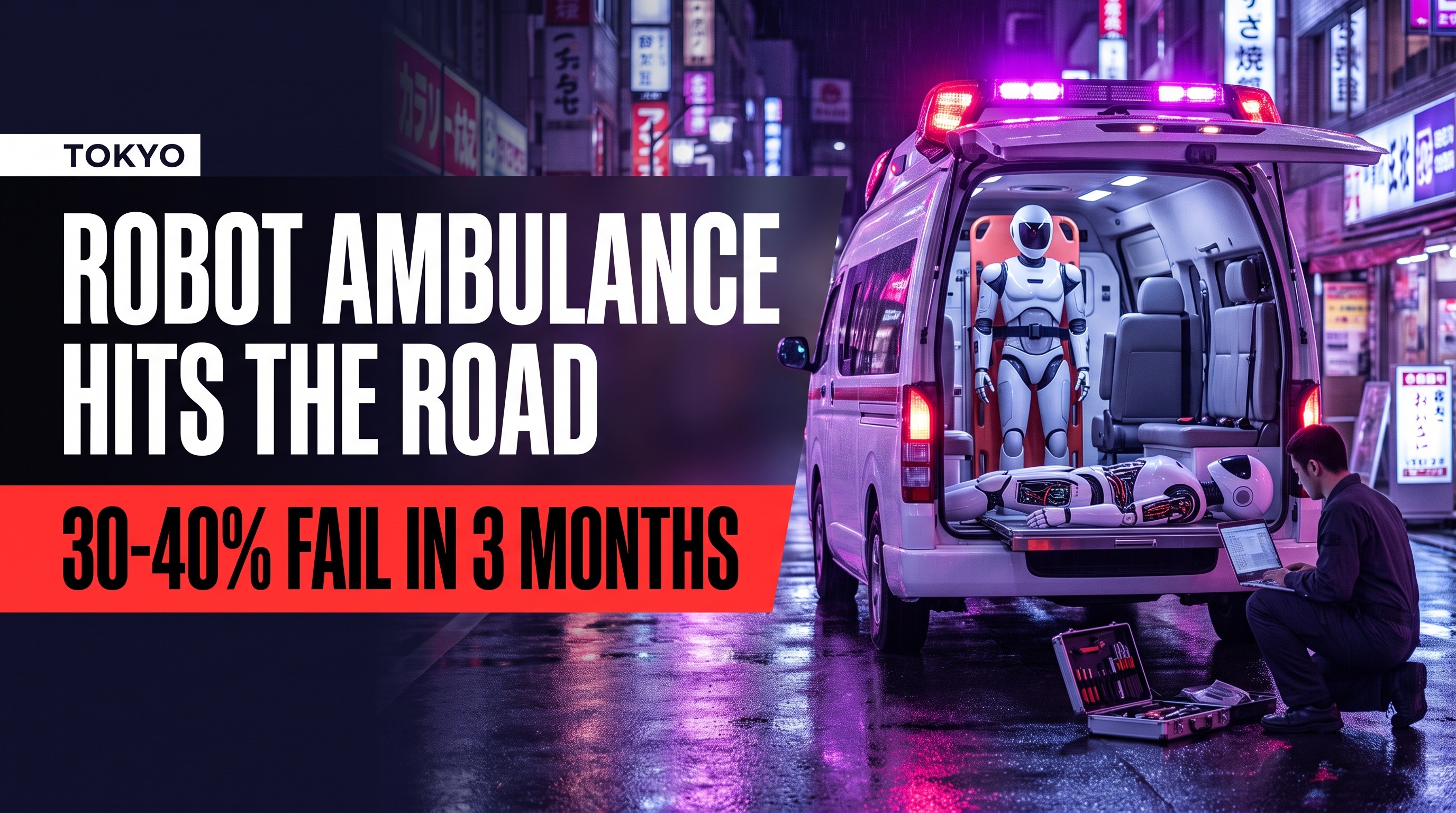 Symbolic image · AI-generated
On September 8, GMO Internet Group unveiled a robot ambulance in Tokyo, and they mean business. The vehicle with purple roof lights has been dispatched to job sites since this month, equipped with a technician, diagnostic equipment, spare parts, and a second humanoid. If the machine cannot be repaired on site, the replacement robot stays and continues working while the defective one is taken back to the workshop.
What is actually remarkable is not the vehicle itself, but the figure behind it. Approximately 30 to 40 percent of devices show component damage after about three months of operation, says Shota Takizawa, an engineer at GMO. It is the first concrete failure rate that an operator has publicly disclosed. The manufacturers have said nothing about this to date.
Behind the vehicle is GMO AI & Robotics Trading, or GMO AIR for short, a subsidiary of the Japanese internet conglomerate. The company does not build robots. It purchases them, primarily from Unitree, programs them for specific workplaces, and installs them at customer sites. This makes it one of those companies that are the first to see what a humanoid actually does in continuous operation and who have to answer for every shutdown. The idea for the ambulance vehicle actually came from frustration: when a machine had to be picked up for repairs, work stopped. So they take a replacement along immediately, explains company CEO Tomohiro Uchida.
The vehicle was designed by Tokyo designer Yasumichi Morita, with light bars on the roof and the lettering "Humanoid Ambulance" on the side. This is obviously also marketing. Still, it is worth looking at the process that GMO has put in place: check, repair, replace, transport away, document. This is not emergency services, this is maintenance, something every forklift manufacturer has been doing for decades. Except it simply did not exist in the humanoid industry until now.
The urgency becomes clear from where the robots work. Since May 2026, GMO AIR has been using humanoids with JAL Ground Service at Haneda Airport to load baggage, move cargo, and clean cabins, scheduled through 2028. An airport tolerates no failures. If a machine stops while loading at six in the morning, a service ticket with a response time of five business days does not help. Added to this is the fact that the Unitree devices used can only lift about three kilos per arm, so they only take on part of the work anyway. The tolerance for failures decreases further when the device is already contributing little in normal operation.
Takizawa's 30 to 40 percent is not a statistic, but the experience of an engineer with his machines and their deployment profiles. That is exactly what makes it valuable. Because what appears in the datasheets is load capacity, running time, price. What does not appear: mean time between failures, spare parts availability, repair time. In other words, precisely the three values that an operations manager asks about first before integrating a machine into their workflow. Agility reported over 65,000 operating hours for Digit 4, an impressive figure that includes all repairs for those hours, without ever breaking them down. Depending on the model, batteries last two to four hours under load, also not a value with which you can plan a shift.
One vehicle is not a service network. The ambulance is based at the corporation's headquarters in Tokyo, it only goes to robots that GMO has deployed itself, and every deployment is decided individually. Still, costs need to be calculated: vehicle, spare parts inventory, engineer, insurance, dispatch. This only pays for itself when enough devices are installed at enough customer sites. For now, GMO is mainly collecting data about its own product, and that is the more interesting part of the exercise.
For Switzerland, the comparison is uncomfortably revealing. Zurich Airport solved its service robot problem in August differently: 17 devices for CHF 297,253, rented rather than purchased, with maintenance and upkeep included in the monthly fee. When you rent, you buy yourself out of the downtime risk and pass it on to the operator. But if you order a humanoid directly from China because the price on the product page looks tempting, you are left alone with a defective knee joint. A service workshop for humanoids does not exist here, spare parts supply does not either, and the customs handling for a return shipment to Hangzhou is a story in itself.
That is the real news from Tokyo. Not that someone painted a robot ambulance, but that the industry is arriving where every other type of machinery has long been: at maintenance contracts, response times, and replacement devices. Manufacturers talk about capabilities. Operators talk about availability. Until those two conversations meet, a replacement humanoid in the trunk will remain the more honest answer.
This article was created with the support of artificial intelligence and editorially reviewed. The article image is an AI-generated symbolic image, not a press photo.