Nine minutes to charge, 23 kilos to lift: Agility removes the fence from the humanoid
On September 15, Agility unveiled Digit 5, a humanoid designed to work alongside humans without protective fencing: 22.7 kilo payload capacity, ninety minutes of runtime, nine minutes charging time. It won't be sold until 2027, first in North America, then in the EU and Great Britain. That's precisely when the new EU Machinery Regulation takes effect, and the robot doesn't have a CE mark yet.
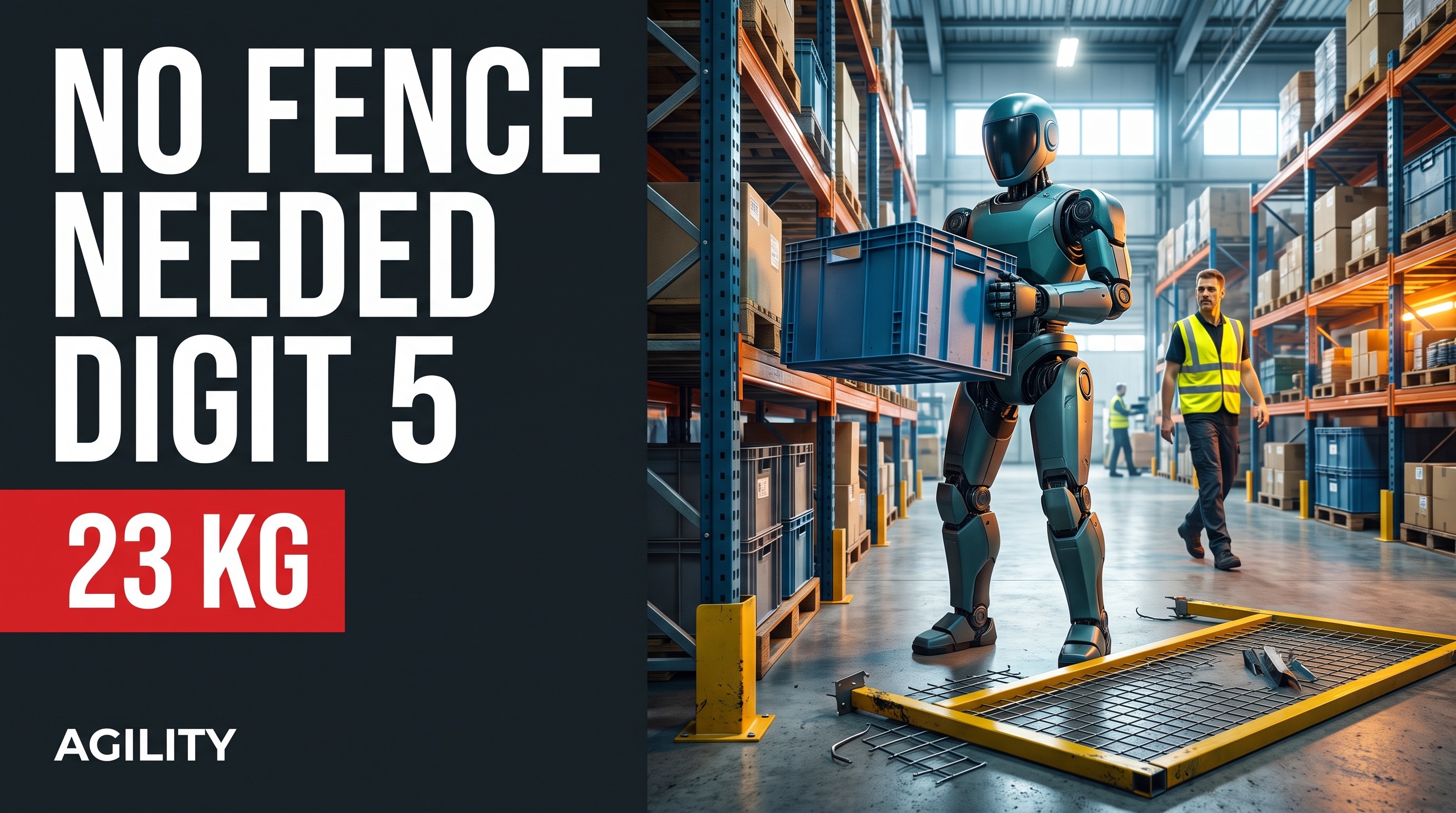 Symbolic image · AI-generated
On September 15, Agility unveiled Digit 5, the company's first humanoid explicitly designed to work alongside humans without protective fencing. 22.7 kilo payload capacity—40 percent more than before—1.81 meters tall, 129 kilos heavy, ninety minutes of runtime, nine minutes charging time. The work-to-charging ratio thus becomes ten to one instead of two to one, and the manufacturer expects over twenty productive hours per day.
You can't buy it yet. Early access in the first half of 2027, general availability by year-end, followed by the EU and Great Britain. This is precisely where it gets tricky: The new EU Machinery Regulation takes effect on January 20, 2027. Digit 5 doesn't have a CE mark; Agility writes that one is expected.
The legs are the most striking feature. The predecessors walked with joints bent backward, a design reminiscent of a bird that Agility defended for years against mockery. Digit 5 has human-like leg proportions and its own actuation with cycloidal gearboxes, designed for repeated lifting rather than spectacular walking. Add to that interchangeable grippers with standardized ISO flanges. Reach height increases from 1.68 to 2.20 meters, making even the top shelf accessible.
The safety architecture falls into three parts: recognizing people, communicating its own intent, independently monitoring its own movement. For recognition, Agility combines multiple sensor types with its own algorithms; the robot can dodge, stand still, or sit down. Light and sound signals indicate where it intends to go next. And a separate safety controller intervenes if someone gets too close, independent of the AI that otherwise controls the robot. Agility is also the first partner for Nvidia's Halos platform and uses IGX Thor for this. That's considerably more concrete than the usual assurances that a robot is safe. It's still not clearance for unrestricted operation: the company's own product page states that individual safety functions are still being developed and the specifications are preliminary estimates from the pre-series.
For Europe, this is more than a legal technicality. The Machinery Regulation, which replaces the old directive in January 2027, addresses precisely the cases that Digit 5 embodies: machines with self-developing behavior, safety functions dependent on software, and cybersecurity as part of compliance. Some of these products must now be reviewed by an independent body. Anyone wanting to place a humanoid in a European facility in 2027 isn't just selling hardware; they must demonstrate a safety concept that scarcely exists in this form yet.
Switzerland isn't standing aside here, but right in the middle of it. Swiss machinery regulations follow EU law, and anyone bringing a robot to market here will eventually have to provide the same evidence. Add to that the operational side: when the fence comes down, the risk assessment shifts from manufacturer to operator, and Suva ultimately doesn't look at the datasheet but at the workplace. Schaeffler, an Agility customer for years and present in Switzerland with its own facilities, is among the few industrial operations that already have real-world experience with this.
The timeline is the most uncomfortable number in the entire announcement. In documents for the planned IPO, initial delivery of Digit v5 was still projected for the second half of 2026. That became early access in the first half of 2027—a six-month delay for a company that reported approximately 1.8 million dollars in revenue and 138.1 million dollars in losses in 2025. The 300 million dollars for a thousand devices appearing in the same documents as order backlog come from a related customer and are contingent on milestones that still need to be reached. That's not earned money.
What Agility has going for it is operating hours. Digit 4 accumulated over 65,000 hours at GXO, Toyota, and Mercado Libre, with all the failures and repairs that come with it. This experience is built into the redesign. But it's the track record of the old machine, not the new one. Whether 23 kilos, nine-minute charging time, and an independent safety controller will perform in continuous operation as the presentation promises will only be seen in 2027 with the first customer who actually leaves the fence down.
Agility doesn't name a price.
This article was created with the support of artificial intelligence and editorially reviewed. The article image is an AI-generated symbolic image, not a press photo.