Ordering a robot to Switzerland: What the price on the product page doesn't tell you
A robot dog from $1600, a humanoid from CHF 13,500, credit card is all you need. Legally, you become an importer yourself in Switzerland, and the battery is too large for postal return shipping. What direct imports really cost and why going through a dealer is usually cheaper in the end.
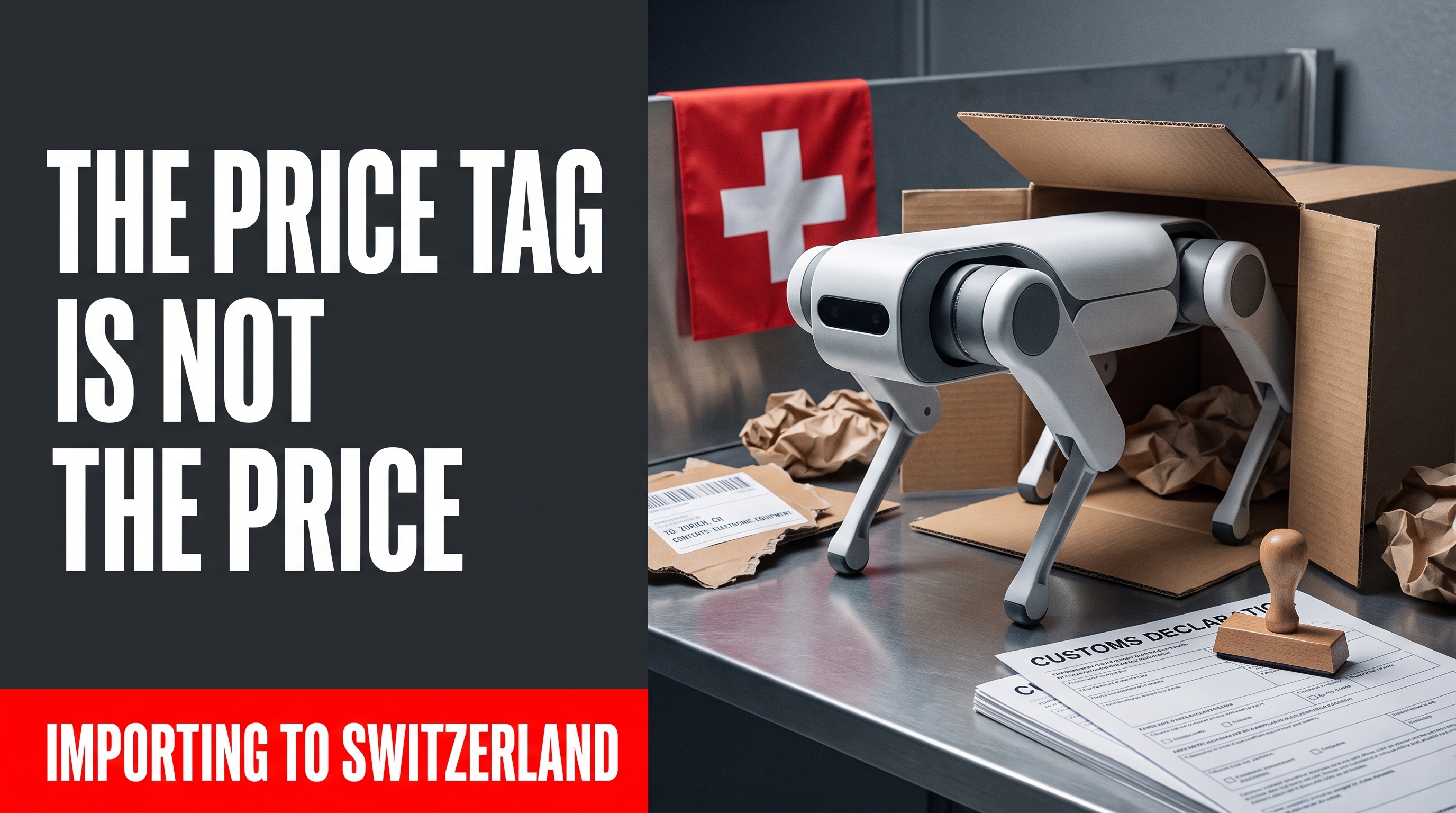 Symbolic image · AI-generated
It always starts the same way. You watch a video of a robot dog doing a backflip, and twenty minutes later a Unitree Go2 is in your shopping cart. From around $1600, the humanoid G1 from around CHF 13,500, credit card is all you need. So far everything proceeds like buying a toaster. The difference comes after: whoever imports directly becomes legally responsible as an importer in Switzerland and is liable for ensuring the thing doesn't harm anyone.
Then there are costs that the shopping cart doesn't mention, and a detail that only becomes apparent in an emergency. The standard battery of a Unitree Go2 has 236.8 watt-hours. The international postal limit for lithium batteries in a device is 100. Which means, loosely speaking: it can go there, but it can't come back.
Let's start with the most pleasant part, the money, because here Switzerland is surprisingly straightforward. On the goods value comes the value-added tax of 8.1 percent, which is called import tax on imports because a law without its own term wouldn't be a proper law. It's calculated on goods plus freight. There's no more customs duty—Switzerland abolished industrial tariffs at the beginning of 2024, a rare case of bureaucratic generosity. Then there's the customs clearance fee from the post office or courier, with a percentage on top for express services because they had to advance the money. The famous CHF 150 exemption threshold doesn't help: it applies to travelers, and if you carry a humanoid across the border in your backpack, you have other problems anyway. So the rule of thumb for direct imports is: goods price, freight, 8.1 percent on top, customs clearance fee on top of that.
It becomes less entertaining with the Product Safety Act, which treats personal use the same as placing on the market. So you don't just buy a device, you also take on the role of importer—without pay, without a company, but with full responsibility. If a guest steps into the robot's work area, there's no Swiss importer you can point to. There's only you and your personal liability insurance, and you should read it beforehand. With radio equipment, the regulatory situation is similarly unsentimental, even when you're not thinking of a radio set. Legally, a radio installation is any device that intentionally transmits or receives radio waves—so anything with WLAN, Bluetooth, mobile network, or remote control. These robots are controlled via app or remote control, and Unitree additionally mentions a built-in 4G module for the Go2 Pro and Edu, for the Edu with eSIM. A robot with its own SIM card is thus a radio installation, whether you like it or not. Bakom states that the person importing a wireless device from abroad is personally responsible for its conformity, and that importing a non-conforming radio installation is punishable and subject to fines. For certain frequencies, usage restrictions also apply in Switzerland. What you need before purchasing is therefore the declaration of conformity, in a national language or in English.
In law there's a simple rule: the cheaper the purchase, the weaker your position. In Switzerland you have two years of warranty under the Code of Obligations, a period that cannot be shortened by contract. With the battery, this is often waived and replaced with a six-month guarantee, which is permissible and still annoying. In Germany you have EU law, though enforcement is sluggish. When ordering directly from China, you have rights on paper and in practice a support chat where someone is very polite and does very little.
And then comes the moment when something breaks, because it will. Lithium batteries are hazardous goods. The post office only accepts them in international transport if they're installed in the device and have at most 100 watt-hours. The Go2, with 236.8, is far above that. So the robot isn't defective, it's stranded. What helps now is a shipping company with hazardous goods handling, corresponding freight costs, and patience—and the same applies in reverse for replacement batteries. That's why the most boring question before purchase is the most important: where is the nearest service point and are spare parts available. Not how long the battery lasts.
When you put the two paths side by side, direct imports become less attractive than they seem. An important detail here, where most price comparisons fail: Unitree offers the Go2 as Air from $1600, as Pro from $2800, as X from $4500, and as Edu between CHF 11,190 and 15,600. If you see the cheapest price in the manufacturer's shop and a higher one at a dealer, you're often comparing two different devices. And part of the real difference isn't a markup at all, but import tax, freight, and customs clearance that you'd pay anyway, just calmly and without a form at midnight. What you get in addition is banal and critical in an emergency: an invoice that carries weight in a Swiss court, a person on the phone, the European device version with declaration of conformity, and warranty processing where the dealer takes the device in rather than you becoming a hazardous goods shipper yourself.
That's precisely where the savings calculation falls apart. A single repair case eats up the saved difference and costs additional weeks. If you use the robot professionally, you lose orders during that time. If you use it privately, you own the living room's most expensive decoration temporarily. The price difference is thus not a discount, but a bet that nothing happens. With a device with twelve powered joints and a battery under constant stress, that's a bet with unfavorable odds. Which brands have a distribution partner in Europe at all is listed in the manufacturer directory on robothub24.ch.
The honest closing sentence isn't: don't do it. It says: compare the same model, add tax, freight and fees, and clarify before ordering who will repair it. If the answer to that last question is nobody, you haven't saved anything, you've just bought the risk. At least it can do a backflip.
This article was created with the support of artificial intelligence and editorially reviewed. The article image is an AI-generated symbolic image, not a press photo.