Beijing bans the AI companion, and two months later it's delivered as a robot
Since July 15, China prohibits providers from designing anything that creates emotional dependency or damages real relationships. The country's largest AI apps shut down their companion features within ten days. Since September 15, UBTech has been shipping a companion robot with silicone skin, and so far no one has said whether the rules apply to it.
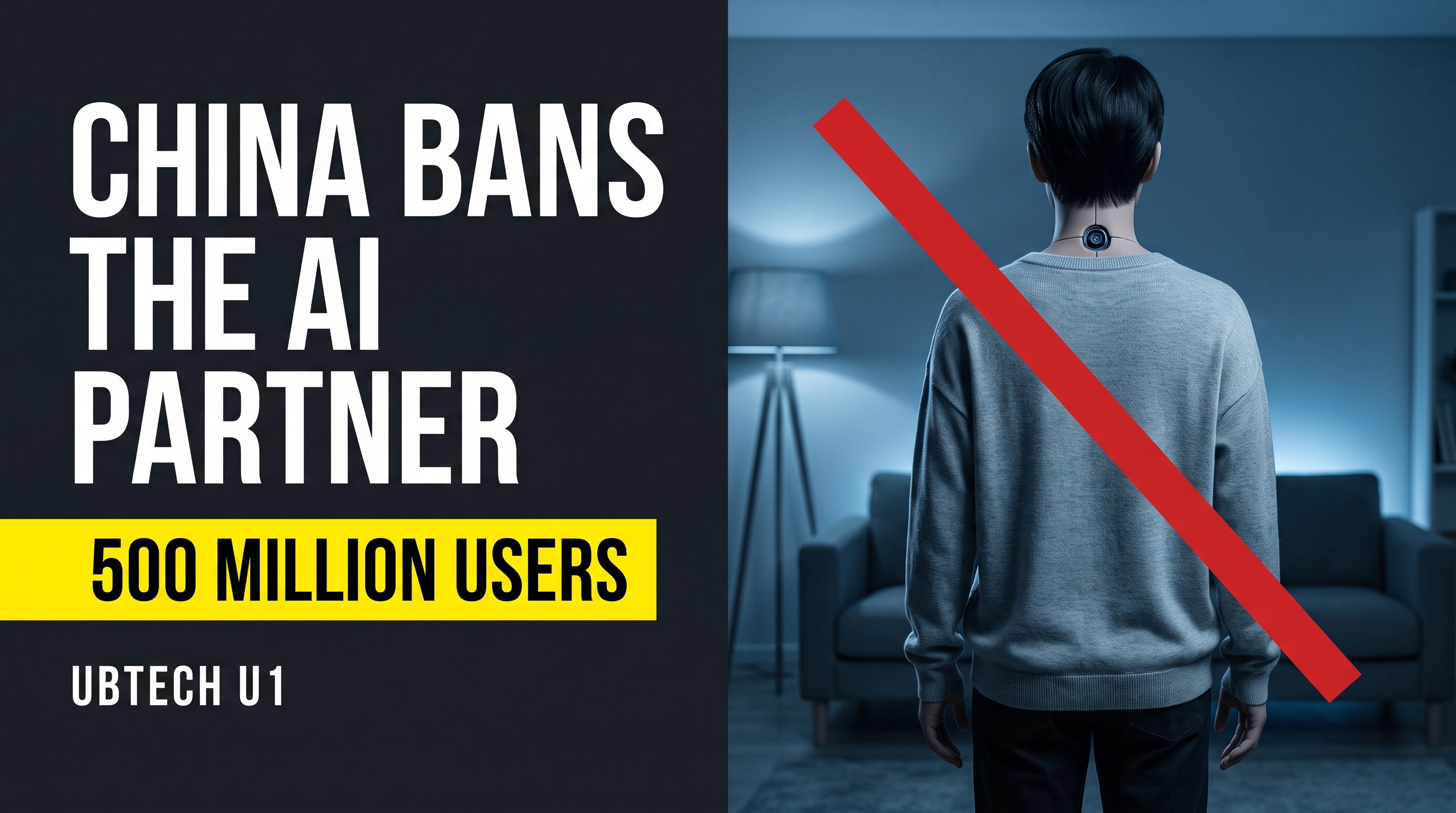 Symbolic image · AI-generated
Since July 15, what is prohibited in China is exactly what UBTech has been shipping since September 15. The interim regulations for AI services with human-like appearance ban any design that creates emotional dependency or damages real relationships. Doubao and Qwen, together with over 500 million monthly users, shut down their companion features within ten days. Virtual partners are completely banned for minors.
Two months later, a manufacturer from Shenzhen puts exactly this promise into the living room: 183 centimeters, silicone skin, eye contact, from 119'800 Yuan, over 11'000 orders. The regulations govern services, not machines. Whether a robot with its own emotion model falls under this has not been answered by anyone so far.
Article 8 of the regulations is remarkably direct. A provider must not be «excessively accommodating» to its users if this creates dependency or addiction, and must not emotionally manipulate anyone to make them act against their own interests. Added to this are concrete obligations: Every user must be told they are speaking with a machine. After two hours of continuous use, a break reminder must appear, regardless of age. Anyone identified as dependent receives a clear warning. If a system detects a genuine crisis, such as suicidal thoughts, it must intervene and contact a trusted person. The rules were issued on April 10 by the Cyberspace Administration together with four other agencies, including the Ministry of Industry. On the same July 15, bans on replicated genitalia and erotic algorithms also came into force.
The reason is not stated in the text, but the authorities speak it openly. China has a birth rate problem, and Beijing expects digital intimacy and real family formation to compete for the same emotional capacity. The market for intelligent companionship reached around 50 billion Yuan in 2025, about 7.4 billion dollars, and forecasts see it beyond 120 billion by 2027. Around 65 percent of users are between 18 and 24 years old, precisely the age group that statistically should be finding partners and having children. At the same time, 323 million people over sixty live in China, more than half of them without children in the household.
Implementation was brutally swift. Tencent's Yuanbao discontinued its companion features as early as June 30, Doubao and Qwen followed on the deadline, ten days after the announcement. On Chinese platforms, users subsequently mourned characters they had trained over years to replicate the speech of deceased relatives. Others lost a relationship that had been happening for them daily for two years. Some parents were relieved. This is the spectrum a state must reckon with when it ends a bond by regulation.
And this is precisely where the gap opens. The regulations apply to services, and their review thresholds are tailored to apps: A security assessment is required when a provider launches, makes substantial changes, or exceeds one million registered or 100'000 active users. A device that is sold eleven thousand times and whose model runs on a Rockchip RK3588 in the chest without cloud and without app store review does not reach any of these thresholds. UBTech sells the U1 exclusively to adults and emphasizes that user data does not leave the device. Both of these read less like marketing than like preemptive compliance with a rule the company doesn't know applies to it.
For Europe, this process is more revealing than any debate about unit numbers. Since August 2, 2026, Article 50 of the EU AI Act requires a system to identify itself as a machine, and through the market access principle, this also affects providers delivering from Switzerland into European territory. But nothing more. The question of whether a product may be built in a way that creates attachment is not yet posed binding anywhere in Europe. China poses it, from demographic self-interest and with the means of a system that can shut off access overnight. Inquiries about companion robots reach us at robothub24.ch regularly, mostly from the care sector, and there attachment is not a side effect but the purpose. Whoever wants to use such devices in Switzerland in the future will have to be measured against a rule that doesn't even exist here yet.
This article was created with the support of artificial intelligence and editorially reviewed. The article image is an AI-generated symbolic image, not a press photo.