Magnesium or knitted fabric: The materials a robot is made from determine where it's allowed to stand
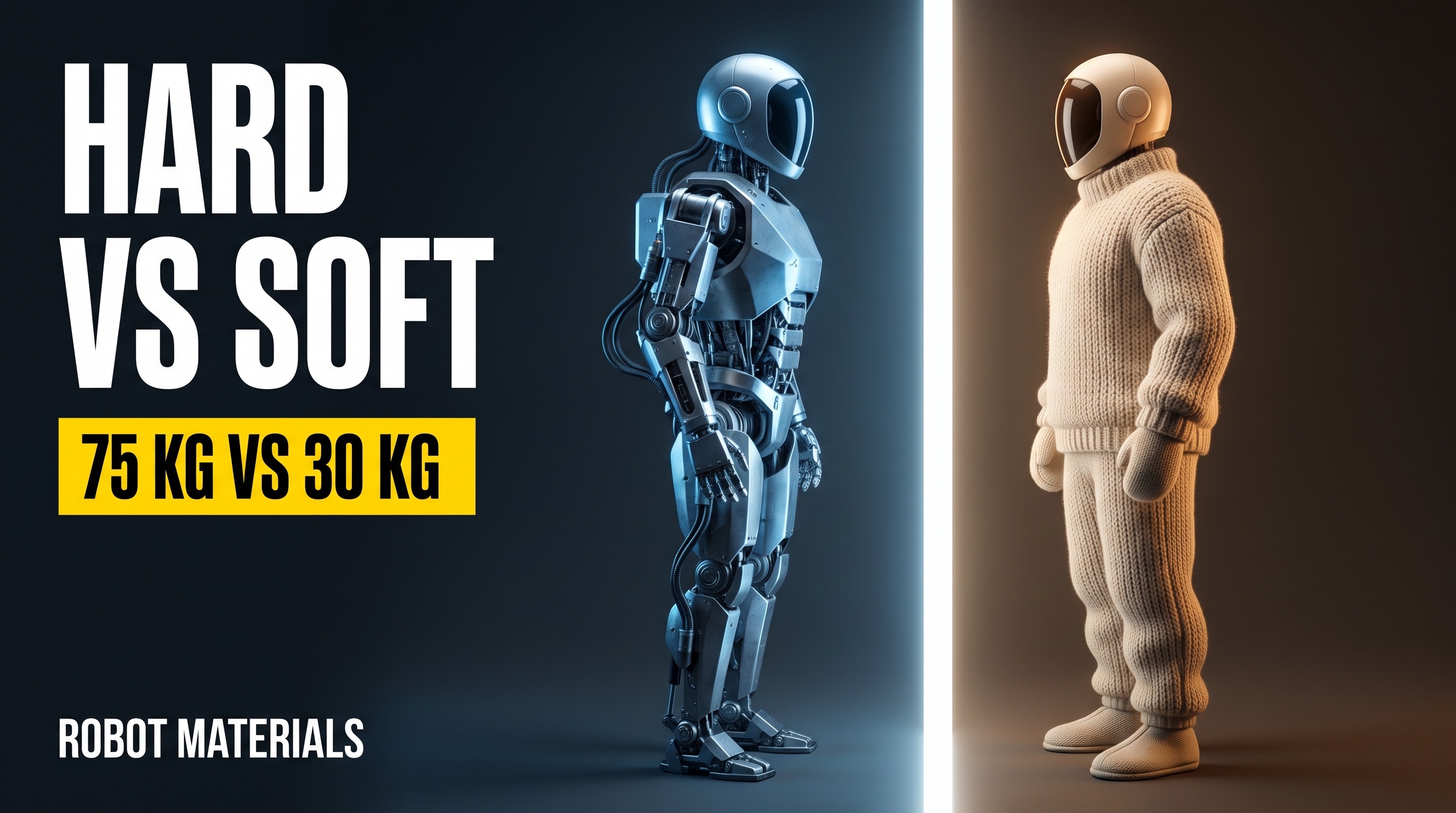
EngineAI's T800 weighs 75 kilos and is housed in a magnesium-aluminum frame, while 1X's Neo is almost the same size but weighs just 30 kilos and is soft beneath its knitted covering. The choice of materials determines whether a machine must stay behind a safety barrier or can enter a home. Why the question of materials is more important than any demo video when making a purchase.
 Symbolic image · AI-generated
EngineAI's T800 is 1.73 meters tall, weighs 75 kilos, and is housed in a magnesium-aluminum frame. It delivers 450 newton-meters of peak torque and runs at speeds of up to three meters per second, which translates to around 340 joules of kinetic energy. 1X's Neo is almost the same size but weighs just 30 kilos, consists of a 3D lattice polymer beneath its knitted covering, and is moved by tendons rather than rigid gears.
Two machines, the same design, two completely different material choices. More than just the data sheet depends on this: one belongs behind a safety barrier, the other is allowed in a home. When you buy a robot, you're first buying a material concept.
Magnesium alloys, with a density of around 1.8 grams per cubic centimeter, are the lightest structural metals available—roughly two-thirds as heavy as aluminum and a quarter the weight of steel. Add carbon-fiber-reinforced plastics and the high-performance plastic PEEK, which now replaces metal in housings, gears, and joint shells. Tesla shed around ten kilos with this combination on the second-generation Optimus, making the machine noticeably faster. In robotics, lighter doesn't just mean more efficient—it also means more responsive, because every kilo less reduces the moment of inertia of the entire arm.
The price for this rarely appears in brochures. Rigid metal structures store and transfer energy with almost no loss. When a 75-kilo body hits a person at full speed, the kinetic energy is transferred unimpeded—there's no crumple zone. Add sharp edges, pinch points on openly moving joints, and heat from the drives. And underneath it all sits a lithium-ion battery typically storing two to three kilowatt-hours—roughly as much energy as a very large e-bike battery. Mechanical damage is no theoretical problem, which is why reputable manufacturers now work with ceramic fleece, aerogel insulation, and flame-resistant housings.
This is precisely where soft construction comes in. The Neo has no exposed pinch points, the joints are enclosed, and the body consists of an open-pore lattice structure that deforms on contact. The tendon-driven limbs have low moment of inertia, which in an emergency does exactly what a rigid gear cannot: the movement gives way. 1X cites a head impact HIC value below 250, a metric from vehicle safety where 1000 marks the threshold for serious injury. At 30 kilos and typical household speeds, kinetic energy remains in the range of 30 to 60 joules. This isn't magic—it's simply physics: half the mass, half the speed, a fraction of the impact force.
Soft construction has its limits too. A lattice polymer creeps under sustained load, textile coverings get dirty and wear out, tendon pulls stretch and need readjustment. Repeatability in the tenth-of-a-millimeter range, as required in assembly, cannot be achieved this way. If you want to move 20-kilo loads eighty times an hour, you can't get around rigid structures and powerful gears. The T800 isn't poorly designed—it's designed for a different environment.
A third camp goes even further, copying not the function but the body structure itself. Clone Robotics showed a prototype called the Protoclone that has a polymer skeleton with reproductions of all 206 human bones, plus around a thousand artificial muscle fibers made from mesh tubes that contract when water is pumped into them. A 500-watt pump takes the role of the heart and simultaneously cools the structure. 200 degrees of freedom, 320 pressure sensors, 70 position sensors. The machine cannot yet stand or walk freely—a walking demonstration is scheduled for 2027, a commercial product for 2028. The appearance is disturbing, and that's the point: the more human-like materials and movement become, the less reliably humans assess the machine.
For practical purposes, this sorts into a fairly clear picture. Metal and carbon belong where payload and precision matter and access is controlled—in manufacturing, warehousing, and outdoor facilities. Soft structures belong where people stand nearby unexpectedly: care, household work, reception, retail floors, workshop assistance. Silicone skin and artificial muscles have their place in therapy, research, and training—for example in nursing schools where students practice on realistic bodies. The decisive question, then, isn't what a robot can do, but how close it's allowed to come to people.
Legally, this is no gray area. ISO 10218 was reissued in 2025 and integrated the formerly separate specification ISO/TS 15066 with its biomechanical limits for force and pressure into the second part. For service and assistance robotics outside industry, ISO 13482 applies. You can't achieve these limit values with software alone. A heavy, rigid robot can only brake on collision, while a light, compliant one causes little harm by its very construction. Anyone putting a machine into operation in Switzerland bears the responsibility for risk assessment themselves, and it starts with the question of what the machine is made from.
Swiss research is unusually well positioned in this field. The Soft Robotics Lab at ETH Zurich works on compliant and biohybrid systems, at EPFL Josie Hughes researches soft grippers and materials with variable stiffness, and at Empa the group led by Mirko Kovac develops soft systems for inspection and environmental monitoring. This is no longer a niche—it's one of the few areas where European suppliers actually have something to offer against Chinese mass manufacturing.
For purchase decisions, this means: read the data sheet backwards. How much does the machine really weigh, how fast does it actually move in operation, are the joints covered, what battery is inside and how is it protected, is there a declaration of conformity referencing ISO 10218 or 13482. A video shows what a robot does at its best. The materials list shows what happens at its worst.
This article was created with the support of artificial intelligence and editorially reviewed. The article image is an AI-generated symbolic image, not a press photo.