No legs, please: A European startup abandons its design after five weeks
The European startup Nucleus showed off a bipedal humanoid in early August. Since this week, the same system stands in the same hall on wheels: ten kilos of payload per arm, six times as much battery, five to nine hours of continuous operation. The facility managers demanded it, literally with the words 'no legs'.
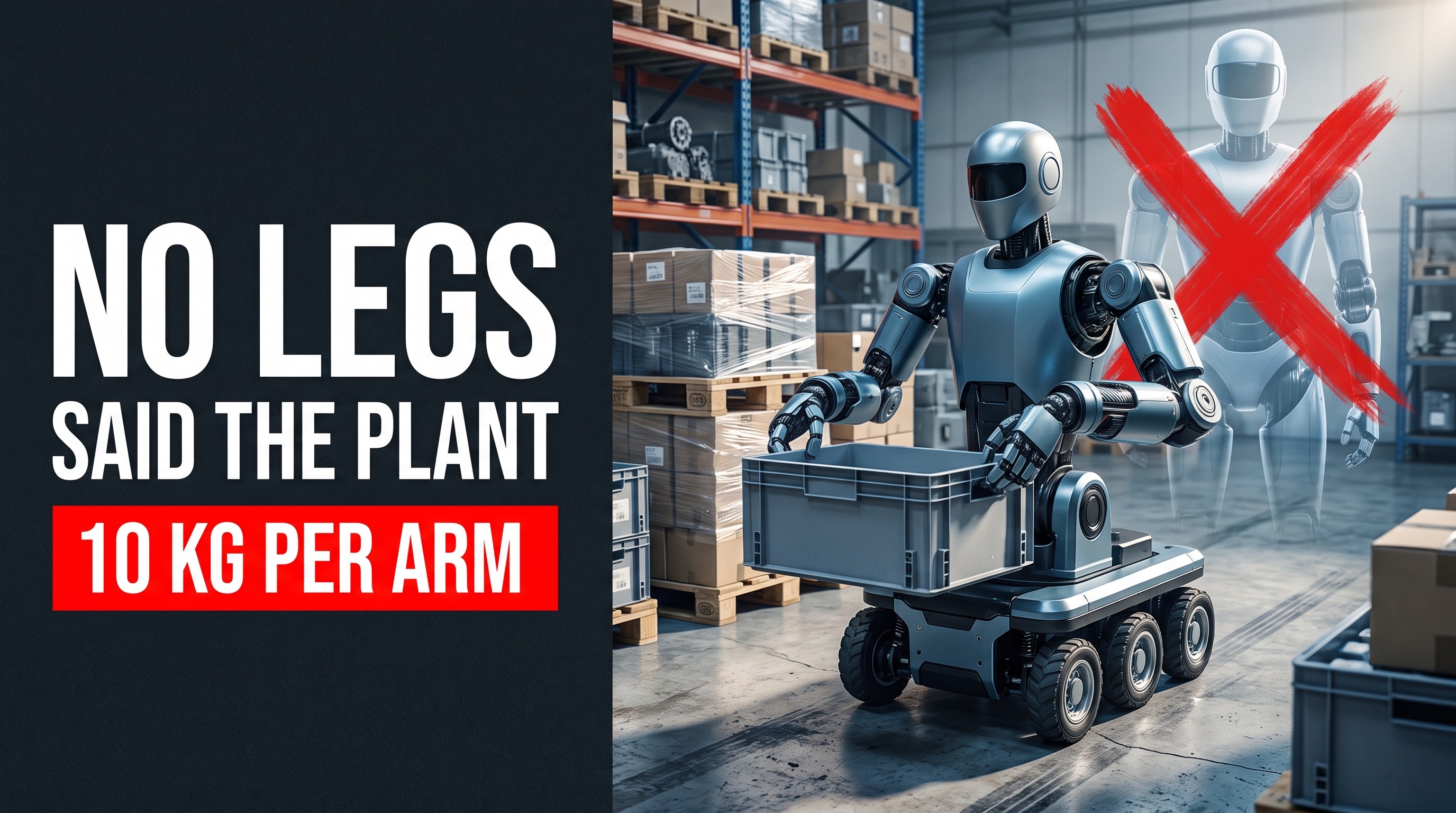 Symbolic image · AI-generated
Five weeks ago, the European startup Nucleus made its first public appearance with a bipedal Unitree G1. Since this week, a different robot stands in the same logistics hall: same software, same arms, but the legs are gone. Nucleus II runs on wheels. Ten kilos of payload per arm, six times as much battery, five to nine hours at a stretch. Co-founder Melvin Schwarz states the reason bluntly: the facility managers demanded it, literally 'no legs'.
With this move, a European provider is abandoning the design that half the industry is currently using to raise capital. Three months in actual shift operations were enough to show: the warehouse floor is flat, and a fall costs more than legs would ever bring in.
At Nucleus, billing is not for the machine, but for the task completed. Robotics as a Service is what this model is called—the customer pays per grip and per box, the hardware risk stays with the provider. This also explains why the switch could happen so quickly. If you haven't sold robots, you don't have to explain the robots you've sold.
Behind the much-praised autonomy, a human still sits today. When the robot can't proceed because a box is jammed or a label is missing, an operator takes over from a distance. Now this person gets a feel for what they're doing: the controls vibrate on contact, force feedback increases with the deviation between the desired and actual arm position, and a display warns before a component is damaged. Each of these interventions subsequently goes into training. The person at the controls is thus not just a last resort—they are the data source.
Nucleus won't say which drive platform sits under the torso. The videos show self-printed mounts; the base is clearly purchased. This is the uncomfortable part of the story for everyone betting on proprietary hardware: a provider whose value lies in software can swap out the chassis like a supplier. By the end of the first quarter, up to 25 devices are to be in operation.
Nucleus is not alone in this move. Lumos Robotics drives its dual-armed MOS 2 on wheels following lines from Mitsubishi Electric, and a Counterpoint Research survey of 22'000 humanoids delivered in the first half of 2026 shows that a significant share of the volume doesn't actually stand on two legs. At trade shows, the biped walks around. What gets ordered is often something else.
The building itself argues against the trend. A wheeled robot can't climb stairs, cross high thresholds, and comes to a standstill at every ramp. Those building new on greenfield sites can design that away. Those who, like many Swiss suppliers, work in established buildings from the seventies, with intermediate floors, cargo lifts, and a step between warehouse and assembly, don't have that problem so easily solved. Legs solve it, but they cost payload, runtime, and considerable patience with safety approvals.
For an operation now requesting quotes, this is the most useful question of the month: What exactly does the device need to overcome, and how often per day? Those who know the answer can tell offers apart, rather than being swayed by video footage. Nucleus next plans to release recordings of multi-hour shifts, complete with uncut errors and failed grips. Measured against what the industry usually shows, that would almost be provocative.
This article was created with the support of artificial intelligence and editorially reviewed. The article image is an AI-generated symbolic image, not a press photo.