80 percent automated, no one at the controls: XPeng's robot walks off the production line on its own
On September 7, XPeng launched the production line for the humanoid IRON in Guangzhou. The first robot left it on foot, without anyone switching it on, achieving over 80 percent automation in core processes. Tesla has not even publicly shown its third-generation Optimus in the same period.
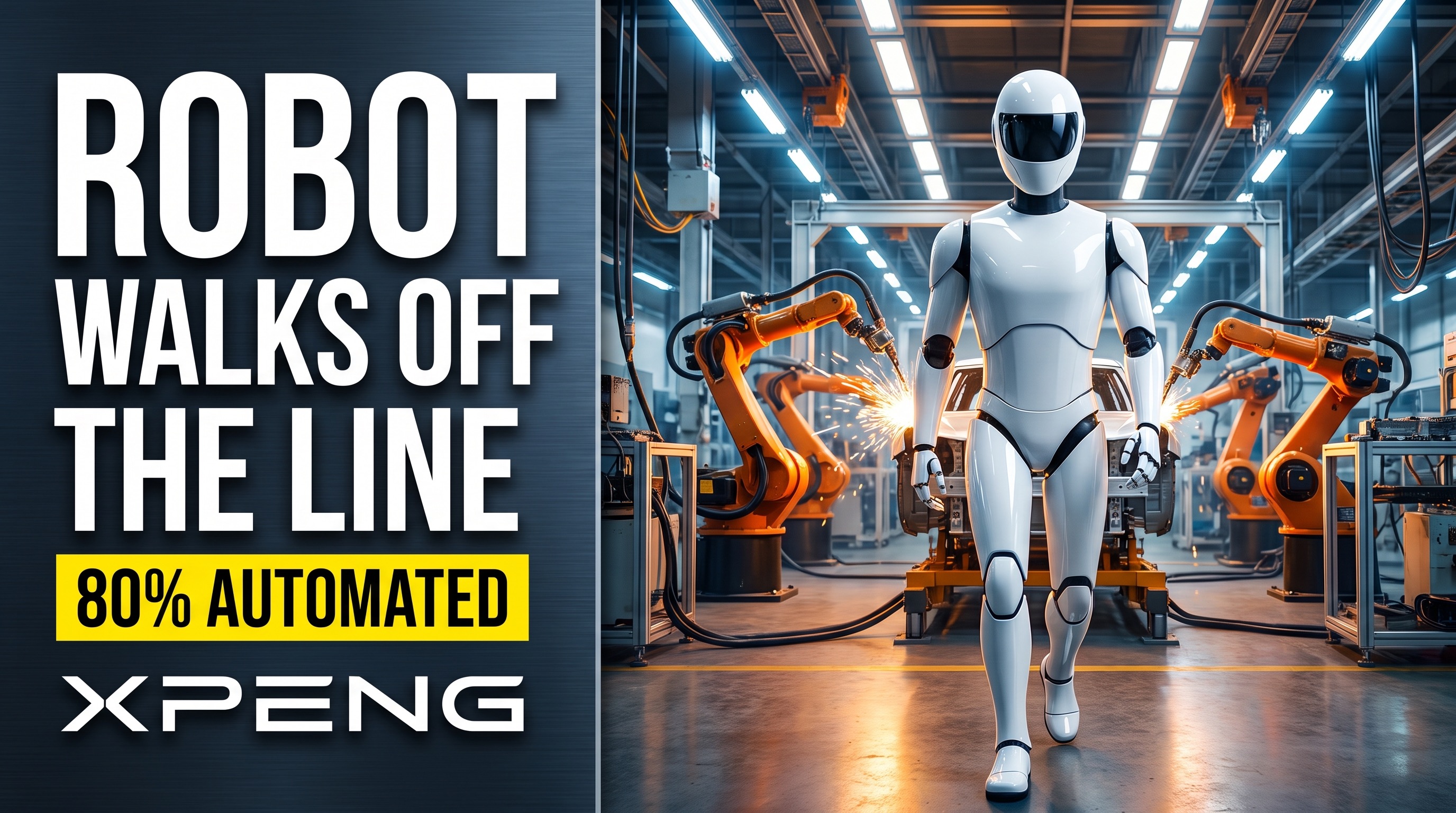 Symbolic image · AI-generated
On September 7, XPeng launched its production line for the humanoid IRON in Guangzhou, and the first robot walked off it on its own two feet. No one switched it on, no one carried it out. Core processes run at over 80 percent automation, and the robot shares 85 percent of its supply chain with the company's automotive manufacturing. Inside its head sit three proprietary Turing chips with 2250 TOPS.
No manufacturer has ever demonstrated the leap from prototype workshop to serial production so publicly before. What makes it striking is the comparison with Tesla, which let its self-imposed deadline for the third-generation Optimus slip and still hasn't shown its hardware. XPeng aims to be production-ready by year-end, with deliveries to external customers only beginning in 2027.
The first units won't go into a factory hall but into the company's own showrooms and onto the corporate campus. There they guide visitors around, explain cars, and do their rounds as security personnel. This might seem modest at first glance only. XPeng's robotics chief himself admitted in April that hardware remains the bottleneck, above all the hands, which wear out too quickly during demanding grasping tasks. A showroom is predictable; a warehouse is not.
"The production lines for robots emerged from scratch with no precedent to follow," said CEO He Xiaopeng at the launch. Today's step is small, but they are building manufacturing for an entirely new product category. Part of the staging was that he placed an employee badge around the robot's neck.
Technically, the production-series IRON has come a good deal further than the stage version that walked the runway in Shenzhen in January. The three Turing chips compute control models directly inside the robot, bypassing the cloud, which reduces the delay between perception and movement. In the second quarter, XPeng merged its robotics and autonomous driving data teams and has since sent the robot through the same vision-language-action pipeline trained in cars over millions of kilometers. The result is a device that remembers twelve faces, switches between Chinese and English in conversation, avoids moving obstacles, and navigates to its charging station on its own, including plugging and unplugging.
This is paid for with fresh capital. In late August, the spun-off robotics division raised over 900 million dollars at a valuation exceeding 6.3 billion, led by IDG Capital, with Tencent and Alibaba on board. It is the largest single private funding round China's embodied AI scene has yet seen. When you put industry figures alongside this, you understand the urgency: In the first half of 2026, roughly 19,100 humanoids were delivered worldwide, 272 percent more than the previous year, and over 97 percent of them came from China.
Tesla is working from the same script, just behind closed doors. Supply chain sources say the company placed initial orders for roughly 5000 component sets from Chinese actuator and ball screw manufacturers and internally aims for 10,000 to 20,000 units. Nothing of this has been seen to date. The difference between the two automakers at the moment is less a technical one than a communications one. One shows a running production line, the other promises one.
For Europe, 2027 will be interesting, when deliveries to customers outside China are supposed to begin. By then, it will be decided under what conditions such a device may operate here at all. AGIBOT just had TÜV Rheinland issue safety certificates at IFA Berlin a few days ago, a sign of how seriously Chinese manufacturers now take European market access. For Swiss companies, there's the more mundane question that doesn't come up at any press conference: Who repairs this thing if an actuator burns out after eight months, and how long does it sit idle then. In Tokyo last week, a provider presented a kind of roadside assistance service for humanoids—spare parts and technicians in a service van, stretcher included. This seems quirky but is the sober answer to a machine that only ties up capital while idle.
Whether Guangzhou or Fremont ultimately delivers the volumes is, for a company in the Midlands, initially secondary. What matters more is that the first generation of these machines arrives in Switzerland not as a prototype but as a product with a serial number, spare parts list, and warranty. That will show whether the figures from China mean anything here too.
This article was created with the support of artificial intelligence and editorially reviewed. The article image is an AI-generated symbolic image, not a press photo.