3.5 billion for compute time, 1.9 billion raised: Figure orders robot brains in bulk
On September 3rd, Figure signed a contract for up to 100,000 graphics chips, larger than any capital the company has ever raised. 3.5 billion dollars go to British cloud provider Nscale, which is simultaneously entering Figure as a shareholder. The first chip runs at the earliest from the second half of 2027.
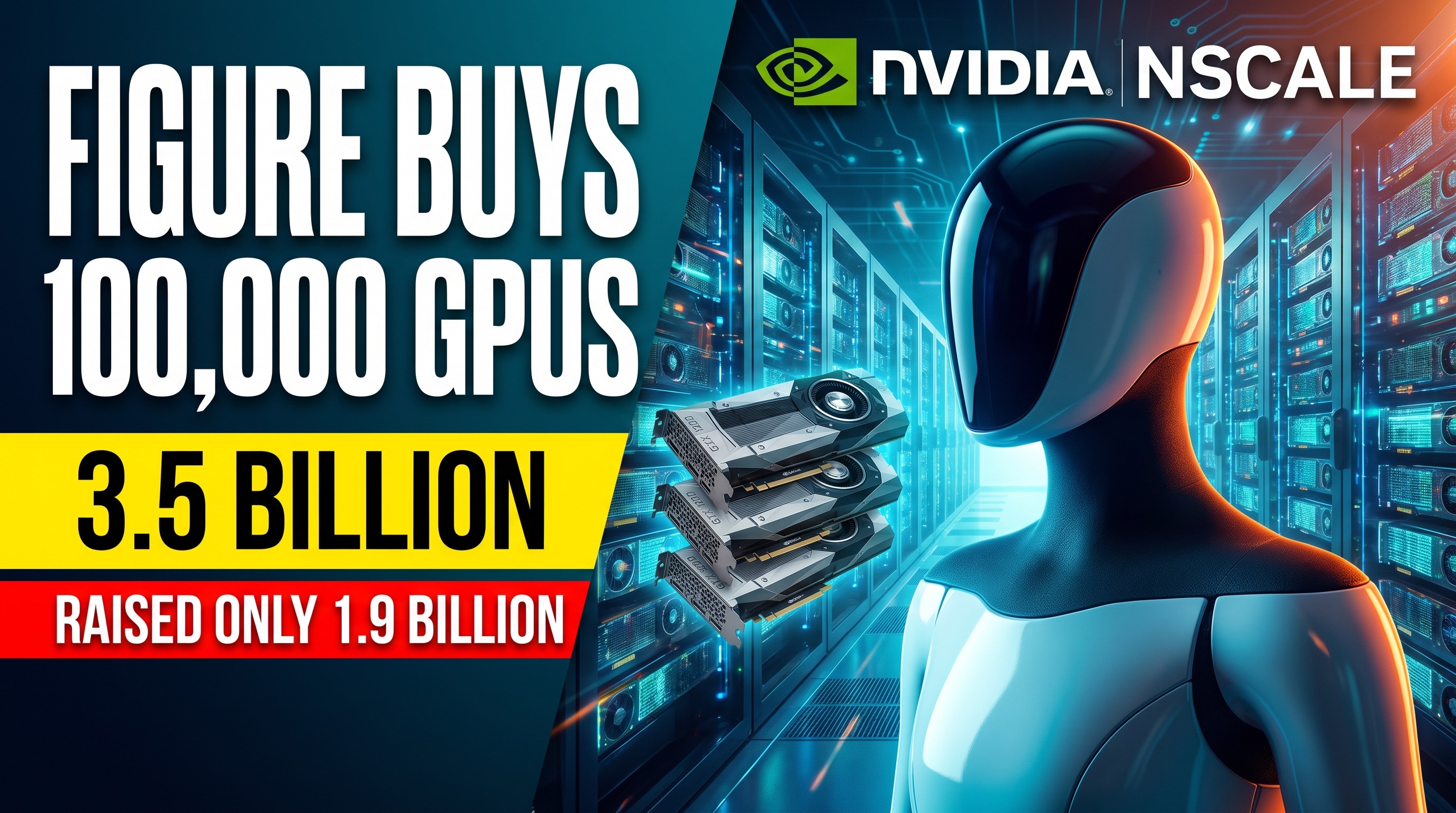 Symbolic image · AI-generated
On September 3rd, Figure signed a contract for computing power larger than any capital the company has ever raised. 3.5 billion dollars go to British cloud provider Nscale for up to 100,000 graphics chips on Nvidia's upcoming Vera-Rubin platform, with the intention to expand to over 6 billion later. Since its founding, Figure has raised around 1.9 billion.
A robot builder thus commits itself to expenses on the order of magnitude of a language model lab, without significant revenue. It becomes sensitive through one line in the fine print: Nscale simultaneously enters Figure as a shareholder. The money thus runs partially in circles, and the first chip in Barstow, Texas runs at the earliest from the second half of 2027.
Nine days before the contract, CEO Brett Adcock explained what his company was lacking. Figure had reached a point where mechanics were no longer the bottleneck, but data and computing power. For the data, the company launched the Index app at the end of August, a kind of gig platform: people film themselves washing dishes, folding laundry, putting things away and get paid for it. Around 44,000 people participate, and according to Figure, 35 minutes of video material now flows in per second. Per thousand hours collected, there are 373 different tasks, 1,146 objects, 116 environments. Figure wants to spend a billion dollars alone on this data collection.
Nscale is no random partner in this equation. The London-based company with data centers in Norway, Portugal, Iceland, Britain and Texas raised two billion dollars at a valuation of 14.6 billion in March, with Nvidia as an investor. Microsoft has reserved 200,000 Nvidia accelerators at Nscale. So Nvidia puts money into Nscale, Nscale puts money into Figure, Figure buys computing time from Nscale on Nvidia hardware. Jensen Huang calls this the flywheel of physical AI in the announcement. You could also look at it more soberly: a considerable portion of the sum is a transaction between parties that partially own each other.
What's missing from the announcements is the payment schedule. Neither Figure nor Nscale have disclosed over how many years the 3.5 billion will be distributed and what happens in case of an exit. At a valuation of 39 billion from the last funding round, that's not an acute problem as long as fresh capital keeps flowing. It becomes one as soon as the market runs out of patience. And Figure still sells no robots to private households, despite that being the stated justification for all this effort.
For European manufacturers, the contract shifts the benchmark. Whoever builds a humanoid here is no longer just competing for engineers and suppliers, but for computing time that is pre-ordered years in advance. Hexagon is developing its AEON in Zurich, Neura is partly based here, and both work with budgets that look modest next to 3.5 billion for graphics chips. That doesn't have to be a disadvantage. Those with less computing power must build more efficient models, and efficient models later run on a machine standing in a factory hall in the Midlands without being tethered to a hyperscaler's fiber optic cable.
For Swiss companies thinking about acquiring a humanoid next year, this announcement contains an uncomfortable question. The device price a manufacturer quotes today still doesn't include the training costs behind it. At some point, someone has to recoup these billions, and there are only two ways to do it: higher prices or a subscription for the machine's capabilities. Anyone comparing offers now should therefore focus less on the purchase price and more on what's contractually said about the software.
This article was created with the support of artificial intelligence and editorially reviewed. The article image is an AI-generated symbolic image, not a press photo.