20 million for the first hall, 200 for the rest: Europe's first humanoid factory is Chinese
On September 2, series production of humanoid robots on European soil began in the Serbian town of Šabac, operated by Shanghai-based manufacturer AGIBOT and automotive supplier Minth. Two days later, the same company announced at IFA Berlin the TÜV Rheinland certification of its flagship model and a European distribution partner. While the USA places foreign robotics on a blacklist, a Chinese manufacturer is emerging in Europe with factory, test seal, and dealer network.
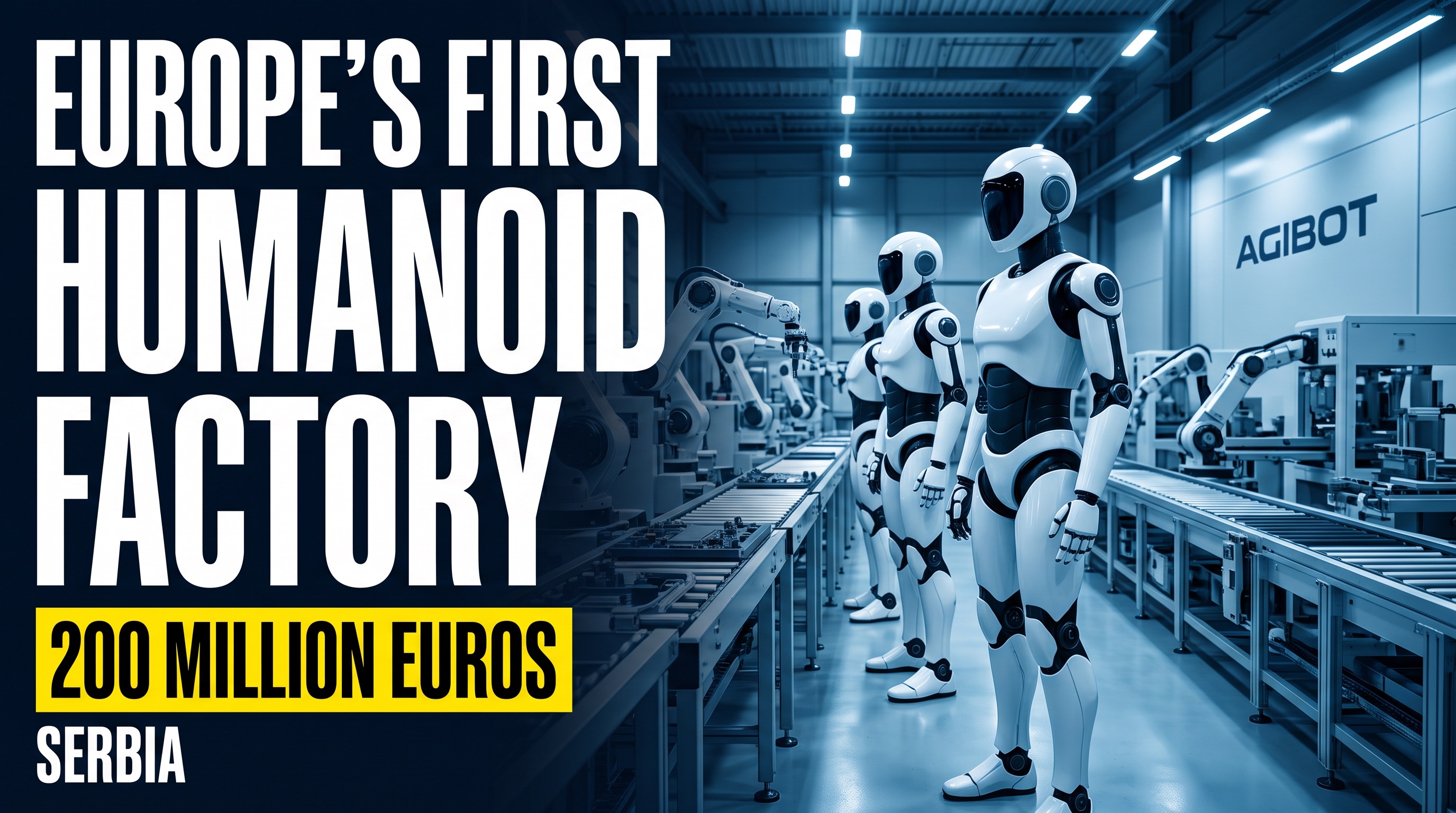 Symbolic image · AI-generated
On September 2, series production of humanoid robots on European soil began in the Serbian town of Šabac, operated by Shanghai-based manufacturer AGIBOT and automotive supplier Minth. First phase: 20 million euros, around 5,000 units. In mid-September comes the groundbreaking for a robot park in Inđija, 200 million euros, up to 20,000 units per year.
Two days later, the same company announced at IFA Berlin something that carries more weight than any production hall: TÜV Rheinland has certified its flagship model, plus there is a European distribution partner. The USA placed foreign robotics on a blacklist in late July. Here, the opposite is growing—a Chinese manufacturer with European factory, European test seal, and European dealer network.
The hall in Šabac belongs to Minth Metal Parts Majur, a facility for automotive parts that the corporation has operated for years and where over 2,000 people work in the region. The robots are not being built on greenfield, but rather among running presses and conveyor belts. This is intentional. AGIBOT collects movement data from such environments with which their own models are further trained, and a factory already running in rhythm produces more of that than any test laboratory. Serbian President Aleksandar Vučić attended the opening and named the 5,000 units as the initial target.
The company behind this is no outsider. In the first half of 2026, AGIBOT supplied just over forty percent of all humanoids delivered worldwide, overtaking Unitree; their Shanghai facility released its 15,000th robot this summer. Unitree regularly contests the figures because AGIBOT also counts mobile two-arm units that roll on wheels instead of standing on legs. For customers, the dispute is secondary. When someone is equipping a factory hall, they want a device that does the job, not one that fits the definition.
At IFA, the breadth of the product range became clear. Center stage was the A3, a 173-centimeter-tall and 55-kilogram-heavy biped with swappable batteries, alongside the mobile X2 Ultra, which was sent down the catwalk at the show. There is also the wheeled G2 for assembly and material transport, the cleaning machine C5, quadruped models for inspection runs, and a five-fingered hand called OmniHand. But the real news was more understated: The A3 Ultra received RED DA, RED NB, and Safety AK certificates from TÜV Rheinland. Behind this stands CE compliance according to the European Radio Equipment Directive plus verified safety functions. Further models are undergoing the same certification procedures.
For a foreign manufacturer, this is precisely the high hurdle, not mobility. A device moving among people cannot be put into operation without these papers in any facility that takes its occupational safety seriously. Distribution is handled by Tekpoint, a European distributor, and the focus is notably not on industry but on shops, hotels, and cleaning. There, integration cycles are short, the device is deployed in days rather than months.
Skepticism is warranted nonetheless, at one point that the communiqués omit. An assembly line does not make a Chinese robot a Serbian one. Whether a device assembled in Šabac counts as original goods under tariff law depends on how much value creation actually occurs on site, not on where the final screwdriver was applied. Actuators, gearboxes, and computing units continue to come from China. Whether a supply chain emerges in Serbia or merely final assembly with a European address will be decided in the next two or three years. The 20,000 units annually is a plan, not a capacity.
For Swiss buyers, more depends on this question than appears. Since October 1, 2010, a free trade agreement has applied between EFTA and Serbia, and commercial goods of origin pass duty-free. Whoever orders a device here should ask to see the certificate of origin before calculating the price. More important still is the certification side: Switzerland does not conduct its own robot approvals; in the procurement process, CE declarations and safety certificates are requested. A manufacturer who has these documents from TÜV in hand is suddenly capable of satisfying requirements in a bid, whereas a year ago they would have failed at the form stage. And a distributor in Europe means simply: replacement parts in days instead of weeks.
What the factory is really worth reveals itself not in Berlin. A choreography on the trade show catwalk proves little about a machine that should pack boxes for eight hours straight with no one standing beside it. The proof comes when the first devices assembled in Šabac must hold up through a shift in European operations. Until then, the balance sheet of this week remains geographical: mass production of humanoids no longer takes place only in East Asia.
This article was created with the support of artificial intelligence and editorially reviewed. The article image is an AI-generated symbolic image, not a press photo.