The Box in the Hallway: What Really Happens the Day After a Robot Arrives
A bipedal robot costs less today than a used car. The first afternoon is wonderful, the second day is demanding. A scene from the hallway, with numbers that no brochure prints in bold.
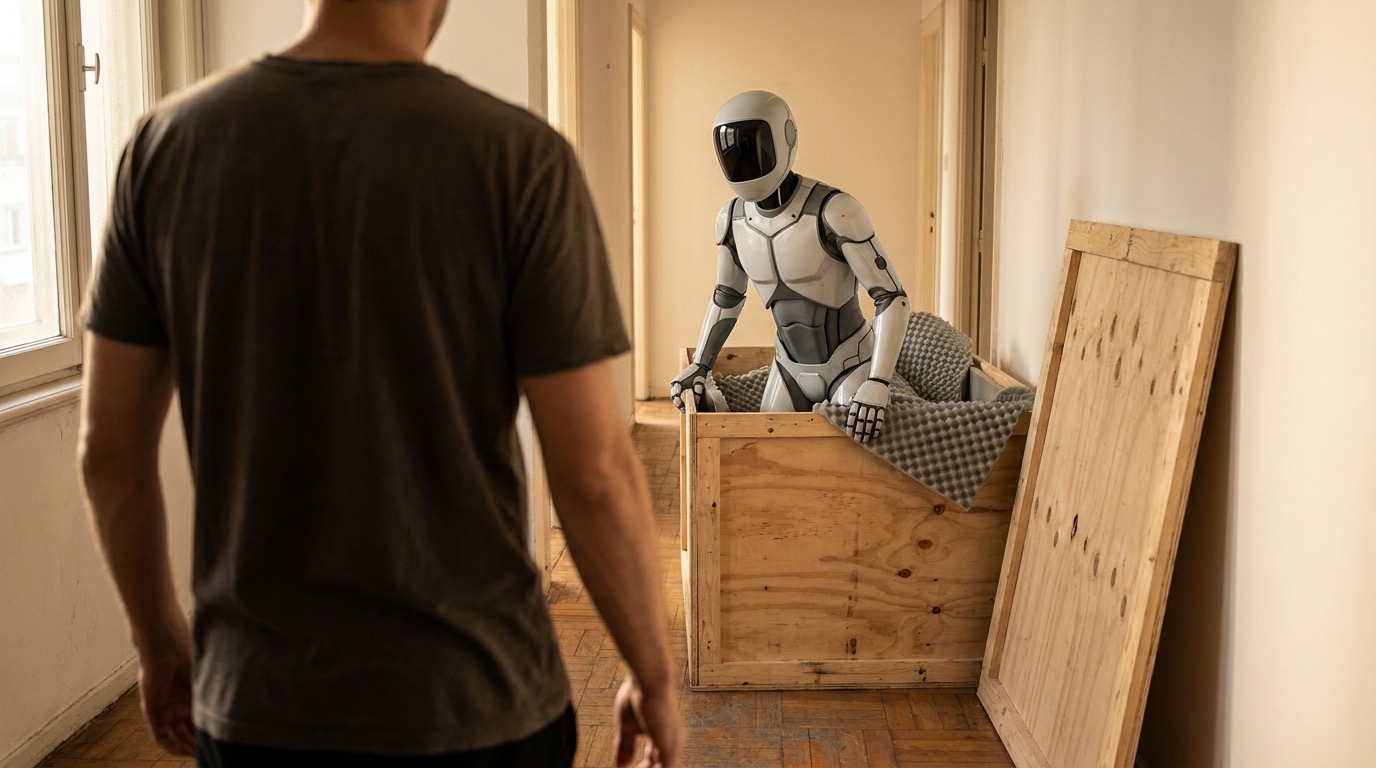 Symbolic image · AI-generated
The box is larger than expected. Plywood, metal corners, stickers with Chinese characters, and it's standing in the middle of the hallway because the driver didn't want to carry it up to the second floor. Inside is a bipedal robot. 1.21 meters tall, 25 kilograms heavy, 5900 dollars expensive. The lid opens, two hands grip under the shoulders, and then the thing stands up the way nothing else stands up that you've ordered online.
The scene is made up. The numbers in it are not, and what comes after that isn't either.
The first afternoon is the easiest part of the whole story. App on the phone, turn on Bluetooth, pair, a built-in tutorial guides you through the operation. After that, the robot walks through the apartment, turns on command, shows its camera image on the display, and does exactly what was shown in the videos. The neighbors come over. It's a wonderful afternoon.
On Sunday you want more. The robot should go to the door when someone rings, or at least avoid the dog. And at this point the buyer encounters the sentence that no brochure prints in bold: On the cheaper models, you can't run your own program. They are demo units. If you want to build something yourself, you need the developer version, and with the larger model that costs not 13500 dollars, but starting at 43900. This can't be unlocked afterwards.
Let's assume they bought it right from the start. Then on Monday evening they're sitting there with a network cable in their hand. The connection to the robot doesn't run over the wireless network, but over cable. The robot creates its own small network and doesn't distribute addresses in it, so you have to manually give your laptop a matching number. And the laptop wants Linux, because the manufacturer's software doesn't take anything else seriously.
The evening still ends with an error message. Between your own program and the robot sits intermediary software that carries messages in both directions, and it must be in exactly one specific version. If the installation doesn't find it, everything breaks. This is the point where most people give up for the first time, and it's no shame, because the message simply means nothing to a layperson.
At least you're not alone in this today. A language model translates the Chinese documentation, interprets the error message, and even writes the first movement program. It can't connect to the robot, it doesn't see the network in your apartment, you type every command yourself. But the distance between curiosity and your first own script has become smaller than it was two years ago.
And then comes the moment that no video shows. Before the first own movement program runs, the robot hangs in a frame. That's how the manufacturer describes it themselves for their test mode. Mats lie underneath, a second person stands in the room, and you've practiced beforehand how to stop everything immediately. If you think that's exaggerated, you should know that the knee joint of the larger model alone delivers 120 newton meters. A device like that doesn't fall gracefully. It hits hard.
That leaves the question of what you end up with. The robot walks safely on level ground. It masters rehearsed movement sequences, it responds to speech, it sees what's in front of it. What it doesn't do: walk independently through unfamiliar rooms and accomplish tasks there. Grasping is immature, stairs are unreliable, and endurance is disappointing. Reports mention ten to fifteen minutes of work, then five to ten minutes of cooling down. This device won't fold laundry.
If you want it more honest, buy the four-legged robot dog. It starts at 1600 dollars, walks over grass, sand, and stairs, handles inclines up to forty degrees, captures a map of the building with its laser scanner, and travels set routes. It's suitable for monitoring a hall today. It's less suitable for video, and that's exactly where the difference lies between a tool and a promise.
For Swiss buyers there isn't much to add, but it's worth knowing beforehand. There have been no tariffs on such devices since early 2024, the import tax of 8.1 percent remains. More delicate is the CE mark, which confirms that a device complies with European safety regulations. The information about this contradicts itself depending on the source. Asking the seller in writing before purchase costs nothing and is everything in case of dispute.
The box in the hallway is not a finished product. It's a kit with legs. If you know that beforehand, you'll have an exceptionally good summer with it. If you don't know it, you've bought an unusually expensive room decoration for 5900 dollars that dances on command.
This article was created with the support of artificial intelligence and editorially reviewed. The article image is an AI-generated symbolic image, not a press photo.