A usable movement from 300 attempts: China's robots are learning slower than they're being built
In a state-funded training center in Liuzhou, people with VR headsets are teaching over a hundred humanoids simple hand movements. A usable movement emerges from three hundred attempts. A Reuters investigation from August 31 shows how far China's robot hardware has outpaced robot intelligence.
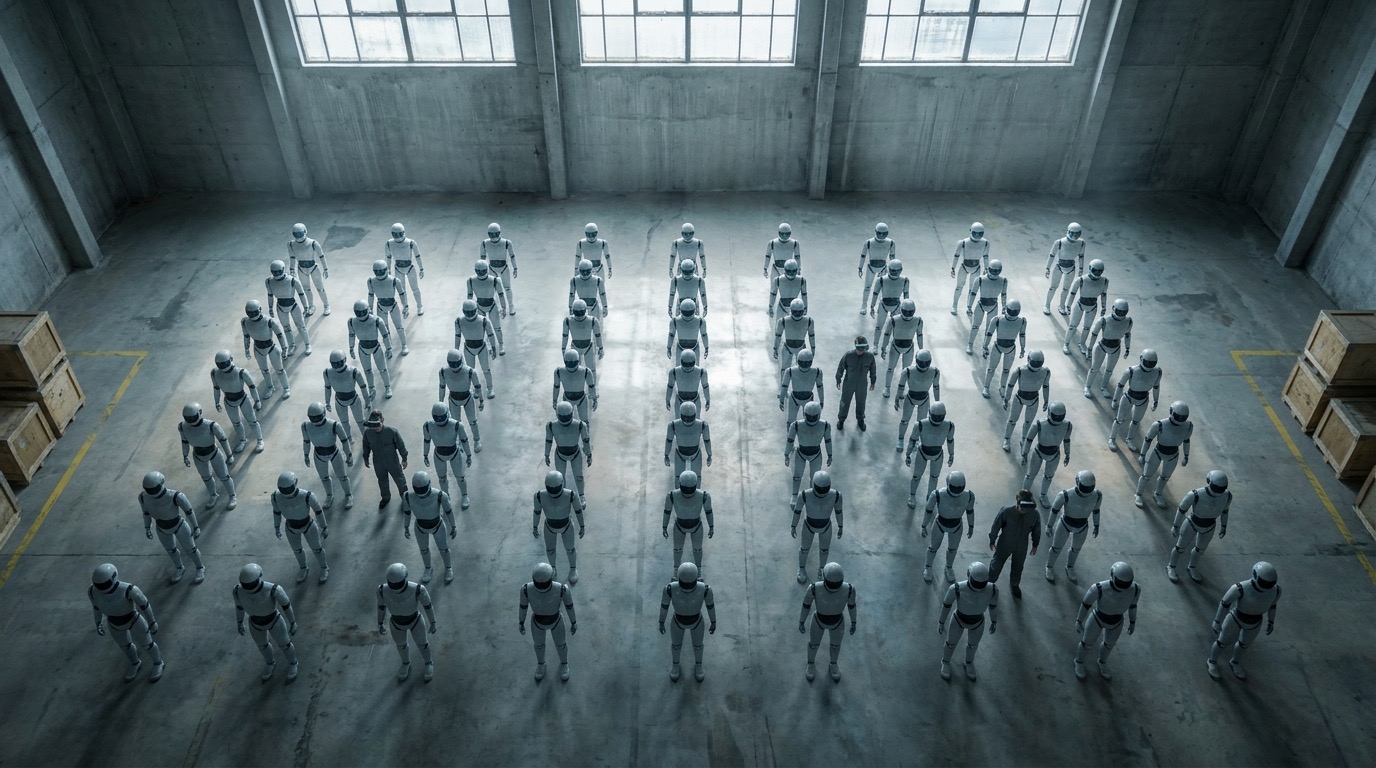 Symbolic image · AI-generated
In a hall in Liuzhou, a dozen people wearing VR headsets guide more than a hundred humanoids through hand movements such as sorting boxes and making coffee. From three hundred attempts by an untrained trainer, a single usable movement emerges; for trained trainers, one from fifty. The figures come from a Reuters investigation from August 31, based on nearly a thousand procurement documents and forty interviews.
China's robot hardware has outpaced robot intelligence, and this can now be quantified. Authorities purchased humanoids for 230 million dollars in the first half of the year, up from 62 million in the previous year. The industry has around 500,000 hours of usable training data available. According to industry estimates, one hundred million would be needed.
The center in Liuzhou is owned by the regional government of Guangxi, which awarded UBTech a contract worth 18 million dollars last October to equip the hall with robots and the necessary technology. What is created there is meant to be sold: movement data for factories. Three employees told Reuters that the project cannot sustain itself on its own. Operating costs are high, and prices for training data in a market that didn't exist three years ago are low. During a visit, one of the humanoids could barely carry a crate. About twenty percent of a human's speed, said an employee; in two to three years, the machines could catch up.
The reason for the sluggishness lies in the nature of the models. A language model processes text and generates text. A factory robot must translate images into force and movement, into the grip around a piece of fabric, into the torque on a screw. Vision-Language-Action models is what these systems are called, and they are significantly harder to train because they require thousands of hours of real-world situations. But above all, they are brittle. If the light changes, the angle, the surface, or the object, the learned movement falls apart. "The problem shifts from the last ten centimeters to the last one, sometimes to the last millimeter," said Jia Baoxiong from Beijing's Institute for General Artificial Intelligence.
The state planning authority now counts over 150 humanoid manufacturers, more than there are Chinese electric car brands. The Ministry of Industry expects over 100,000 humanoids to be built in the country this year. Worldwide, around 20,000 units were delivered last year, with 95 percent from Chinese production. The grid operator State Grid announced in April that it would invest one billion dollars in humanoid and two-armed robots for grid maintenance and substation inspections. Shenzhen aims to build a cluster with 1200 companies by next year.
This demand comes almost entirely from the state, and that skews every figure one reads. Deep Robotics from Hangzhou disclosed that around 42 percent of its net profit of 4.2 million dollars came from subsidies. The company has sold four humanoids in two years. At the same time, prices are falling: Morgan Stanley expects a 15 percent decline for 2026; Leju's Kuavo became cheaper in 2025 by just over a quarter to around 46,000 dollars; and a dance robot for advertising appearances costs 440 to 600 dollars per day to rent instead of around 1500 in the previous year.
Not everyone sees this as healthy. "There will definitely be consolidation, the question is just who it hits and how ugly it gets," says Kevin Xu of Interconnected Capital. Lizzi Lee from the Asia Society Policy Institute describes the method more soberly: Beijing deliberately launches a kind of hunger games in which overcapacity is not an operating accident but part of the search process. In the end, a few globally competitive companies remain. The path to get there ruins the others.
There are applications that already make economic sense today. Galbot operates robots in more than two dozen Chinese cities in pharmacies that retrieve packages from shelves based on digital orders. A device needs about a minute for this, and according to company information, the hit rate is over 95 percent, with the few errors mostly concerning grasping rather than selection. A typical store carries 5,000 to 6,000 items in thirty to fifty square meters. Exactly such tight, repetitive tasks are the realistic entry point, not the universal helper.
For Swiss companies, this has two practical implications. First, the price of a Chinese humanoid is currently not a reliable benchmark because it is partly subsidized and partly a loss-leader price. Those making purchases should therefore focus less on the acquisition price and more on the question of whether the manufacturer will still exist in five years and whether spare parts and software updates will be available then. Second, the robotic arm remains the better choice for most tasks in a factory hall—faster, more reliable, in use for decades. Geely also confirmed that in Ningbo, despite humanoid tests with UBTech, arms and autonomous transport systems continue to handle the critical steps.
How dependent on Chinese hardware Europe already is became clear in July at the RoboCup in South Korea. Teams used to bring their own machines; now almost all play with Chinese robots, as a manager of South Korean manufacturer AeiROBOT noted. Even if the expected consolidation sweeps many brands from the market, supply chains remain where they are today. For Europe, this means: the shortfall is not in motors and gearboxes, but in data, and data is generated where robots actually work. In Liuzhou so far, it takes three hundred attempts for one usable hand movement.
This article was created with the support of artificial intelligence and editorially reviewed. The article image is an AI-generated symbolic image, not a press photo.