The glove writes along: Tacta wants to teach robots fine motor skills
California-based startup Tacta Systems unveiled a robotic hand with fifteen movable joints and sensors smaller than a grain of sand at the end of July. More exciting than the hand is the accompanying data glove: skilled workers wear it during normal work, while 256 sensors per fingertip record everything. When you put it on, you teach the machine what you yourself have learned over years.
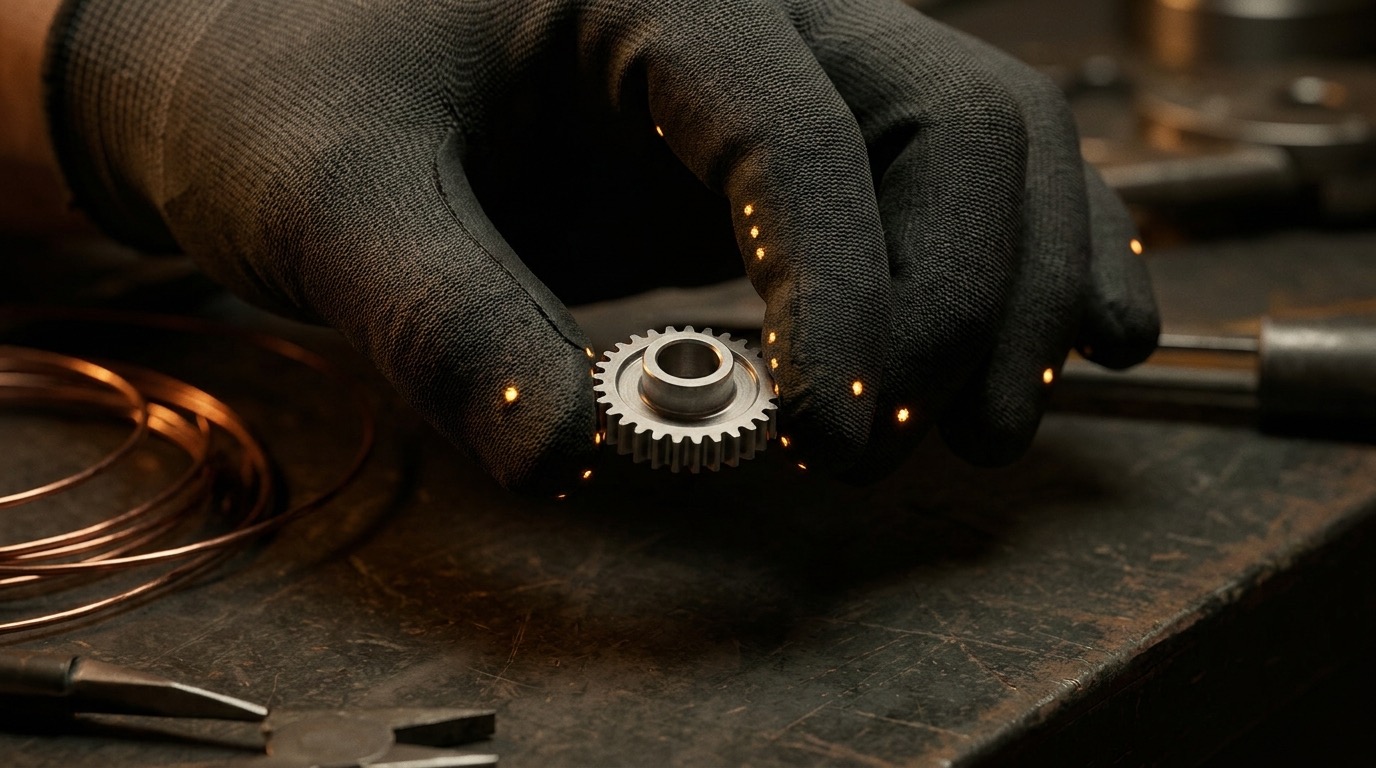 Symbolic image · AI-generated
At the end of July, California-based startup Tacta Systems presented a robotic system comprising three parts: a human-sized hand with fifteen movable joints, a data glove, and an AI model that learns from one and controls the other. The tactile sensors are smaller than a grain of sand and measure pressure from 250 to 700,000 Pascal. It is not powered by motors, but by fluid in thin tubes. Delivery begins in early 2027.
More exciting than the hand is the glove. Skilled workers put it on and continue working as usual, while 256 sensors per fingertip record force, movement, and temperature. Every work hour becomes training material. Whoever wears the glove teaches the machine what they themselves have learned over years.
Tacta calls the drive principle Fluidic Tendon. A fluid moves through the pull cables, shifting small pistons in the fingers. The advantage lies in space and heat: the fingers can be kept very slim, and virtually no waste heat is generated in the hand itself. CEO Vikram Pavate puts the service life at up to 30 million cycles, significantly more than conventional cable-driven hands, where a single broken cable can disable the entire hand. Each finger can exert up to 25 Newton of force, roughly 2.5 kilograms per fingertip. The sensors measure temperature to a tenth of a degree of precision, and because they wear out, the fingertips are intentionally designed as replaceable wear parts.
Behind this is a diagnosis that has become consensus in the industry. "Humans have a remarkable brain, but AI is catching up," Pavate says. "We have passable eyes, and computer vision has caught up. What's been missing are the hands." For language models, half the internet is available as training material. For grasping, fitting, and inserting, there is nothing comparable, because tactile sensation cannot be tapped anywhere. The glove is meant to fill exactly this gap. It streams its data wirelessly to a local device, requires no training, and is deployed directly on the customer's line to fine-tune a pre-trained model.
First, Tacta is targeting electronics manufacturing: installing connectors, assembling cable harnesses, fitting sensitive components. Those jobs that are listed as semi-skilled in statistics but actually require years of practice. Founded in 2023, the company has raised 75 million dollars so far, of which 64 million in a Series A led by America's Frontier Fund and SBVA. Momentum comes from the American debate about reshoring production, as electronics assembly without cheap manual labor can only be recovered through automation.
Little of this is proven so far. Not a single TactaBot has been delivered yet, the specifications for cycle strength and precision come from the manufacturer itself, and the competition is not standing still. South Korean company Tesollo is preparing for an IPO while simultaneously developing hands for humanoids, startup Contactile sells grippers with their own tactile sensors, and virtually every major humanoid manufacturer is working on their own solution. Announcing a robotic hand today does not enter a niche but a crowded field.
For Switzerland, the topic is closer than it might appear at first glance. Where value creation depends on precision assembly, medical technology, watch movements, sensors, and small batch production in the MEM industry, the hand is the bottleneck, not the robot arm. These companies face two problems simultaneously: they cannot find enough skilled workers, and some of the experienced ones will retire in the foreseeable future. A system that first records and then replicates know-how hits this nerve pretty exactly.
There remains the uncomfortable question of who actually owns the recorded finger dexterity. Tacta describes the glove as a tool that contributes to its own dataset with every work hour. From the company's perspective, that is an efficiency gain. From the perspective of the person wearing it, their own professional experience flows into a model. Pavate dreams in interviews of sushi chefs and pianists with gloves. The first real application will probably look more prosaic, somewhere on an assembly line where a position has been open for months.
This article was created with the support of artificial intelligence and editorially reviewed. The article image is an AI-generated symbolic image, not a press photo.