800 Volts in the Rack: A Zurich Startup Wants to Hand Over the Most Dangerous Work in Data Centers to Robots
Zurich startup Exclaim Robotics emerged on August 4th and announced a pre-seed round of 4.95 million dollars from Founderful and Playfair. The company is building mobile robots that replace faulty hardware in AI data centers. The impetus is the transition to 800-volt direct current in the rack, where routine maintenance becomes work with arc flash risk.
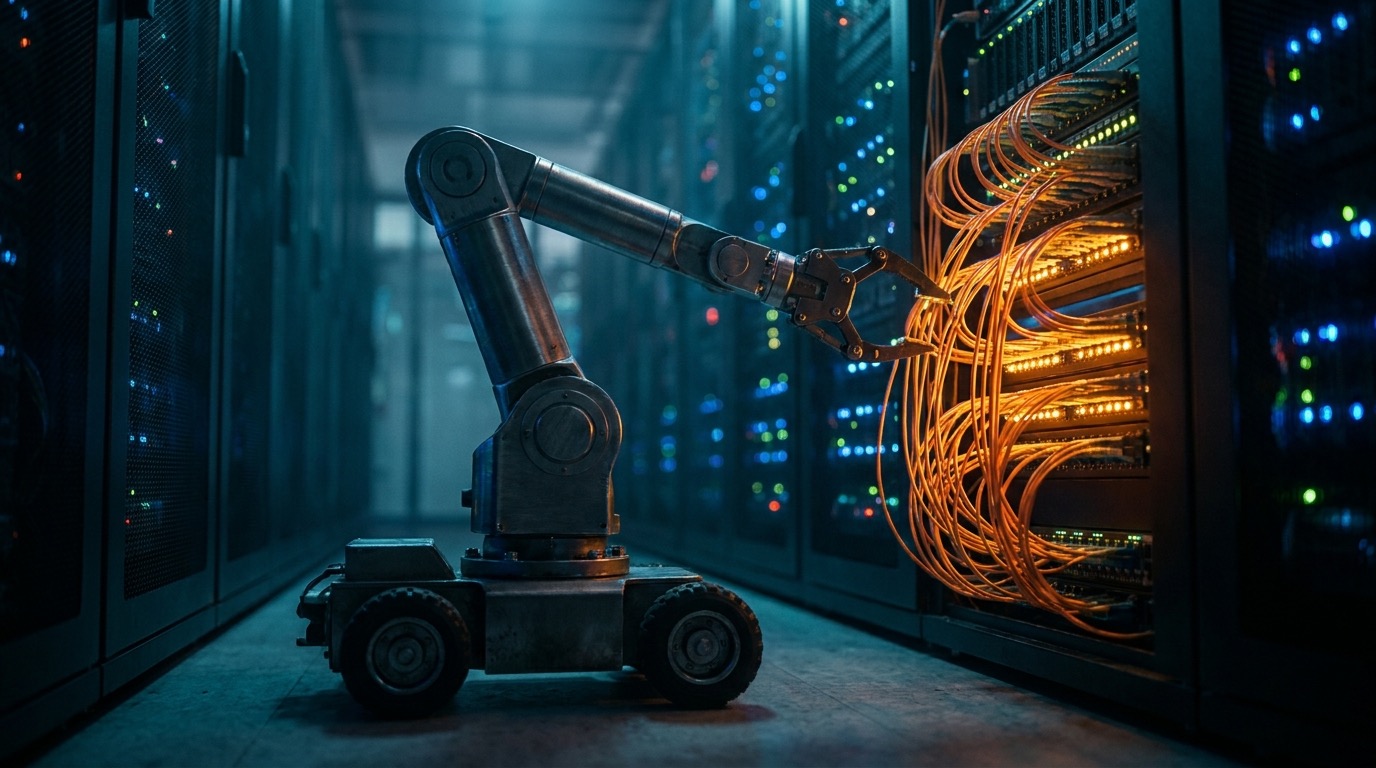 Symbolic image · AI-generated
Nearly five million dollars for a company without a finished prototype: Zurich startup Exclaim Robotics emerged on August 4th with a pre-seed round of 4.95 million dollars from Swiss fund Founderful and London-based investor Playfair. The company plans to build mobile robots that replace faulty hardware in AI data centers.
The motivation is uncomfortably concrete. The next generation of AI racks delivers 800-volt direct current directly into the cabinet, and at this voltage, opening a rack front becomes work with arc flash risk. Capacity is growing faster than personnel can be trained. Ironically, the last unautomated layer of the data center becomes the most dangerous.
Practically everything in a modern facility can be managed remotely. The physical interior cannot. When a drive fails, someone still has to walk through the hall and put their hand on the metal. Exclaim targets exactly this gap, and deliberately not with a universal machine. The robot should navigate autonomously through the data hall, position itself in front of a rack, and work the front from floor to top rail without any modifications needed to the building. The renderings on the company website show two arms on a vertical column, mounted on a mobile platform.
The first task list sounds deliberately unspectacular: clean and swap optical transceivers and SFP modules, reconnect copper cables, replace drives. This is fine motor skills in the centimeter range, not heavy work. Training begins first in simulation, where a movement can be practiced thousands of times, then on real racks with real sensors. If the machine is not confident enough about an action, it does not attempt it but hands over to a human at remote control. For a startup whose robot might handle hardware worth a mid-range car, this restraint from overconfidence is the real product decision.
Behind the company is Helen Oleynikova, who spent fifteen years in robotics before founding: Willow Garage, Google, Microsoft, Nvidia, plus a doctorate from ETH Zurich on mapping and planning in complex environments. She is a co-developer of nvblox, the library for 3D mapping and collision avoidance that now sits in Nvidia's Isaac ROS. She got the idea at Microsoft, where an internal collaboration first showed her what robotics in data centers could look like. In January 2026, she left ETH to pursue it full-time. The founding team includes, among others, Patrick Pfreundschuh, also an ETH doctoral student and part of the team that won the DARPA Subterranean Challenge.
"The pace of innovation in data center infrastructure reminds me of the space race," says Oleynikova. Liquid cooling, 800-volt DC throughout the building, possibly superconducting power rails cooled with liquid nitrogen. Maintaining that by hand becomes more dangerous every year.
Skepticism is warranted nonetheless, and Exclaim voices it themselves. Dexterous manipulation has been the unsolved problem of robotics for decades, and while a server room is more orderly than an apartment, the cable management in front of a well-stocked rack front is anything but neat. Playfair describes the first year accordingly soberly: it is about reliably mastering a few specific tasks without ever damaging anything. A robot that scratches an optical module costs more than it saves. And 4.95 million dollars is a very modest starting line measured against the sums Chinese humanoid manufacturers are currently raising.
What makes this especially remarkable is the sharpness of focus. While the industry debates universal robots that can do everything a little bit, this team picks a single room type with standardized dimensions, known geometry, and a customer who calculates downtime in francs per minute. The Zurich environment provides the ingredients practically free of charge: an ETH with decades of navigation and mapping research, a dense network of robotics companies, and Founderful as a funder accustomed to deep tech from the academic environment. For the Swiss robotics scene, Exclaim is thus less of a sensation than further proof of a pattern that has solidified over recent years.
Whether this becomes a business depends not on vision but on a very mundane question: can the machine cleanly swap a module a thousand times in a row. Long-term, the company wants to offer the same capability wherever maintenance is dangerous or hard to reach, next in high-voltage and energy infrastructure. Until then, there is first a prototype that does not yet exist.
This article was created with the support of artificial intelligence and editorially reviewed. The article image is an AI-generated symbolic image, not a press photo.