BYD's first robot doesn't stand on the production line, it stands in the dealership
BYD has confirmed its first humanoid robot: Xiao Di, 1.61 meters tall, 58.5 kilograms, 31 degrees of freedom. It won't work in the factory, but will greet customers in pairs or groups of three in every branch. It won't come to the USA—the FCC made sure of that six days before the announcement.
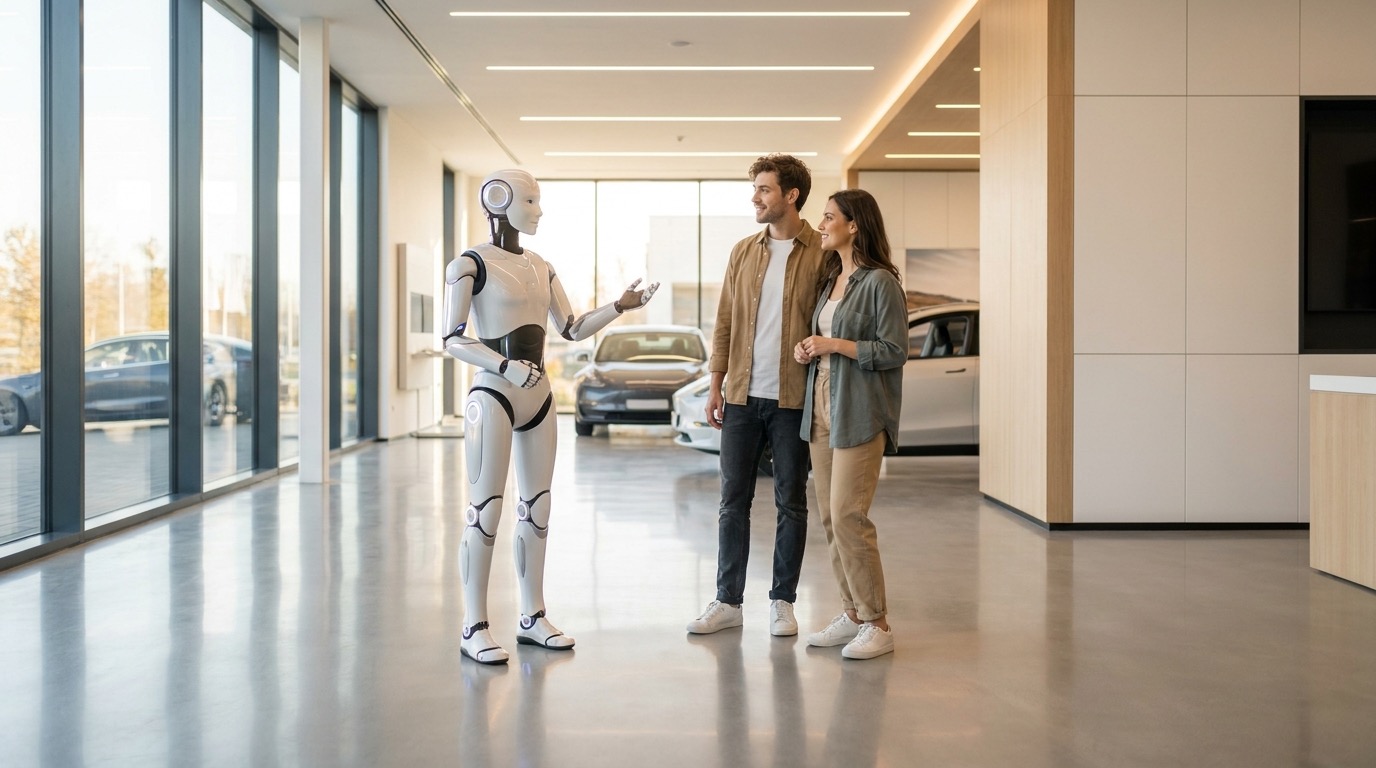 Symbolic image · AI-generated
On August 4, BYD officially confirmed its first humanoid robot. Xiao Di measures 1.61 meters, weighs 58.5 kilograms, has 31 degrees of freedom, and won't be placed on an assembly line, but in the showroom. Two to three units will greet visitors in each branch in the future, explain models, and demonstrate features.
While half the industry talks about robots in factory halls, BYD occupies the space where such an investment immediately translates into customer contact. Yet Xiao Di won't come to the USA: six days before the announcement, the FCC authority effectively excluded new Chinese humanoids from imports.
The device will be shown in the company's own experience center Di Space in Zhengzhou, explicitly as a functional prototype and not as a concept study. The rollout was rather inelegant: in late July, a post with first details appeared on Weibo, then quickly disappeared. After that, BYD confirmed to Chinese business media what had leaked, and released a teaser—a new friend would stop by in early August. That's how you talk about a sales assistant, not an industrial machine. The Hong Kong stock briefly gained over two percent after the confirmation.
The technical specifications show what Xiao Di was built for. According to the manufacturer, the hands position with millimeter precision and grasp objects weighing about one kilogram. That's enough for a brochure or charging cable, not for a gearbox. The degrees of freedom are distributed across seven per hand, six per leg, three in the hips, and two in the neck. What stands out is how much investment went into perception and interaction: 360-degree vision, continuous environmental modeling, threefold recognition of face, gesture, and lip movement, plus translation into six Chinese dialects and six foreign languages. This isn't a sensor package for palletizing—it's one for conversation.
It makes sense that BYD is stepping up here. The company manufactures batteries, electric motors, and power electronics itself—exactly the three most expensive assemblies of a humanoid. What goes into millions of vehicles can be manufactured at unit costs that a pure robotics manufacturer can only dream of. The same logic Tesla brings to Optimus, just with significantly more vehicles behind it. We already discussed BYD's entry into robotics here, back then without a concrete device. Now there is one.
The rest of China's automotive industry is taking the same path. Xpeng is working on Iron, Chery on Aimoga, plus FAW, Changan, Dongfeng, and GAC with their own programs. The difference lies in the place of use. Most target manufacturing and logistics, where the benefit is high, but the reliability requirement is brutal. BYD chooses the easier field. A robot that greets a customer and fumbles embarrasses itself. A robot that fumbles in final assembly costs a vehicle.
You could cynically say Xiao Di is above all a very expensive eye-catcher. That's not entirely wrong, but it falls short. When you let robots talk to customers in thousands of branches, you collect interaction data in amounts no laboratory can generate. That's exactly what the entire industry lacks. And the showroom is a controlled, flat, well-lit space—roughly the friendliest thing you can ask of a humanoid.
Then there's politics. On July 28, the FCC added newly developed humanoid and quadruped robots from China, as well as networked inverters, to its ban list, citing cybersecurity, espionage risks, and critical infrastructure protection. This explicitly affects models without prior US approval, including Xiao Di. For Tesla, that means peace from Chinese competition in its home market for now. For all other markets, Europe included, it doesn't apply.
By Swiss standards, the reception robot in the dealership initially sounds like a gimmick, and in a garage with six employees, it will remain one. It gets interesting at the large brand dealerships in Zurich, Bern, or Geneva, where advice must be multilingual and staff is scarce. Twelve languages and dialects in one device is a different argument there than in Zhengzhou. Whether a customer spending 60,000 francs wants to be advised by a machine, however, is not yet answered.
This article was created with the support of artificial intelligence and editorially reviewed. The article image is an AI-generated symbolic image, not a press photo.