Strike against a robot that isn't even here yet
In Ulsan, 35,000 Hyundai employees downed tools because the company wants to deploy 25,000 humanoid robots in its factories. There are none there yet in Korea. That's exactly the point: the union wants a say while it still can.
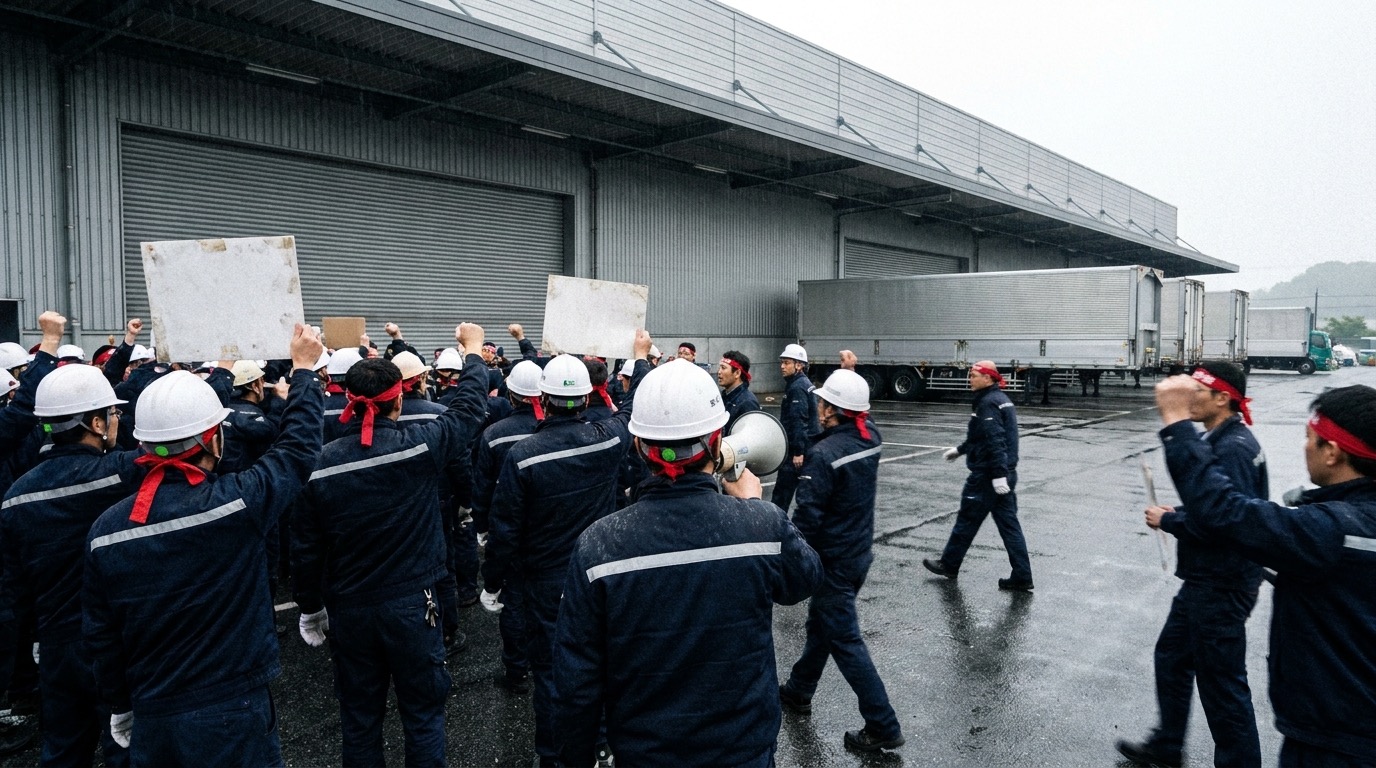 Symbolic image · AI-generated
On July 20, the assembly lines in Ulsan, South Korea, ground to a halt. 35,000 employees stopped work for four hours at the world's largest car factory. Hard-bargaining unions are nothing new at Hyundai—they've been part of the summer landscape there for decades, as regular as the rainy season. What was new was the reason for the strike. Workers downed tools against a machine that doesn't currently exist in any Korean factory.
The machine in question is Atlas, the electric humanoid from Boston Dynamics. Hyundai has announced plans to deploy over 25,000 units in its own Hyundai and Kia factories. The first confirmed deployment is not in Korea but at Metaplant in Georgia, planned from 2028 onwards, initially for part sequencing and from 2030 for assembly tasks as well. There is no timeline for Korea. The union isn't waiting anyway.
What it's demanding is pretty unprecedented in automotive industry history: a contractually binding right of approval. No humanoid robot should enter a Korean factory without prior consent from the workforce representatives. Two additional demands target the same core concern. Production workers should shift from hourly wages to fixed monthly salaries, so that fewer working hours don't quietly translate into less pay. And the retirement age should rise from 60 to 65.
In previous waves of automation, things unfolded differently. First came the technology, then jobs disappeared, then negotiations took place over severance packages and retraining. The Korean metal union is reversing the sequence. Byun Jun-hwan, its general secretary and chief negotiator, summed it up matter-of-factly: the protective mechanisms must be in place before the first robot crosses the factory threshold. Back in January, the union had publicly stated that without an agreement, not a single robot with new technology would enter the facility.
The timing is no accident, but cold calculation. In Georgia, there is no union, so nobody has leverage. In Ulsan, there is, and roughly half of all Hyundai global production runs there. The partial strikes from July 13 to 15, then just two hours per shift, cost an estimated 5,000 vehicles and around 200 billion Won, roughly 145 million dollars. That hits a company already struggling with a significant drop in operating profits and US tariffs.
The fact that the strike happened specifically on July 20 has a second reason. That same day marked the end of the contractual deadline by which Hyundai acquired the last roughly ten percent of Boston Dynamics from SoftBank, for approximately 325 million dollars. Since then, the robotics company belongs entirely to the auto group. The last external voice on the board is gone, and with it, the last brake on the pace of expansion.
Technically, it's understandable why the workforce is nervous. The new Atlas is roughly 1.9 meters tall, weighs about 90 kilograms, and has 56 degrees of freedom. It can briefly lift 50 kilograms and works around the clock with swappable batteries. Above all, it's no longer programmed but trained: movements are demonstrated by people in motion-capture suits, refined through millions of simulation runs, and then transferred to the actual machine. A new task should be mastered within a day. A classical welding robot does one thing very well and nothing else. This one can be reassigned like an employee.
Hyundai disputes the displacement logic. Vice-chairman Jaehoon Chang argues that people will train, monitor, and maintain robots, taking on more demanding work. That may be. In some halls, that's true; in others, barely. So far, the company has left unanswered the union's simple calculation: to run a facility around the clock requires three people and one robot.
Remarkably, Hyundai made a move in early July that went largely unnoticed. In the twelfth round of negotiations, management accepted a union consultation right for new business areas, explicitly including artificial intelligence and robotics. Previously, this applied only to the automotive sector. Consultation isn't quite a veto, but it's also not nothing. Agreement wasn't reached at that time on actual wage demands, nor has it been on employment guarantees in AI matters to this day.
Behind this lies a regulatory vacuum. For mixed work environments involving humans and operating humanoids, no binding safety standard yet exists; ISO 25785-1 for dynamically balancing robots is still being developed. What's being negotiated in Ulsan is therefore effectively substitute legislation at the bargaining table.
For Switzerland, this is more than a footnote from the Far East. Our industry traditionally settles such questions through collective labor agreements and social partnership, not through strikes, and in the MEM sector, the peace obligation has applied for decades. The mechanism behind it, however, is the same: whoever wants a say in the terms of a technology must have it before it enters the factory. Swiss collective agreements currently say practically nothing about humanoid robots. The topic is likely to be on the table at the next round of negotiations.
What emerges from Ulsan will be read far beyond Korea. The UAW in the United States will negotiate the same questions with Tesla, GM, and Ford in the foreseeable future. If the Korean union succeeds in writing approval rights into the contract, a template exists that will be copied. If it doesn't, the other side has one more argument.
This article was created with the support of artificial intelligence and editorially reviewed. The article image is an AI-generated symbolic image, not a press photo.