Lifting a dumbbell, plucking a grape: 1X gives its household robot Neo new hands
On July 9, 1X unveiled new hands for its household robot Neo: 25 degrees of freedom, tendon-driven actuation, and tactile sensing in the fingertips. The manufacturer is hitting on the industry's sore spot, because what actually makes humanoids useful is not determined by how they walk, but by how they grasp.
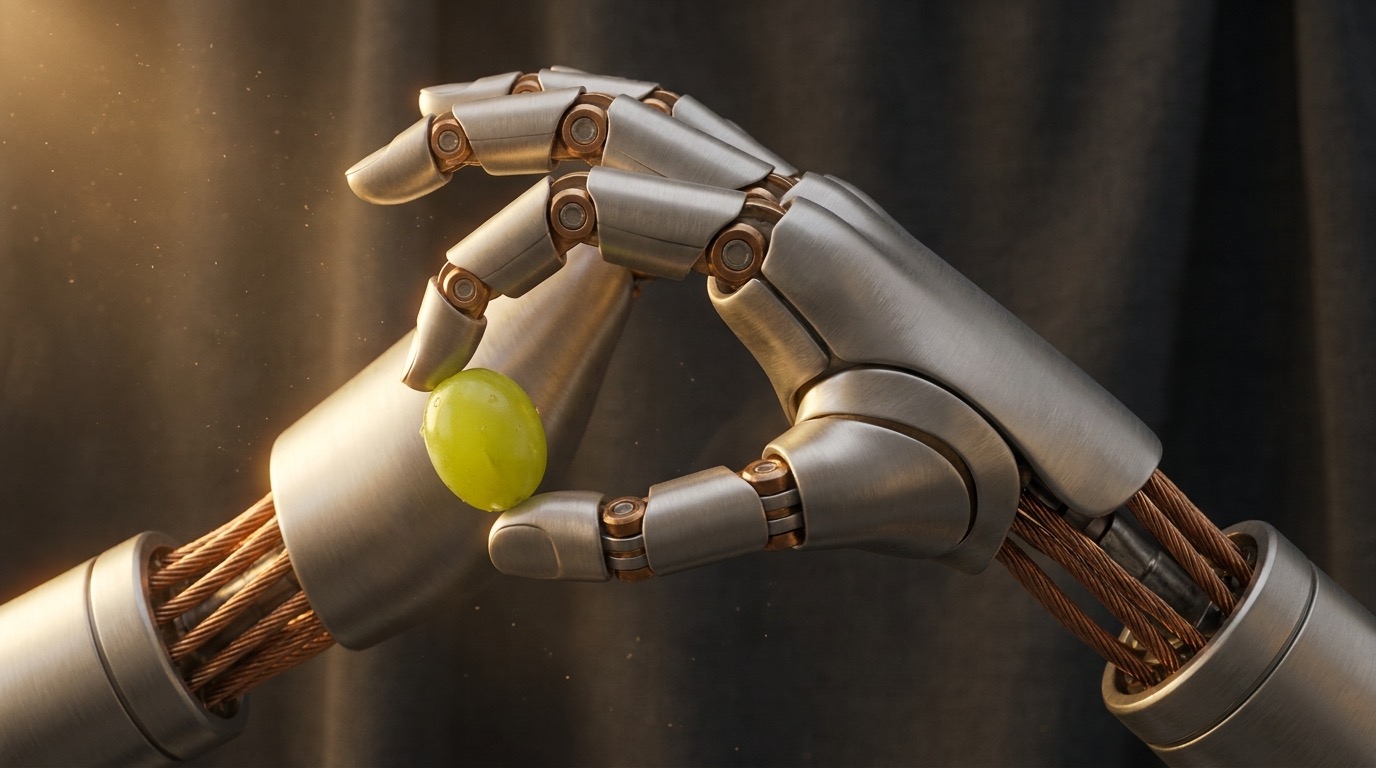 Symbolic image · AI-generated
Lifting nine kilograms and then immediately plucking a grape from the stem without crushing it: With this feat, Norwegian-American robotics company 1X unveiled new hands for its household robot Neo on July 9. 25 degrees of freedom, tendon-driven actuation, tactile sensing in the fingertips. CEO Bernt Børnich doesn't hold back on confidence: "This is what the industry has been waiting for."
That a manufacturer makes such a fuss over a single component has a simple reason. Humanoids can now perform walking, stair climbing, and even backflips with remarkable reliability. The bottleneck is at the end of the arm. Whether a robot actually does work in a household or factory ultimately comes down to one thing: the hands. Folding laundry, loading a dishwasher, picking up a screw—this is where machines still fail most often.
1X's new hand relies on a principle that comes closer to the human model than conventional robotic grippers. The motors sit in the forearm, with tendons running through the wrist to the fingers. 22 powered degrees of freedom are built into the fingers and palm, with three more in the wrist. The fingers are compliant: when pressed against, they yield and report the force being applied. At the finger joints, the hand achieves up to 45 Newtons of grip force and positions itself with 0.2 millimeter precision.
More interesting than the raw numbers is the sense of touch. Sensors in the fingertips measure not only pressure and contact point, but also shear forces—that is, the lateral sliding of an object. If a glass starts to slip from the robot's hand, it feels this and adjusts its grip before it falls. This is the difference that separates true grasping from mere clamping.
1X has also thought about everyday use. The hands are waterproof to IP68 standard and made from food-safe materials, so Neo can simply hold them under the tap. In the demo video, the robot screws in a light bulb, picks up a screw from the floor, zips up a zipper, and assembles Lego. According to the company, hundreds of units have already rolled off its own production line, with capacity for 10,000 hands this year. Every Neo delivered will get them.
For the industry, the announcement is a sign of where competition is shifting. What counts is no longer the most spectacular demo, but the question of who can manufacture fine manipulation at scale. Neo will be supplied first in the USA; Swiss households still have to wait. However, for those who want to follow how quickly such capabilities make their way into available devices, the Swiss market already offers plenty of examples today, from cobots with grippers to the first humanoids in robothub24's directory.
Whether the hands deliver on what the video promises in everyday use remains to be seen once the first customers have been operating their devices for longer. But the direction is right: the household robot doesn't get closer through bigger promises, but through better fingers.
This article was created with the support of artificial intelligence and editorially reviewed. The article image is an AI-generated symbolic image, not a press photo.