Small, soft, and worth $50,000: Amazon acquires Fauna Robotics, makers of Sprout
At the end of March, Amazon purchased New York-based startup Fauna Robotics, along with its child-sized humanoid robot Sprout. The robot is sage green, soft-padded, and above all: nowhere near ready for the living room yet. Nevertheless, the deal reveals a lot about how seriously the company is taking the household robot.
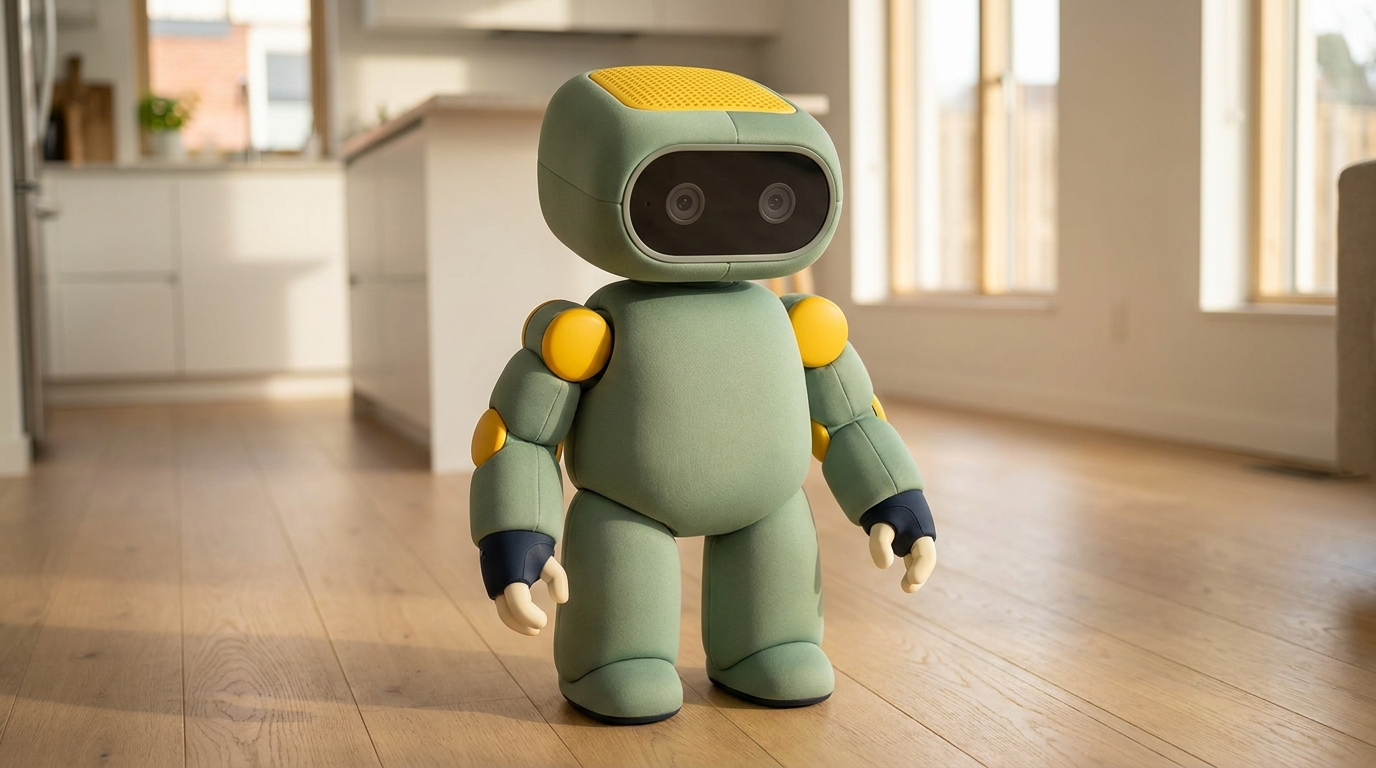 Symbolic image · AI-generated
Sprout is 1.07 meters tall, weighs 22.7 kilograms, and wears a soft foam shell in a muted sage green. Instead of a hard plastic shell you could bump into, a yielding outer skin. Instead of a mask, a face made of an LED strip running all the way around, plus two movable eyebrows. When you first see this creature, you think more of a toy figure than an industrial robot. That's exactly the intention.
Behind Sprout is Fauna Robotics, a startup founded in New York in 2024. The founders come from Meta and Google, the team has around 50 people. In early 2026, the company emerged from obscurity and introduced the robot, announcing a price: $50,000 for the so-called Creator Edition. A few weeks later, on March 25, Amazon confirmed the acquisition. The entire team is moving to the Personal Robotics Group of the company, the division that already oversees the mobile home robot Astro.
It's worth pausing at the price for a moment. No one pays $50,000 for a helper that unloads the dishwasher. Sprout is not designed as a consumer device, but rather as a developer platform. Fauna supplies the robot along with modular software, pre-built components for navigation, mapping, and teleoperation, plus the necessary interfaces. Research labs and companies are supposed to build their own applications on it without starting from scratch on tedious groundwork. Among the first customers are Disney, Boston Dynamics, and the universities of New York and San Diego. A robot for programming, then, not a robot to buy.
Technically, the device is quite mature. 29 degrees of freedom are distributed across arms, legs, neck, and gripper; the arms reach from the floor to table height. Inside, an NVIDIA Jetson AGX Orin computes with 64 gigabytes, plus a ZED-2i stereo camera, several time-of-flight sensors, and a microphone array. The battery can be swapped while operating and lasts three to three and a half hours. Sprout can walk, kneel, stand up from a squat, grasp light objects, and get back up after a fall. Heavy loads or repetitive work are not its forte. It is built to move among people, not to displace them from the factory floor.
With this, the acquisition fits into a larger pattern. Amazon already operates a massive robot fleet in its warehouses, coordinated by its own AI, and maintains majority ownership of the two-legged warehouse assistant Digit from Agility Robotics. So one pillar is the factory. With Fauna, the company is now securing the second: the platform technology for the robot in the private household. Astro can mainly patrol and film so far, and it has no hands. Sprout brings precisely this missing capability with it, albeit for now on a lab scale.
For a Swiss audience, the case is less interesting as a purchasing opportunity than as a landmark. Sprout won't be in stores here anytime soon, and certainly not at a consumer price. What the deal demonstrates is a shift in power. The household robot is no longer emerging only from small startups with tight budgets, but is becoming a strategic priority for one of the world's largest technology companies. Whether this will result in an affordable device for the living room in a few years, or whether Sprout will remain a research platform, remains open. One thing is certain: Amazon is not willing to leave the answer to chance anymore.
This article was created with the support of artificial intelligence and editorially reviewed. The article image is an AI-generated symbolic image, not a press photo.