15,000 robots rolling off the line: China's market leader demonstrates serial production pace
China's market leader AGIBOT has built its 15,000th robot, the latest model a mobile semi-humanoid for factory use. What's particularly remarkable is the speed of serial production. While the West is still talking about prototypes, China is currently deciding who will control robotics unit volumes and thus costs.
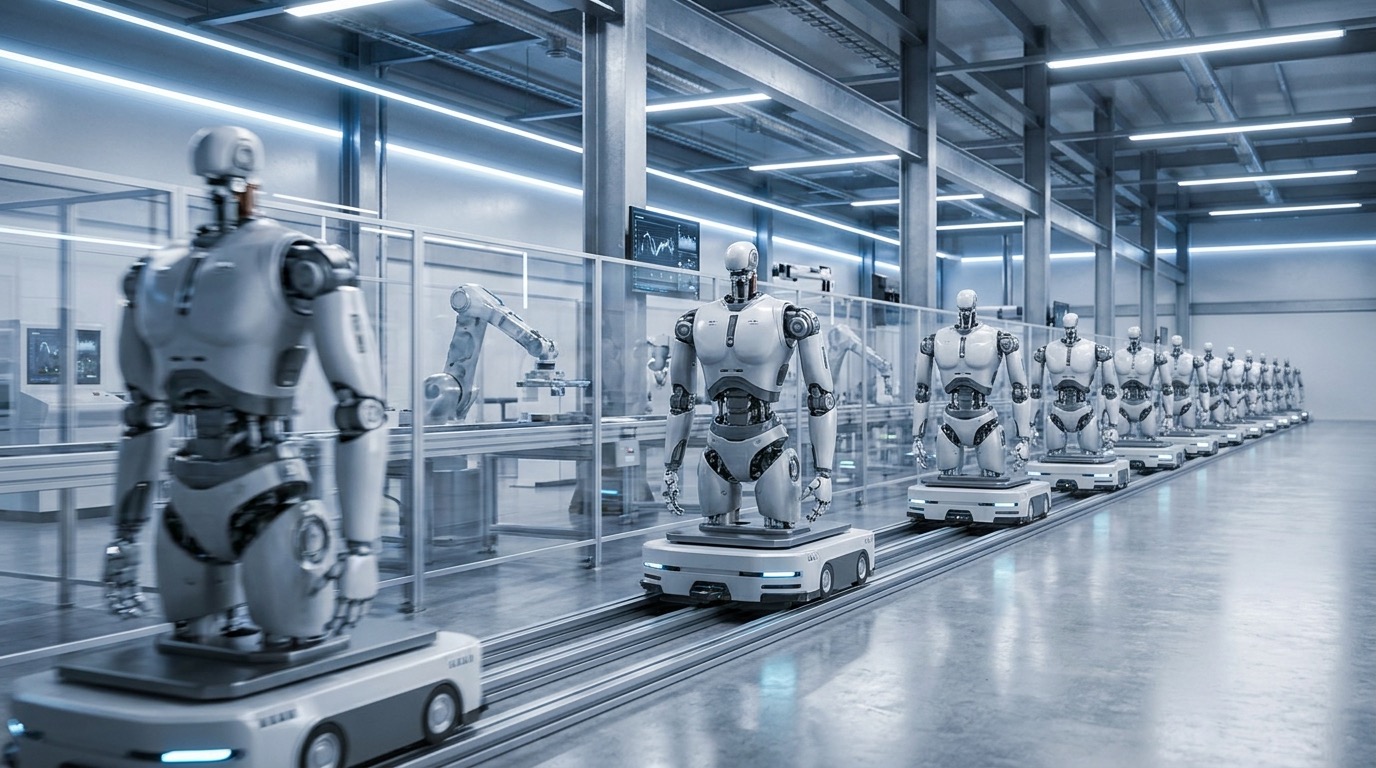 Symbolic image · AI-generated
On June 28, AGIBOT's 15,000th robot rolled off the production line. The number itself is remarkable, but the pace behind it is even more so. The Shanghai-based company took just three months to go from 5,000 to 10,000 units.
The anniversary model is called G2 and is not a classical humanoid that walks on two legs. It's a mobile robot with a human-like upper body and two arms, built for factory tasks. Many consider this exact design—torso and arms on a rolling base—the pragmatic intermediate step: less spectacular than a walking humanoid, but more robust, cheaper, and deployable today.
AGIBOT is far from a fringe player. According to market researcher Omdia, the company was globally number one in humanoid shipments in 2025, with just over 5,000 units and a 39 percent market share. At the end of June, the company had its G2 work live-streamed from a factory for around one hundred hours, where it inspected tablets and kept pace with human coworkers on the production line.
The real point is the shift taking shape behind all this. In the US and Europe, many headlines focus on impressive prototypes and large funding rounds. In China, it's increasingly about unit volumes. Those who build robots by the thousands gain experience, drive down costs, and feed their AI with data from real-world operations—a competitive advantage that reinforces itself.
For Swiss companies, this is a double-edged sword. On one hand, useful robots become available faster and likely cheaper over time. On the other hand, manufacturing, and with it the know-how, is increasingly concentrated in Asia. Companies sourcing robots domestically will have to get used to the fact that the most exciting equipment comes from China, much like we've long known from consumer electronics.
For now, a production number says nothing about how well these robots actually perform in everyday use. But it does say something about the direction. The question is no longer whether humanoids can be mass-produced, but who will ultimately set the pace. Right now, there's a pretty clear answer to that.
This article was created with the support of artificial intelligence and editorially reviewed. The article image is an AI-generated symbolic image, not a press photo.