Isaac 1: The Friendly Robot That Cleans Up Your Living Room
US start-up Weave Robotics has unveiled «Isaac 1» – a mobile household robot that collects scattered items and places them in a basket. Instead of an expensive humanoid robot, the company deliberately focuses on a simple, friendly device that performs a specific task.
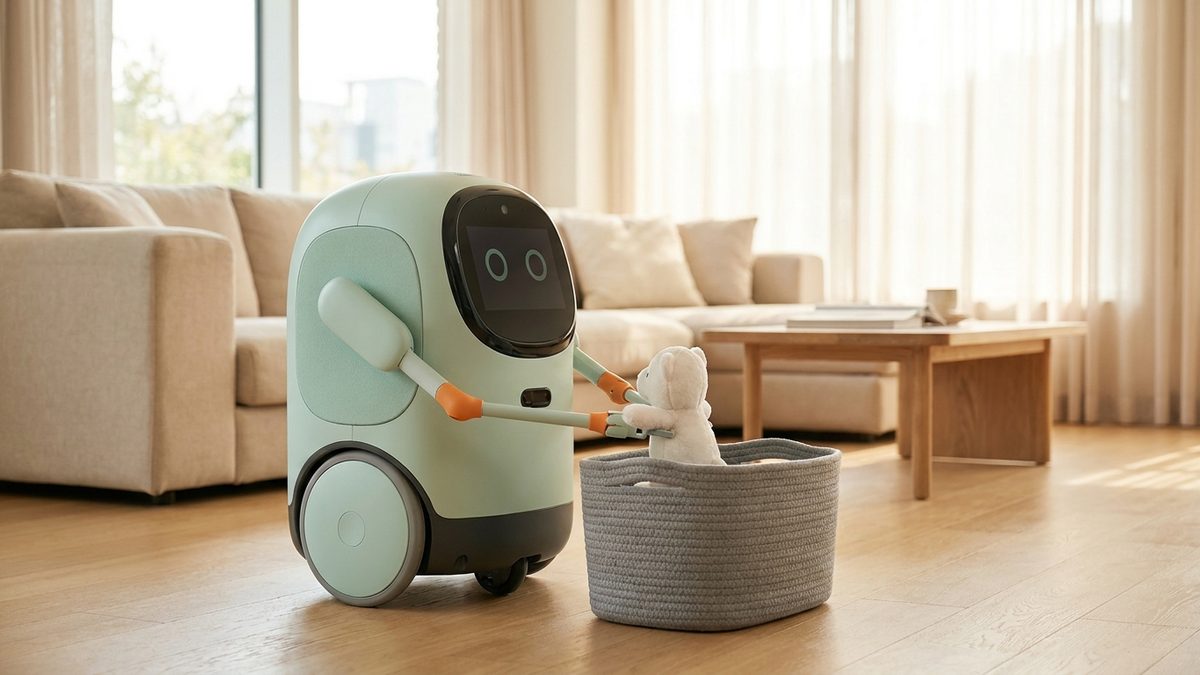 Symbolic image · AI-generated
Imagine a small, friendly robot rolling through your living room on wheels, recognizing a plush toy lying around, gently picking it up, and placing it in a basket. That's exactly what California start-up Weave Robotics demonstrates with its new model «Isaac 1», which it publicly unveiled for the first time in San Francisco in mid-June.
Isaac 1 deliberately doesn't look like a laboratory prototype, but rather a finished consumer product: a softly rounded, mint-green housing, a friendly «face» made from a display, and two arms with simple two-finger grippers with orange tips. On a mobile base, the robot rolls through the room, searches for scattered objects, and puts them in their proper place.
The device's predecessor, «Isaac 0», could do only one thing – but did it reliably: fold laundry. It remained stationary in one location and cost around 10,000 US dollars. With Isaac 1, the company now returns to its original idea of a mobile helper against everyday chaos in the home.
Behind this lies a clear strategy. While other companies – such as 1X with its roughly 20,000 dollar humanoid robot NEO – want to build a machine that can do everything, Weave takes the opposite approach: rather a simple «household appliance» that masters a manageable task well and gets to market quickly. Co-founder Kaan Doğrusöz openly warns against staying in the prototype phase for years instead of delivering something useful.
What's particularly interesting is the task chosen. Folding laundry can be broken down into fixed processes – tidying up, by contrast, is almost unlimited: the robot must recognize what an object is, where it lies, and where it belongs. Every living room is different. Whether Weave's approach – narrowly defined tasks that work reliably – will also function in this messy reality is the real test. For consumers, however, Isaac 1 shows the direction ahead: away from expensive all-purpose machines, toward affordable robots for clearly defined everyday tasks.
This article was created with the support of artificial intelligence and editorially reviewed. The article image is an AI-generated symbolic image, not a press photo.