BYD becomes robot manufacturer – and shifts the balance of the entire industry
The world's largest electric vehicle manufacturer is officially entering humanoid robotics. After four years of secret project 'Yao-Shun-Yu', BYD is already testing around 150 prototypes in its own factories – using technology from its e-cars. What this means for the industry.
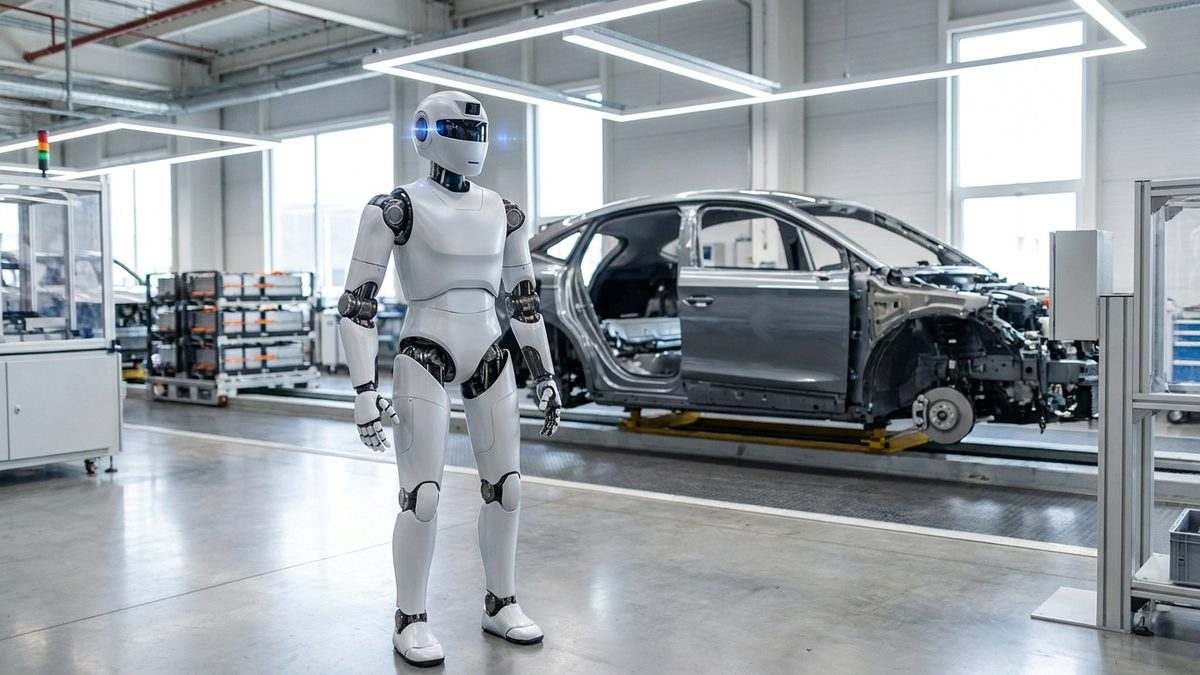 Symbolic image · AI-generated
The world's largest electric vehicle manufacturer is officially entering humanoid robotics. BYD has confirmed that the company has been quietly developing its own humanoid for around four years – under the project name 'Yao-Shun-Yu', named after the legendary ruler figures from Chinese mythology. What began in 2022 as an initiative of the company's own 15th business division is today a program with around 4,000 developers, of which over 30 percent hold doctorates and which covers the entire chain from mechanics through electronics and control systems to AI algorithms.
Technically, the project is already well advanced. According to the company, the seventh generation of the robot is approximately 1.70 meters tall, walks on two legs at 1.5 meters per second and carries a nominal load of 50 kilograms. Sensors include lidar and a 6-axis tactile system. BYD is keeping precise specifications on autonomy, degrees of freedom or price under wraps for now – but something else is decisive: The company is expressly building the robot on the technology of its electric vehicles, namely on high-density batteries, sensors, motors and software that BYD manufactures in the millions anyway.
What's remarkable is the rollout sequence. Rather than immediately promising a consumer product, BYD is currently testing around 150 prototypes in its own factories. For 2026, the plan is to deploy 20,000 units internally – initially for repetitive and physically demanding tasks on the production line. A new industrial park in Xi'an is expected to achieve an annual capacity of up to 50,000 robots in the medium term. Only in a second phase should the machines take on commercial roles, for example as greeting and advisory robots in the global BYD dealer network.
This sequence – first the own factory, then the market – is a strategic advantage. BYD has a huge, controlled test environment with real production pressure. This provides operational data, uncovers weaknesses and finances development through internal productivity gains long before a single robot needs to be sold.
BYD's entry is more than just another announcement in an already overheated field. It marks a structural shift: the automotive industry is becoming the most serious challenger to specialized robotics start-ups. BYD joins Tesla, XPeng and Xiaomi – automakers whose core competencies translate almost seamlessly to humanoids. Actuators are fundamentally electric motors, robots need high-power-density batteries, both products thrive on sensor fusion, real-time software and – above all – on the ability to reliably and cheaply manufacture complex hardware by the thousands.
This is precisely where the real explosive power lies. BYD is known for cutting costs through radical vertical integration: the company manufactures its own battery cells, semiconductors, sensors and drives. If this logic carries over to humanoids, price pressure on the entire industry should increase – similar to what Unitree is already demonstrating with entry-level models starting at just a few thousand dollars. For established providers from Figure through Apptronik to Boston Dynamics, this means: competition is shifting from pure demonstration capability to industrial scaling, unit costs and a reliable supply chain – disciplines in which automakers have been at home for decades.
Three consequences are becoming apparent. First, industrialization is accelerating: anyone who wants to manufacture 50,000 units per year and simultaneously owns the largest customer – their own factories – redefines the pace. Second, price pressure increases, making humanoids transition faster from research and pilot objects to real operational assets. Third, value creation shifts: it's not the most spectacular demo video that wins, but whoever masters hardware, software and manufacturing at competitive costs.
For a platform like robothub24, this development is doubly relevant. More manufacturers and falling prices mean a broader, more dynamic offering – and a market that transitions more quickly from specialized tool to tradeable commodity. BYD is therefore listed as a reference manufacturer in the robothub24 directory as of today.
This article was created with the support of artificial intelligence and editorially reviewed. The article image is an AI-generated symbolic image, not a press photo.